"... A CALL TO ACTION - Everyone is Home: Yellowknife's 10 Year Plan to End Homelessness - The people of the North have taken on and overcome seemingly insurmountable challenges. Yellowknifers carve their lives from an environment others see as harsh and unforgiving as much as it is breathtaking. As in many Northwest Territories communities, the city is forging a future made up of increasing diversity, grounded in ways of life existing since time immemorial. Yellowknife is at a crossroads as a community. Whether thinking about the economic future, urban revitalization, commitment to authentic Reconciliation, or approach to governance, the city has to grapple with emerging complex social challenges if it is to become the prosperous and thriving community residents envision to create together. Homelessness is a true test of the Yellowknife's resilience – an expression of extreme deprivation with consequences and impacts that affect every single person. It calls upon all to act. Continuing to manage homelessness costs more than ending it; the impacts of homelessness on emergency rooms, jails, police, and the courts is significant and does little to address root causes. Moving towards a Housing First approach, which places emphasis on moving people rapidly into housing with wrap-around supports, will help end their homelessness, and relieve pressure on emergency services in the community.
Homelessness in Yellowknife and the North is a legacy of Canada's colonial past, intimately tied to the ongoing impacts of residential schooling and intergenerational trauma. As such, homelessness is much more than someone's lack of housing or shelter – it is a manifestation of dispossession, displacement, and disruption forpeople, families, and entire Indigenous communities at a spiritual, social, and material level.ß
Finding a way forward to end homelessness is therefore more than providing housing and shelter – as much as these remain essential. True wellness places importance on the physical, mental, emotional, and spiritual of people, families, communities, and their interconnectedness with one another and the land.Ending homelessness is a collective responsibility, and this Plan is a call to action for all to take another step on a journey of healing and Reconciliation.
ORGANIZATION: City of Yellowknife
PUBLICATION DATE: 2017 ..."
http://homelesshub.ca/resource/everyone-home-yellowknifes-10-year-plan-end-homelessnessEVERYONE-IS-HOME---YELLOWKNIFE-10-YEAR-PLAN-TO-END-HOMELESSNESS-FINAL-REPORT-JULY-2017.pdf
Rare And Mysterious Vomiting Illness Linked To Heavy Marijuana Use – Cannabinoid hyperemesis syndrome was first documented in Australia in 2004. Physicians have historically misdiagnosed it as the more generic cyclic vomiting syndrome. "... Throughout the nearly two decades of pain, vomiting and mental fog, Queen visited the hospital about three times a year, but doctors never got to the bottom of what was ailing her. By 2016, she thought she was dying, that she "must have some sort of cancer or something they can't detect," Queen recalls.
But she didn't have cancer. She had an obscure syndrome called cannabinoid hyperemesis syndrome, a condition only recently acknowledged by the medical community. It affects a small population — namely, a subset of marijuana users who smoke multiple times a day for months, years or even decades.
There's no hard data on the prevalence of the illness. But in California and Colorado, which have loosened marijuana laws in recent years, some emergency physicians say they're seeing it more often. One study in Colorado suggests there may be a link. ..."
https://www.npr.org/sections/health-shots/2017/11/30/564993538/rare-and-mysterious-vomiting-illness-linked-to-heavy-marijuana-use"...Ryerson University @RyersonU is offering $100,000 #CDN$ in funding to encourage startups to tackle changes and come up with new ideas in the changing media landscape.
The Digital Media Zone @RyersonDMZ (DMZ)'s Sandbox at Ryerson has partnered up with the Ryerson School of Journalism @RSJnow (RSJ) and Facebook to announce the Digital News Challenge. The challenge aims to encourage new startups in the media field.
"Quality journalism delivers facts and ideas that help us better understand society, and each other," said Kevin Chan, head of public policy at Facebook Canada in a press release.
"The Facebook community values sharing and discussing ideas and news, which is why it is critical for us to partner with leading organizations like the DMZ and Ryerson School of Journalism to support the Canadian news ecosystem and help these startups succeed."
The challenge comes after the RSJ formally announced a partnership with the DMZ and Facebook on Sept. 28 this year.
The program, called the "Digital News Innovation Challenge" will provide five startups with five months of incubation at Sandbox. Startups will have access to mentors, experts in the field, capital and other resources to develop an innovative business model [...]
Applications for the challenge open Jan. 25, 2018 and close March 9, 2018. Finalists will be chosen to pitch to a selection committee during March and the winning participants will be formally announced on March 29. Winning participants will be enrolled in the DMZ's Sandbox from April to September....."
https://theeyeopener.com/2017/11/ryerson-offers-100k-in-funding-for-digital-news-startups/The Digital Media Zone (DMZ)'s Sandbox at Ryerson
https://dmz.ryerson.ca/You have questions, we have answers.
From the application process to how you can get involved with the DMZ, here are the answers to your questions.
https://dmz.ryerson.ca/faq/$100,000 #CDN$ @RyersonDMZ Sandbox funding changing media landscape startups @RSJnow Ryerson University @RyersonU
http://ow.ly/sZ1P30gWnbk Digital Media Zone (DMZ)'s Sandbox at Ryerson
https://dmz.ryerson.ca/ "...On June 15th, the #CRTC came out with its #WirelessCode revisions and officially ruled that there would be no more carrier-#locked #phones as of December 1st, 2017. Specifically, the CRTC ruled that customers who own locked devices would be entitled to #free #unlocking upon request beginning on that date, while all newly purchased devices would have to be be sold unlocked. At the time, the CRTC's then Chairman, Jean-Pierre Blais, said that his only regret was not making the decision sooner. "Frankly, that's one case where I think my gut was telling me we probably should've forced unlocking," said Blais, in an interview with the Financial Post. "It would've helped three years sooner, a more dynamic marketplace." Now that we're approaching the day the ban comes into effect, MobileSyrup has reached out to stakeholders from the Canadian wireless industry -- from carriers to industry activists and analysts -- to nail down key details. Which carriers will actually sell all devices unlocked and which will sell locked devices with instructions? How will the unlocking process work for the various carriers? What does this mean for roaming? What might this do for wireless competition in Canada? Read on to find the answers
Read more at MobileSyrup.com: Here's everything you need to know about Canada's unlocking fee ban...."
https://mobilesyrup.com/2017/11/29/heres-everything-you-need-to-know-about-canada-unlocking-fee-ban/"... The report's authors measured freedom of expression in 172 countries between 2006 and 2016 through a metric they have described as the Expression Agenda. This is based on 32 social and political indicators such as media bias and corruption, internet censorship, access to justice, harassment of journalists, and equality for social classes and genders. Hughes said journalists were threatened by intimidation, prosecution and even murder in some parts of the world; there were 426 attacks against journalists and media outlets in Mexico in 2016 alone. He believes the UK was responsible for one of the most draconian surveillance legislation in the form of the Investigatory Powers Act, which "offers a template for authoritarian regimes and seriously undermining the rights of its citizens to privacy and freedom of expression". ...."
https://amp.theguardian.com/media/2017/nov/30/press-freedom-at-all-time-low-journalist-safety-article-19-v-dem-study "...N.W.T. Supreme Court Justice Shannon Smallwood decided Monday that city council made a mistake in 2015 when it dismissed an appeal Granite Ventures Limited brought forward after a building inspector issued Do Not Occupy and Fire Watch orders on a condominium development owned by the company.
City councillor Niels Konge is one of three directors of the company along with Alex Arychuk and Greg Littlefair.
"City council did not address the issue of whether the orders were properly imposed in the first place and decided the appeal on a basis that [Granite Ventures] did not have an opportunity to address," Smallwood wrote in her decision.
"By doing so, city council denied [Granite Ventures] procedural fairness," she said. ..."
http://www.cbc.ca/news/canada/north/yellowknife-building-inspector-order-appeal-1.4423983#WARNING to #TELUS 867 #cell customers... just received... #phishing SMS message "... Dear customer,
Due to an inaccuracy in your mobile bill, Please accept this 53.45$ transfer: http:// r e f u y e. c o m ..." redacted screencap image attached
Northern Clipper @Northern_Clips
Replying to @amapresident @KenWyattMP and
URL for PDF download?
http://mediamentor.ca https://twitter.com/Northern_Clips/status/935773358276403201Canadian man accused in Yahoo hack pleads guilty in American court
"...U.S. law enforcement officials call the 22-year-old Baratov a "hacker-for-hire" and say he was paid by members of Russia's Federal Security Service to access more than 80 accounts.
Outside court Tuesday, Baratov's attorneys said their client hacked only eight accounts and did not know that he was working for Russian agents connected to the Yahoo breach. Baratov was arrested in Hamilton, Ont., in March and later agreed to forgo an extradition hearing and face the U.S. charges.
"He's been transparent and forthright with the government since he got here," said one of his attorneys, Andrew Mancilla...."
http://www.cbc.ca/news/canada/hamilton/baratov-yahoo-hack-guilty-1.4423936?cid=@amapresident
AMA President Retweeted Indigenous doctors @AIDAAustralia 7h7 hours ago
AMA Indigenous Health Report Card – 'A National Strategic Approach to Ending Chronic Otitis Media and its Life Long Impacts in Indigenous Communities' – launched by The Hon @KenWyattMP and @amapresident at Parliament House. #EarHealthForLife
Free PDF Download
https://ama.com.au/system/tdf/documents/2017%20Report%20Card%20on%20Indigenous%20Health.pdf?file=1&type=node&id=47575Indigenous doctors @AIDAAustralia
AIDA is a not-for-profit professional association contributing to equitable health and life outcomes, and the cultural wellbeing of Indigenous people.
AMA Indigenous @AIDAAustralia
https://twitter.com/AIDAAustraliaAIDA - Australian Indigenous Doctors' Association Ltd
https://www.aida.org.au/Australian Medical Association President @amapresident Retweeted #Indigenous #doctors @AIDAAustralia 7h7 hours ago "... AMA Indigenous #Health #Report Card – 'A National Strategic Approach to Ending Chronic #Otitis #Media and its Life Long #Impacts in Indigenous Communities' – launched by The Hon @KenWyattMP and @amapresident at Parliament House. #EarHealthForLife ..."
Free #PDF #Download
https://ama.com.au/system/tdf/documents/2017%20Report%20Card%20on%20Indigenous%20Health.pdf?file=1&type=node&id=47575Indigenous doctors @AIDAAustralia AIDA is a not-for-profit professional association contributing to equitable health and life outcomes, and the cultural wellbeing of Indigenous people. on Twitter
https://twitter.com/AIDAAustraliaAIDA - Australian Indigenous Doctors' Association Ltd on the web
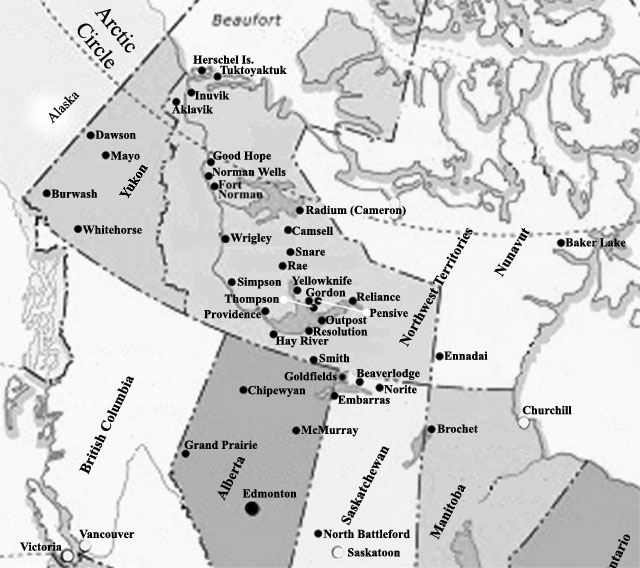
https://www.aida.org.au/🇨🇦's Northwest Territories and Yukon Radio System (NWT&Y) is a virtually unknown saga in Arctic and northern exploration.
http://www.nwtandy.rcsigs.ca/ System Map
http://www.nwtandy.rcsigs.ca/graphics/system_map.jpg🇨🇦's " #NorthwestTerritories and #Yukon #Radio System" (NWT&Y) a virtually unknown saga in #Arctic and northern #exploration.
http://www.nwtandy.rcsigs.ca/ #telecom #CDNpoli #NWTel #NWTpoli #communications #Telegraph #Telecom #MicroWave #RadioTelephone #Telephone #NT #CanadianNationalTelecommunications #SystemMap
http://www.nwtandy.rcsigs.ca/graphics/system_map.jpg🇨🇦's #NWT + #Yukon #Radio System (NWT&Y) a virtually unknown saga in #Arctic #boreal #exploration
http://www.nwtandy.rcsigs.ca/ #SystemMap
http://www.nwtandy.rcsigs.ca/graphics/system_map.jpg #telecom #CDNpoli #NWTel #NWTpoli #Telegraph #Telecom #CNCPTelecommunications #MicroWave #RadioTelephone #Telephone #NT
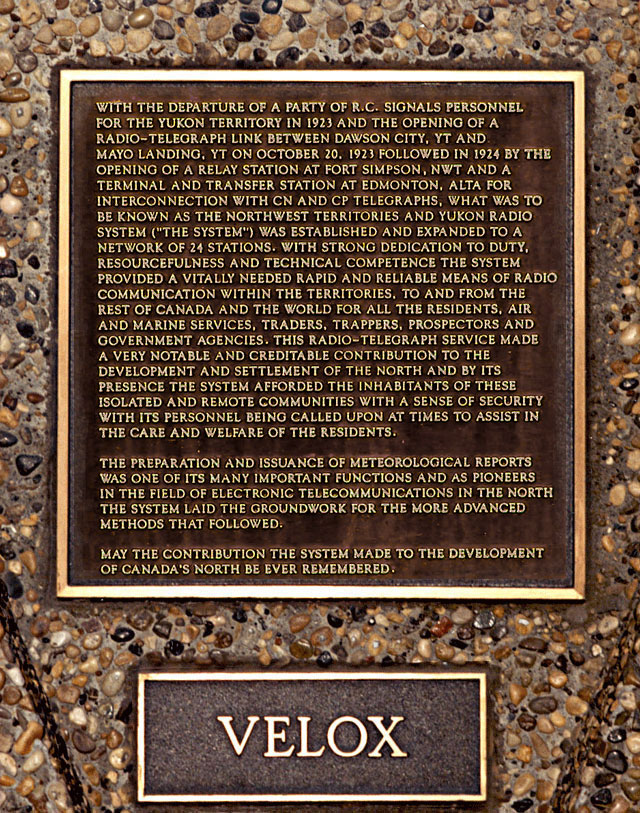
Northwest Territories and Yukon Radio System "...In 1922, the vast Canadian north, from Hudson Bay to the Alaska border, comprising of the Northwest Territories and the Yukon Territory, had no means of communication with civilization, or "outside" as it was known, except a limited mail service by boat in summer and dog-team in winter. In addition to this limited mail service Dawson City, YT was served by a telegraph line from Hazelton, BC operated by the Dominion Government Telegraph Service. The telegraph line was none too reliable due mainly to maintenance difficulties as it ran for hundreds of miles through uninhabited wilderness and over extremely rugged terrain. [...] The story of the Northwest Territories and Yukon Radio System (NWT&Y) is a virtually unknown saga in the history of the development of northern Canada. The contributions of the men who staffed the stations are largely unheralded. In his post-script to the official history, WO1 Cal Vince says: "Northerners will also remember Signals primarily as magistrates, Airways and Transportation agents, acting minions of the law and prime movers in community affairs. It is the unmistakeable fact that the fine reputation built by the Royal Canadian Corps of Signals during 37 eventful years of service in the north country was not the result of the efforts of one, two or even three individuals, but rather the results of the combined efforts of every officer and man who served on this now non-existent arm of the Royal Canadian Corps of Signals." These are not the normal roles of soldiers on active service. But there in the Canadian northland they were engaged in unusual circumstances and eventful times. Not only was Canada's northern frontier and its resources in the early stages of exploration and development, but the science, technology and practical applications of global telecommunications and air transportation were also probing new frontiers. The Royal Canadian Corps of Signals was asked by the Government of Canada to step into the breach and fill the void in long-distance telecommunication to serve those industries and the embryonic communities in the northern territories. In the process the Signallers found themselves, perforce, fulfilling duties far beyond anything they had learned at the School of Signals in Vimy Barracks. In enthusiasm, ability, dedication and inventiveness they were not found wanting. In the nearly four decades (1923-59) that their System operated they left behind them a proud and impressive legacy..."
http://www.nwtandy.rcsigs.ca/graphics/velox.jpghttp://www.nwtandy.rcsigs.ca/The Northwest Territories and Yukon Radio System
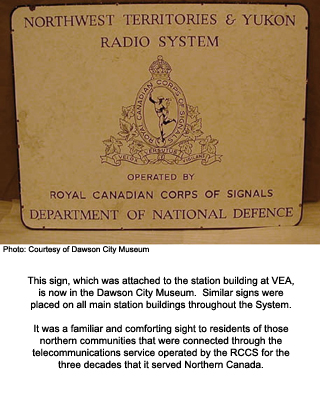
http://www.nwtandy.rcsigs.ca/S_Pix/dcm_vea_sign.jpgMap of System
http://www.nwtandy.rcsigs.ca/map_system.htmhttp://www.nwtandy.rcsigs.ca/graphics/system_map.jpg"... Welcome to
http://www.rcsigs.ca the RC Sigs Militaria Web Site, a site dedicated to capturing, preserving and sharing the rich history of the Royal Canadian Corps of Signals and its antecedents. The site has a large body of information and images dealing with history, units, regulations, uniforms, insignia, places, equipment and just about anything else related to the Canadian Signal Corps. Feel free to start exploring using the side menu and follow your interest through the site. A search function is also available to locate information if you're not sure where to find it. [...]
NWT and Y History Portal
A project to capture the history of the Northwest Territories and Yukon Radio System was undertaken by Michael Martin in 1999. Over the years he's done a fantastic job of building up
www.nwtandy.rcsigs.ca and we all owe him a huge debt of gratitude. When Micheal was looking for someone to pass the torch to I offered to integrate his content with this, the main site and I am slowly tackling the daunting task. A NWT&Y portal has been created within this site to keep the material viewable in it's familiar format and as a collection. Please check it out and let me know what you think...."
"...The Royal Canadian Corps of Signals established long distance shortwave telegraphic communications stations in the north in 1923, prior to World War II. Their function was to enable the relay of telegraphic messages to and from the wired CN and CP telegraph networks in the south. From 1959 to March 1960, the stations were handed off to the federal Department of Transport; the stations by 1972 were redundant to fully developed CNT local and long distance telephone service with access to CN Telegram service via the telephone operator...."
https://en.wikipedia.org/wiki/Northwestel"....2016 was a rough year. After Nov. 8, it became almost unlivable. In my case, a sustained state of anxiety and depression erupted occasionally into nausea and panic. Behaviors buried since the Bush era made their reappearance, and I even did some brand-new things, like physically threaten someone who called me a faggot. It was as if something — myself, I guess — was trying to figure out how to exist in this new reality.
Before the election, I hadn't always been at peace, but I'd settled into a homeostasis in which I felt at least possibly useful, based on the idea that action at the bottom could affect things at the top — like Obama with the Keystone XL pipeline, for example. But now what? Under power that would clearly never give a flying fuck about any progressive pressure unless it actually stopped the whole system, my psychic bedrock seemed to be crumbling.
First World problems, of course. Most people in the world have recently known, or currently know, exactly what it's like to live under power that's indifferent to their lives and desires. Even many Americans know this — for example, the Lakota Sioux of Standing Rock, who are seeing the last shreds of their world threatened by the "Black Snake," as they call the oil industry trying to build a pipeline right through their watersheds. For them and other First Nations, our coming autocracy is just a new flavor of authoritarian disregard.
Hmm. Maybe they could help with my bedrock erosion problem....."
https://wagingnonviolence.org/feature/standing-rock-solved-2016-first-world-problems/The above brought to you by
http://yeslab.org/"... 'Our collective shame': Trudeau delivers historic apology to LGBT Canadians - Prime Minister says state-sponsored laws, policies led to discrimination, violence and ruined lives - Prime Minister Justin Trudeau delivered a historic apology to LGBT Canadians in the House of Commons today, saying sorry for decades of "state-sponsored, systematic oppression and rejection." Speaking to a packed and emotional chamber, Trudeau expressed shame, sorrow and deep regret to the civil servants, military members and criminalized Canadians who endured discrimination and injustice based on their sexual orientation. "You are professionals. You are patriots. And above all, you are innocent. And for all your suffering, you deserve justice, and you deserve peace," he said. "It is our collective shame that you were so mistreated. And it is our collective shame that this apology took so long – many who suffered are no longer alive to hear these words. And for that, we are truly sorry."..."
http://www.cbc.ca/news/politics/homosexual-offences-exunge-records-1.4422546?cid="... Profile - Everett Klippert: The last Canadian to go to jail simply for being gay 1965 legal case started firestorm that led to decriminalization of same-sex acts. On the morning of Aug.16, 1965, in Pine Point, N.W.T., the RCMP began looking into a suspicious fire. By lunch, they had a suspect — Everett Klippert, a 39-year-old mechanic's helper who moved to town a year before. That afternoon, officers brought Klippert to the Hay River detachment for further questioning. In less than a few hours they determined Klippert had nothing to do with the fire. But he had told officers something that would keep him in custody for the next six years. Klippert told them he was gay. ..."
http://www.cbc.ca/news/canada/north/everett-klippert-lgbt-apology-1.4422190Please see The National Congress of American Indians' statement issued on May 3, 2017 on President Trump's use of the name Pocahontas here.
http://www.ncai.org/news/articles/2017/05/03/ncai-condemns-president-trump-s-derogatory-use-of-pocahontas-name-in-political-attackNational Congress of American Indians (NCAI) President Jefferson Keel Issues Statement on the White House Ceremony Honoring Native American Code Talkers "... WASHINGTON, D.C. | On November 27, 2017, the National Congress of American Indians President Jefferson Keel issued the following statement:
"We regret that the President's use of the name Pocahontas as a slur to insult a political adversary is overshadowing the true purpose of today's White House ceremony," stated NCAI President Jefferson Keel, a decorated U.S. Army officer and Vietnam War combat veteran. "Today was about recognizing the remarkable courage and invaluable contributions of our Native code talkers. That's who we honor today and everyday – the three code talkers present at the White House representing the 10 other elderly living code talkers who were unable to join them, and the hundreds of other code talkers from the Cherokee, Choctaw, Comanche, Lakota, Meskwaki, Mohawk, Navajo, Tlingit, and other tribes who served during World Wars I and II. We also honor the service and bravery of all of our veterans and those currently serving from Indian Country. Native people serve in the Armed Forces at a higher rate than any other group in the country, and have served in every war in this nation's history....."
http://www.ncai.org/news/articles/2017/11/27/national-congress-of-american-indians-ncai-president-jefferson-keel-issues-statement-on-the-white-house-ceremony-honoring-native-american-code-talkers"...It is time to bust up the misconceptions perpetuated over 400 years regarding the young daughter of Powhatan chief Wahunsenaca. The truth—gathered from years of extensive research of the historical record, books, and oral histories from self-identified descendants of Pocahontas and tribal peoples of Virginia —is not for the faint of heart.
A Warning To Our Readers: Mature Subject Matter Not Suitable for Children
The story of Pocahontas is a tragic tale of a young Native girl who was kidnapped, sexually assaulted and allegedly murdered by those who were supposed to keep her safe. [...]
Pocahontas Was Kidnapped, Her Husband Was Murdered and She Was Forced to Give Up Her First Child [...]
Pocahontas Was Raped While in Captivity and Became Pregnant With Her Second Child ..."
https://indiancountrymedianetwork.com/history/genealogy/true-story-pocahontas-historical-myths-versus-sad-reality/"... When Mick Mallon found his way to the Arctic, he knew he had arrived.
He left his home in Belfast, Ireland, six decades ago, as a young man with a bachelor's degree and a love of languages. And he has never looked back.
A teacher and linguist, he has dedicated his life to learning and teaching the Inuktitut language.
Mick is one of the country's top Inuktitut scholars.
He's written text books on how the language works. He trained Inuit in their own language, to become educators and leaders. When he can, he still teaches at the Nunavut Arctic College in Iqaluit and online through universities in the United States.
In 2008, Mick was awarded an Order of Canada medal for his contribution.
Mick Mallon is now 84 years old. He needs a cane to amble the tundra behind his house, overlooking Frobisher Bay in Iqaluit. His passion for Inuktitut and for the North burns as bright as ever. But these days, he's also turning to his Irish roots, and discovering another language to master and to champion. ..."
http://www.cbc.ca/radio/thesundayedition/the-sunday-edition-november-26-2017-1.4417692/how-a-rascally-irish-immigrant-became-one-of-canada-s-top-scholars-of-inuktitut-1.44177242017 Santa Claus Parade Yellowknife, Capital of the Northwest Territories 🇨🇦 Canada
🎅🏽🎄🤶🏽🌲🎅🎄🤶🏽🌲🎅🏿🎄🤶🌲🎅🏽🎄🤶🏿🌲🎅🏽🎄🤶🏻🌲🎅🏽🎄🤶🏽🌲🎅🎄🤶🏽🌲🎅🏿🎄🤶🌲🎅🏽🎄🤶🏿🌲🎅🏽🎄🤶🏻🌲
Yellowknife's 2017 Short Santa Shortest I've seen since I've been here...
so for your programming I thought you should know ASAP
The TRT of the unedited run of the parade is 00:14:53:14
So you know it won't get much longer.
Even if I use all the crowd shots I captured ....
Sigh...
2017 Yellowknife Santa Claus Parade
Santa Claus Parade 2017 winners
Not-for-profit: NWT Disabilities Council
Commercial: Yellowknife Coop
School: École Allain St-Cyr
https://youtu.be/0UruncTqResPlaylist of Santa Clause Parades and other seasonal events in Yellowknife NWT
https://www.youtube.com/playlist?list=PLeNJFhWYT9_AGvoNxgMxmZtx8HVT-VZv_2017 Yellowknife Santa Claus Parade
59 images of the Annual Yellowknife 🇨🇦 Santa Claus Parade and Float Competition
https://www.flickr.com/photos/george-lessard/albums/72157687849868982The City of Yellowknife is excited to announce the winners of the Annual Santa Claus Parade Float Competition. This year's parade was held on November 25, 2017 and included 13 floats themed "Your Favorite Christmas Movie". Floats were judged for creativity, use of lights and decorations, incorporation of the theme, enthusiasm and effort.
Not-for-profit: NWT Disabilities Council
Commercial: Yellowknife Coop
School: École Allain St-Cyr
We would like to thank and congratulate all participants. Photos of all floats will be available on
http://www.yellowknife.ca and on the City's Facebook page.
- 30 -
For more information:
Holly Ferris
Special Events Coordinator
City of Yellowknife
events@yellowknife.ca867.920.5676
NWT Disabilities Council
http://www.nwtdc.net/Destination NWT - 西北行之旅
http://www.destinationnwt.comEcole St. Patrick High School
http://www.esphs.nt.ca/Yellowknife Beverages
http://yellowknifebeverages.caYellowknife Education District No. 1
http://www.yk1.nt.ca/École Allain St-Cyr
http://www.allainstcyr.ca/Yellowknife Mountain Bike Club
https://sites.google.com/ykmtbc.ca/wwwWorkers' Safety and Compensation Commission of the Northwest Territories and Nunavut
http://www.wscc.nt.ca/Yellowknife Airport (YZF)
http://www.dot.gov.nt.ca/Airports/YellowknifeSanta Claus Parade 2017 winners
Not-for-profit: NWT Disabilities Council
Commercial: Yellowknife Coop
School: École Allain St-Cyr
The 2017 National Compensation Study for Cultural and Not-for-profit Managerial and Administrative Positions
"...Haven't completed the National Compensation Survey yet? Not-for-profit arts organisations: your participation is important! The valuable information collected from the study will help map the current compensation and working conditions in management and administrative positions within the arts sector. Please submit your answers before November 30...."
http://canadacouncil.ca/spotlight/2017/10/2017-national-compensation-study/"..."Alaska Natives are hit first and hit hardest by global warming and climate change," says Faith Gemmill, who is an Alaska Native Neetsai Gwich'in, and the executive director of environmental group Resisting Environmental Destruction on Indigenous Lands (REDOIL).
Many Alaska Natives still live in villages off the road system. They still hunt and gather for sustenance. Despite the billions of dollars of oil profits the state has seen, dozens of Alaska Native villages have never been equipped with basic resources, like running water, leaving residents to use outhouses and "honey-buckets," and to refill giant barrels of water in their homes.
"We are in a resource state, and we live in third-world conditions," says Gemmill.
But not all Alaska Natives live this way.
Some work for Alaska Native-owned corporations, which can make big profits from the oil industry.
The Arctic Slope Regional Corporation, which made Forbes' list of "America's Largest Private Companies", had revenue of $2.4bn last year. This means that Alaska Natives in that north slope region of Alaska, each of whom are shareholders in ASRC, benefited from those profits.
This has created a divide between those who live off of the land, making little money from the oil industry and seeing the effects of climate change firsthand, and those who profit from its natural resources.
AJ+ travelled to Alaska to explore this divide in its latest installment of its Untold America series. ..."
http://www.aljazeera.com/news/2017/11/alaska-natives-fight-survive-171127123612386.html"... Section 3.2 of the Devolution Agreement contains a commitment for Canada, the GNWT, with the participation of the Inuvialuit Regional Corporation, to commence negotiations for the management of oil and gas resources in the Beaufort Sea, and other northern offshore areas. This commitment includes the negotiation of resource revenue sharing resulting from offshore oil and gas development.
Negotiations were to start 60 days after the signing of the devolution agreement – which occurred on June 23rd, 2013. That means that negotiations should have begun no later than August 23rd, 2013.
Despite repeated requests from both the GNWT and the Inuvialuit Regional Corporation, the federal government has not been willing to sit down to negotiate this critical agreement.
On December 20th 2016, the Prime Minister called my Premier 20 minutes before announcing that all Arctic Canadian waters were indefinitely off limits to future offshore Arctic oil and gas licensing.
"Indefinite" - that was the word the Prime Minister used, and neither the yet‑to-be-negotiated interests of the Government of the Northwest Territories, nor the rights of the Inuvialuit were taken into consideration prior to that decision being made. ..."
http://www.gov.nt.ca/newsroom/news/robert-c-mcleod-presentation-standing-committee-fisheries-and-oceans-bill-c55-act"...The crimes of past Americans against the native inhabitants of this land can never be forgiven or atoned for; the absolute minimum that Trump could do is accord the Navajo Code Talkers the same respect that he does to white veterans – but the watching eyes of genocidal monster Andrew Jackson tells you everything you need to know about how Donald Trump feels about America's persecuted minorities...."
http://verifiedpolitics.com/lakota-sioux-reporter-just-gave-best-response-trumps-native-american-slur/"...The White House said Trump's remark was not a racial slur and deflected questions about it by bringing up Warren's claim and calling it false. But not everyone was going to let the comment slide.
In addition to drawing outrage on social media, Trump's comments drew the ire of Indigenous leaders from around the country.
John Norwood, general secretary of the Alliance of Colonial Era Tribes, said Trump's nickname for Warren "smacks of racism."
"The reference is using a historic American Indian figure as a derogatory insult and that's insulting to all American Indians," said John Norwood, the general secretary of the Alliance of Colonial Era Tribes, adding that the comment "smacks of racism."
Norwood told MSNBC that the president should "stop using our historical people of significance as a racial slur against one of his opponents."
Native Peoples activist Faith Spotted Eagle of the Yankton Sioux told the Toronto Star that Trump's use of "Pocahontas" is an "emotional assault" that "carries as much weight as a physical assault."
"He can phrase it and twist it and distort it any way he wants, the fact remains: that name does not belong in his mouth," Spotted Eagle told the Star's Daniel Dale. ..."
http://reverepress.com/news/native-american-leaders-issue-statement-response-trumps-racist-remarks/"... Follow the Bell of Batoche Document Trail - Letter from Bishop Vital Grandin to his nephew and sister, January 30, 1879 - Vital Justin Grandin was born on February 8, 1829 in Saint-Pierre-la Cour, France. In 1854, after studies in philosophy and theology, the newly ordained priest volunteered for missionary work in Canada. In 1871, Grandin was appointed bishop of Saint Albert.
Bishop Grandin was temporarily in France in 1879 when he wrote a letter to his nephew and his sister. Grandin told them about his plan to purchase bells for his missions in Canada's North West.
This is a translation of part of his letter:
"…As for the purchases that you are proposing to me, certainly I am always in need of those, but while in Paris I purchased a considerable amount of cloth and merinos (wool fabric). I would still like to buy a printing press; this would cost me over 3,000 francs; I am having over twenty bells cast, all this will cost a lot, and I do not dare to purchase more than I have to spend.. "
On September 2, 1884, Bishop Grandin blessed the bell at St. Antoine de Padoue, the Roman Catholic church at Batoche, and named it "Marie Antoinette." ..."
http://www.cbc.ca/doczone/features/follow-the-document-trailThe Mystery of the Bell Saturday, January 2, 2016 at 2 PM CBC-TV '.... This small bell, weighing 20 kilograms, has a secret past. According to legend, this is the bell that was stolen from the church in Batoche, Saskachewan by Canadian soldiers after they'd defeated Louis Riel and his Metis fighters in 1885.
In the next hundred years, the bell was hidden – buried in a field, submerged in a stream, locked away in a safe – anywhere where it would be kept away from those who wanted it back. The government was looking for it. The Metis were looking for it.
A century later it was stolen back by Metis militants and kept hidden for another twenty years as a power struggle over the future of this icon played out.
The Mystery of the Bell is a CBC-TV documentary that follows the journey of the bell through its tumultuous history, including the larger-than-life drama of rebellion and war on the Canadian frontier. ..."
http://www.cbc.ca/doczone/episodes/the-mystery-of-the-bell"...The official record shows that Vital Grandin, the bishop of St. Albert and one of the most important historical figures of 19th Century Western Canada, was a kind and compassionate man. Of course, his mission was to convert people to Christianity, at whatever cost. This was the essence of goodness, in his era. Despite his ill health, the bishop travelled widely and lived in very remote communities. He might have sought a more comfortable existence in France, where he was born and raised. Schools, roads, entire neighbourhoods are named after him. Grandin opened many, many schools. Education, it seemed, was the way to the soul. For First Nations people, and for all Canadians, the residential school system is not a happy memory...."
https://youtu.be/_ovpZeO3I74"...On December 11, 1857, he was appointed coadjutor Bishop to His Grace Alexandre-Antonin Taché, however his formal consecration took place nearly two years after, on November 30, 1859, by the Founder of the Oblates, now known as St. Eugene de Mazenod. On September 1871 he was appointed the first Bishop of the newly erected diocese of St. Albert, by letter of Pope Pius IX.
Through his dauntless spirit and self-sacrifice he was instrumental in the establishment of the Catholic Church in Western Canada. He died as Bishop of Saint Albert, on June 03, 1902, and will be remembered as the Missionary Bishop. In 1966, his humble and saintly virtues were acknowledged when he was declared Venerable...."
https://caedm.ca/AboutUs/OurBishops/BishopVitalJustinGrandin"...Grandin was born in Saint-Pierre-sur-Orthe, France, on 8 February 1829. He was the ninth son in a family of fourteen children of Jean Grandin and Marie Veillard. He was ordained as a priest in 1854; one month later he was sent by the Missionary Oblates of Mary Immaculate to Canada to perform missionary work in what was then Rupert's Land. Upon arrival he was sent to Saint-Boniface, where Bishop Alexandre-Antonin Taché was in charge. Grandin was subsequently assigned to a mission at Fort Chipewyan (now in Alberta). He next served at Île-à-la-Crosse (now in Saskatchewan) for a number of years...."
https://en.wikipedia.org/wiki/Vital-Justin_GrandinVital Justin Grandin, O.M.I., First Bishop of St. Albert, Alberta. 1829-1902 BY THE REV. BROTHER MEMORIAN [SHEEHY}, F.S.C. [...] As a simple missionary priest, Father Grandin's career was destined to be of short duration. From the late autumn of 1854 until the following summer, the young apostle stayed with Bishop Taché at St. Boniface, preparing himself for his first mission into the North. On June 5, by order of his superior, he left for far-off Fort Chipewyan on Lake Athabaska, which he did not reach until the beginning of August. There he found three fellow Oblates, Fathers Faraud and Grollier and Brother Alexis Reynard, each of whose names is written large in the story of the northern missions.
Father Grandin soon acquired a strange, but beneficient, influence over the Indians placed in his charge. These crude children of Nature yielded at once to that combination of personal holiness and goodness of heart which were the outstanding characteristics of this man of God. His first conquests were among the Crees and the Montagnais of Lake Athabaska. Many were the tribes that in after years were to open their simple minds and hearts to his benign influence. With the directness and simplicity that were among the peculiar traits of the plainsmen, one of them said to him one day: "The God whom you preach must be good indeed, you yourself are so good."
At the Nativity Mission, at Lake Athabaska, the young Oblate remained but two years. In September 1857, he betook himself to Ile-à-la-Crosse, which he had visited on his way west and north from St. Boniface. There he manifested a new gift, that of peace-maker -- a gift that was to be brought into requisition on more than one occasion during the years that were to follow. He left this place at the call of the Holy See itself when, despite his youth, he was named co-adjutor to Bishop Taché. Though the appointment was made on December 11, 1857, word of it reached Father Grandin only in July, 1858. It was another eight months before the humble Grandin could be persuaded to accept the dignity of the episcopacy. Even then it took a formal order from Bishop de Mazenod for him to proceed fortwith to Marseilles to prepare for episcopal consecration. Accordingly, he undertook the long journey from his northern outpost to the cradle city of his beloved Order, there to be made a bishop of God's Church. The ceremony took place on November, 30, 1859. ..."
http://www.umanitoba.ca/colleges/st_pauls/ccha/Back%20Issues/CCHA1935-36/Sheehy.htmlThe Diaries of Bishop Vital Grandin. 1875-1877: Volume I Paperback
Paperback
Language: English
ISBN-10: 092912300X
ISBN-13: 978-0929123004
https://www.amazon.ca/Diaries-Bishop-Vital-Grandin-1875-1877/dp/092912300X"...Northwestel was established in 1979 by its owner, Canadian National Railways, spinning off the "northwest" operations of Canadian National Telecommunications (which is not to be confused with CNCP Telecommunications, a joint venture that CP Telegraphs and CN Telegraphs formed). The Newfoundland operation was, the same year, spun off as Terra Nova Tel (TNT). TNT was later purchased by NewTel Enterprises and merged with Newfoundland Telephone in late 1988. [...]
Other independent companies were established in Yellowknife in 1947, Fort Smith, and Hay River in the late 1950s. These systems were all purchased by CNT during the 1961-1964 period.
The independent Yellowknife Telephone Company, its formation begun in the spring of 1947 with a buy-in of $50 per share, has its own colourful history. In order to obtain the franchise, they needed to have 100 telephones operating by December 31 at midnight, but by early December had only 15 connected. They rushed by putting five or six phones in some homes. The inspector attempted to call 100 numbers and received 100 answers, although only a quarter were functioning properly. Service was problematic, with many unhappy customers, and up to ten people were partied on a line. By 1958, the Yellowknife company's service improved, with 700 phones hooked up.
During the 1950s, one of the major shareholders in Yellowknife, Jim Mason, learned that there were second-hand cables for sale from a Stewart, BC, company. The owner had died and his brother, the executor, not knowing much about the company, accepted an offer of $1,000 for the cables, to be shipped by the executor. The cables arrived at a desperate time, long after they were expected, allowing an upgrade of the lines, and turned out to be worth $35,000...."
https://en.wikipedia.org/wiki/Northwestel"...2018 Ice Road Class 1 Driver Positions
Hiring Owner Operators & Company Drivers ~ 200 openings Available
2 years of Class A over the road driving experience preferred
Job Type: Contract..."
https://ca.indeed.com/cmp/Ventures-West-Transport/jobs/Ice-Road-Driver-Need-eb01f6b0888491de"...Located in Yellowknife and reporting to the Manager, Policy and Planning, this position is located in the Corporate Affairs division of the Department of Municipal and Community Affairs (MACA). The Communications Planning Specialist provides communications planning and media relations support and advice to MACA's senior management, managers and staff. ..."
https://ca.indeed.com/viewjob?from=appshareios&jk=19ca1117c69bf22e"...We keep hearing, "Yeah, but Trump was still legitimately elected, he won the election fair and square." Now we're realizing that that may not even be true. I don't personally believe that to be true anymore. I rankle every time somebody says he won fair and square, because that's become less obvious every day. So the last line of defense would be, "Well, even if he didn't win fair and square, he's our president, so we've got to sit back and let whatever Putin's going to do to us continue to happen because we don't want our response to raise his standing in the world." Well, I would submit it raises Putin's standing in the world even more to have an accomplice in the White House...."
http://portside.org/2017-11-25/trump-russia-story-coming-together-here%E2%80%99s-how-make-sense-itStill no medical supervision / treatment / in this "home-grown" residential treatment program?
http://www.cbc.ca/news/canada/north/cambridge-bay-treatment-women-arctic-1.4414740"... A mystery is emerging out the Yukon ice: human hunting tools hidden for as long as 9,000 years have started to melt out. And each new find is another piece to the puzzle of who these people were.
Greg Hare is the archeologist who was there for the recovery of the very first artifact in 1996. Twenty years later he's finding more than ever – because the melt has intensified. ..."
http://www.cbc.ca/natureofthings/episodes/secrets-from-the-ice"... Our ancestors hunted with sophisticated spears called atlatls One of the more intriguing and frequent finds was a hunting tool called an atlatl. Pre-dating bows and arrows by thousands of years, atlatls were carved pieces of wood that had a handle on one end, and a hook with a spear on the other.
A flipping motion propels the weapon with great force over greater distances than spears...."
http://www.cbc.ca/natureofthings/features/canadas-northern-ice-patches-yield-clues-about-how-first-nations-ancestors"...Melting ice patches in the Yukon are helping scientists make new discoveries about human history and Indigenous communities.
'That whole idea of eliminating First Nations history is disappearing with this tactile, tangible way of actually seeing your culture come back out of the ice'
- Andrew Gregg
Andrew Gregg, filmmaker for the CBC Nature of Things documentary, Secrets from the Ice, says the artifacts are especially meaningful to Indigenous elders who went to the residential school system.
"A lot of them were told their history was worthless and they came out of it with ... a sense of shame," Gregg tells The Current's Anna Maria Tremonti...."
http://www.cbc.ca/radio/thecurrent/the-current-for-november-16-2017-1.4403483/how-yukon-s-melting-ice-reveals-human-artifacts-and-indigenous-history-1.4403874The Ultimate Guide to Seeing the Northern Lights in Yellowknife, Canada written by Kat March 24, 2017
Interested in seeing the Northern Lights? I highly recommend going to Yellowknife!
Why Choose Yellowknife?
When people think of places where they can see the Northern Lights, they usually think of Norway, Sweden, Finland or Iceland. Not as many people think of going to Canada to see the Northern Lights! However, Yellowknife is one of the best places in the world to see the Northern Lights due to its northern latitude and high amount of clear dark nights! According to the Aurora Village website, the Northern Lights are visible around 240 nights per year. Yellowknife has been a very popular aurora hunting destination among Japanese tourists for many years and is now beginning to see an increase of tourists from other countries.
I had never thought of Yellowknife as a tourist destination until one day when I was scrolling through my Facebook feed and saw a classmate's photos of the Northern Lights in Yellowknife. I was immediately intrigued and started researching the destination. A few days later, I booked a four night trip there for the end of January/early February. ..."
https://www.memoirsofaglobetrotter.com/northern-lights-yellowknife-canada/Fun Winter Activities in Yellowknife written by Kat October 7, 2017
https://www.memoirsofaglobetrotter.com/things-to-do-yellowknife-winter/"...Over the course of a week, demonstrations have erupted across Europe as thousands of protesters gathered in Stockholm Saturday holding signs reading, "Stop the slavery now, now, now," and "Human rights for all."
Migrants are being sold into slavery, for as low as US$400, to perform excruciating labor, according to the Nov. 14 report. Reminiscent of the auctions during the transatlantic slave trade period, migrants are priced based on their physical capabilities. Many are left broken, mentally and physically, as a result of their forced servitude, the report states...."
https://www.telesurtv.net/english/news/Africans-in-Europe-Protest-Libyan-Slave-Trade-20171126-0015.htmlPresident Emmanuel Macron said via Twitter on Wednesday: "Trafficking in human beings is a crime against humanity."
RT @Emmanuel Macron Emmanuel Macron
"... La traite des êtres humains est un crime contre l'humanité. ..." 9:48 AM - Nov 22, 2017
"...His comments came after Foreign Minister Jean-Yves Le Drian responded to a question on the subject in the National Assembly: "France decided this morning to ask for an urgent meeting of the United Nations Security Council to discuss this issue."
"We are doing it as a permanent member of the Security Council. We have this capability and we are using it," Le Drian said.
After meeting in Paris with the head of the African Union, Alpha Conde, Macron made a commitment for further action: "We can go much further to dismantle the networks" of the traffickers, he said...."
http://www.dw.com/en/france-calls-un-security-council-emergency-meeting-over-libya-slave-trading/a-41491723"...Who's the highest bidder? 800 Dinar! 1,000 Dinar! 1,100 Dinar! In the end, the winning bid is 1,200 Libyan Dinar – the equivalent of $800 (€680). A done deal; however, this isn't just any auction for a car or a piece of art. What's being sold here is a group of frightened young men from Sub-Saharan Africa.
The low-resolution images, apparently taken at a market in Libya earlier in 2017 were shown on the US-based network CNN last week, which looked further into the issue. Journalists working for CNN discovered several such slave markets in the country's interior, proving what experts had feared for a long time: migrants trying to reach Europe via Libya continue to be subject to abuse...."
http://www.dw.com/en/slave-trade-in-libya-outrage-across-africa/a-41486013"...DAKAR (Thomson Reuters Foundation) - A video appearing to show African migrants sold as slaves in Libya sparked a global outcry on Monday as protests erupted in Europe and Africa, while soccer stars to U.N. officials made impassioned pleas for the abuse to end.
Two young men stand in the dark as an auctioneer shouts out prices in the footage published by news network CNN last week, appearing to sell them for the equivalent of about $400 each. ..."
https://www.reuters.com/article/us-libya-slavery-migrants/sale-of-migrants-in-libya-slave-markets-sparks-global-outcry-idUSKBN1DK2AU"... Fountain Hughes (age 101 at the time of this interview) recalls his younger years when he and his family lived as slaves as well as some good advice on how to spend money. Worth listening to. ..."
https://www.youtube.com/attribution_link?a=icZ_olY4Xqs&u=%2Fwatch%3Fv%3D4IfIDrQxI0o%26feature%3Dshare"..."Big strong boys," the man said in the video, according to a CNN narrator. "400 … 700 … 800," he called out the mounting prices. The men were eventually sold for about $400 each, CNN reported. The Libyan government said it has launched an investigation into slave auctions in the country.
Following the CNN report, demonstrators took to the streets in Paris and other cities last week to express their outrage, and Libyans showed their solidarity on Twitter with the hashtag #LibyansAgainstSlavery.
Several world leaders spoke out as well. The chairman of the African Union, Guinean President Alpha Condé, called it a "despicable trade ... from another era" on Friday. The U.N. Support Mission in Libya said Wednesday that it was "dismayed and sickened," and is "actively pursuing" the matter with Libyan authorities...."
http://www.huffingtonpost.ca/entry/video-slave-auction-migrants-libya_us_5a161d56e4b064948072e9f3"... Wes Vent has been spending his one free day a week helping homeless people because he doesn't want to be a criminal and drug addict anymore.
Vent is wearing an ankle monitor and living in transitional housing. He works in construction. A few weeks ago, he joined Chris Pruitt, his treatment peer teacher, giving away warm coats, hats and socks to people living on the city's wintry streets.
He was energized. He had the idea of giving away first-aid supplies, snacks and feminine hygiene products. They met again the next Saturday, another frigid morning, next to Pruitt's pickup at the Brother Francis Shelter, with 100 bags containing about $600 worth of supplies.
A line rapidly formed. There were smiles, hugs and God-bless-yous. The bags were gone in 10 minutes.
Vent and Pruitt beamed.
"That was a beautiful experience," Pruitt said. ..."
https://www.adn.com/opinions/2017/11/24/they-were-homeless-once-now-they-help-others-still-living-on-winter-streets/"... René points out in a lively and descriptive manner how Cuba recovers as a result of Fidel's thinking and action on confronting hurricanes, as if one has been present at each of the massive recovery efforts during the many hurricanes that have descended upon the archipelago since 1959. There are several aspects comprising what Fidel called confronting the "natural phenomena coups" (perhaps making reference to the Batista coup d'état, which Cuba overthrew during the Revolution).
One such feature is the Fidel-inspired strategy of maintaining reserves to confront either military or natural incursions into Cuba. It leaves no stone unturned. The outstanding historian and host takes his avid one-person-audience through this experience both in time and space, as confident in his country's policy as he is in driving in the oftentimes difficult conditions.
From the very first hurricanes that violently shook the palm trees – and much more – after the Triumph of the Revolution, Fidel elaborated his two-pronged thinking: save lives and keep the people informed. Thus, metaphorically speaking, Cuba's national tree, the royal palm, still stands strong despite repeated aggressions...."
http://cuba-networkdefenseofhumanity.blogspot.ca/2017/11/fidels-action-and-thinking-confronting.html"...Lindsay Anderson and Dana VanVeller plan to visit every region in Nunavut — all in search of some hearty seal, char and turbot recipes.
The two already visited Iqaluit, Clyde River and Pangnirtung, where they also attended a community feast.
"People love to talk about food so once we start talking about food, we find the conversation rolls quite easily," said Anderson.
The women are collecting stories and recipes from Nunavummiut to create a cookbook, in partnership with the territorial government's Fisheries and Sealing Division.
After, the government will help distribute the cookbooks for free across the territory.
It's a project to help support the fishing and sealing industries in Nunavut by increasing local demand for the products, says Jade Owen, spokesperson for Fisheries and Sealing...."
Both women hope to visit more communities across Nunavut for recipes in the coming months "to represent as much Nunavut as possible," said VanVeller.
To contact them, email
cookbook.nu@gmail.com.
http://www.cbc.ca/beta/news/canada/north/nunavut-cookbook-fisheries-seal-1.4412560#UnConfirmed images from Zambezi Reporters added 22 new photos Yesterday at 11:15am · "... MORE SHOCKING PICTURES OF SLAVE TRADE, TORTURE, KILLINGS IN LIBYA SURFACE
UN, AU, and ECOWAS are urgently called upon to act and free these young #Africans held in '#SlaveMarkets' in #Libya.
Recently the footage of live #auction in Libya where black youths are presented to North African buyers as potential farmlands and sold off for as little as $400, $500, $600 respectively is disturbing and worrisome...."
https://www.facebook.com/zambezireporters/posts/1362171827239090?pnref=story'America is a myth and the United States is on stolen land.'
https://www.facebook.com/NowThisPolitics/videos/1797268060304676/"..."Ça ira" (French: "it'll be fine") is an emblematic song of the French Revolution, first heard in May 1790. It underwent several changes in wording, all of which used the title words as part of the refrain. [...] At later stages of the revolution, many sans-culottes used several much more aggressive stanzas, calling for the lynching of the nobility and the clergy. [...]
Ah! It'll be fine, It'll be fine, It'll be fine
aristocrats to the lamp-post
Ah! It'll be fine, It'll be fine, It'll be fine
the aristocrats, we'll hang them!
If we don't hang them
We'll break them
If we don't break them
We'll burn them
Ah! It'll be fine, It'll be fine, It'll be fine
aristocrats to the lamp-post
Ah! It'll be fine, It'll be fine, It'll be fine
the aristocrats, we'll hang them!
We shall have no more nobles nor priests
Ah! It'll be fine, It'll be fine, It'll be fine
Equality will reign everywhere
The Austrian slave shall follow him
Ah! It'll be fine, It'll be fine, It'll be fine
And their infernal clique
Shall go to hell..."
https://en.wikipedia.org/wiki/%C3%87a_Ira"... Piaf in technicolor singing an anthem of the Women's March on Versailles, a significant event in French Revolution. No longer the mournful tragedienne in black and white with tales of love and heartbreak, rather a spirited revolutionary singing boldly with brio and conviction, "The aristocrats to the lamp posts." It was the aristocrats who brought street lamps to Paris, now the people would see them hanging from them. The women stormed Versailles, demanding simply bread, which had been limited and overpriced for the people, while the royalty threw great banquets for themselves...."
https://youtu.be/L9VoRmjxvPs "...Whataboutism (also known as whataboutery) is a variant of the tu quoque logical fallacy that attempts to discredit an opponent's position by charging them with hypocrisy without directly refuting or disproving their argument. which is particularly associated with Soviet and Russian propaganda. When criticisms were leveled at the Soviet Union, the Soviet response would be "What about..." followed by an event in the Western world.
Critics of US President Donald Trump charge that he makes use of whataboutism..."
https://en.wikipedia.org/wiki/WhataboutismThe "Make Instant Contact with UFOs and Aliens" kit, 1970
"Guaranteed to make them land"
https://www.facebook.com/PicturesInHistory/photos/a.542142282630324.1073741829.542134512631101/863403673837515/?type=3&theaterResidency / New Adventures in Sound Art / Artist Residency Space / South River, ON
www.naisa.caNAISA is now offering discounted short-term accommodation for its artist residency space for artists who want to focus on their work in a distraction-free environment. The Artist Residency Space, located within NAISA North Media Arts Centre, is a one-bedroom self-contained unit in the heart of South River in the Almaguin Highlands. South River is a neighbour to 2 provincial parks with Mikisew Provincial Park 12 kilometers to the west & a paddling entrance to Algonquin Park only 20 kilometers to the east. The residency space is available for weekly rentals and is ideal for artists looking for a space to edit sounds/video, paint, or write. It is very close to the Ontario Northland bus stop and highway access.
For details on the space, visit
http://naisa.ca/rentals/artist-residency-space/For consideration of an artist residency, please complete the Artist Residency Submission form which can be found here:
http://naisa.ca/rentals/artist-space-application-form/Inquiries & general information:
NAISA North Media Arts Centre
106 Ottawa Ave, South River, ON, P0A 1X0
naisa@naisa.cawww.naisa.caAt the library "Contesting Elder Abuse
2017 University of British Columbia Press (Verlag)
ISBN 978-0-7748-3234-2 (ISBN)
"Dialling a phone"
https://static1.squarespace.com/static/568cbbf725981da938936ada/t/56abe70ffb36b1918661f2a8/1454106608952/phone.png"...Contrary to popular belief, the bill did not attempt to decriminalize homosexuality, but instead established a distinction between public and private sexual acts. The bill only stated that certain sexual acts (such as sodomy) between consenting (homosexual or heterosexual) adults aged 21 years or older, when performed in private, were legal. The presence of more than two people made such acts 'public' and therefore still considered illegal...."
http://www.cbc.ca/archives/entry/omnibus-bill-theres-no-place-for-the-state-in-the-bedrooms-of-the-nation"... The initial response to the outpouring of '#MeToo' around the world has been of outrage at the scale of sexual abuse and violence revealed. The millions of people joining the hashtag tide showed us how little they were heard before. They poured through the floodgate, opening up conversations, naming names and bolstering the frailty of individual statements with the robustness of a movement.
This virtual class action has brought strength to those whose stories would otherwise have not been told. Sexual violence in private almost always ends up as one person's word against another, if that word is ever spoken. Even sexual violence in public has been impossible to call out when society does not view rape as a male crime but as a woman's failing, and views that woman as dispensable.
We are seeing the ugly face of violence brought out into the light: the abuses of power that repress reporting and diminish the facts, and that exclude or crush opposition. These acts of power draw from the same roots, whether they concern the murder of a woman human rights defender standing up against big business interests in the Amazon basin, a young refugee girl forced to have sex for food or supplies, or a small business employee in London forced out of her job for being 'difficult', after reporting the sexual misconduct of her supervisor. In each case, and over and over, these acts of abuse have stemmed from a confidence that there will be no significant reprisal, no law invoked, no calling to account.
But everyone has the right to live their life without the threat of violence. This holds for all people, no matter what their gender, age, race, religion, ethnicity or caste, and irrespective of their income level, sexual orientation, HIV status, citizenship, where they live, or any other characteristic of their identity.
Violence against women and girls is not inevitable. There are many ways to prevent violence in the first place and to stop cycles of violence repeating....."
http://www.ipsnews.net/2017/11/a-life-without-the-threat-of-violence-for-everyone-leave-no-one-behind/"...UNITED NATIONS, Nov 21 2017 (IPS) - As cases of sexual harassment and assault continue to come to light every day, a different campaign to end such violence wants to keep the spotlight shining.
The 16 Days of Activism against Gender-Based Violence, an annual campaign by UN Women, aims not only to end violence against women and girls, but also to leave no one behind.
More than one in three women have experienced violence in some form in their lifetime—that is equivalent to 700 million women, or close to the total population of sub-Saharan Africa. Cases of sexual violence have increasingly come to light among marginalized communities in conflict and humanitarian crises, from Mexico to Myanmar.
The campaign is beginning this year against the backdrop of a global outcry against the "global pandemic".
Millions have rallied behind the #MeToo campaign, which aims to reveal the magnitude of sexual harassment and other forms of violence that women all over the world experience every day.
Though the original #MeToo movement was launched ten years ago by activist Tarana Burke, the more recent viral campaign has inspired many to come forward with their stories, including those who have exposed celebrities and public officials. ..."
http://www.ipsnews.net/2017/11/keeping-spotlight-violence-women-girls/"...Women's rights activists are being targeted at alarming levels. And violence against women politicians impedes progress on women's civil, political, social, economic and cultural rights.
Women who run for office are more likely to encounter violence than men; women human rights defenders are at greater risk; and horrifying sexual violence in conflict shows no sign of abating.
There is increasing recognition that violence against women is a major barrier to the fulfilment of human rights, and a direct challenge to women's inclusion and participation in sustainable development and sustaining peace.
There is also increasing evidence that violence against women and girls is linked to other attacks, including violent extremism and even terrorism.
This violence, the most visible sign of pervasive patriarchy and chauvinism, directly impacts women's physical and psychological health. It affects whole families, communities and societies. ..."
http://www.ipsnews.net/2017/11/violence-women-fundamentally-power/The Mobilizing Inuit Cultural Heritage Project aims to re-engage Inuit voices in the dialogue of contemporary art.
https://twitter.com/MICHProjFacebook Mobilizing Inuit Cultural Heritage Project
https://www.facebook.com/MICHProj"...The Government of Canada has introduced the proposed Cannabis Act and has made a public commitment to legalize cannabis by July 2018. The proposed Act would set the national framework for cannabis legalization while giving provinces and territories the authority to establish measures to control sale and distribution, minimum age for purchase and consumption, drug-impaired driving, workplace safety, public smoking of cannabis and more....."
https://www.eia.gov.nt.ca/en/cannabis-legislationDirect 35 page PDF download
Cannabis Legalization in the Northwest Territories Report on What We Heard
La légalisation du cannabis aux Territoires du Nord-Ouest
RAPPORT « CE QUE NOUS AVONS ENTENDU » Le présent document contient un résumé en français
https://www.eia.gov.nt.ca/sites/eia/files/2017-10-17_what_we_heard_report_-_final_with_french_executive_summary.pdfIn case you missed this or do not read the NP
"...Hmmm. The menu options sound like they've changed..." found at
https://www.facebook.com/NationalPost/photos/a.204553484594.161158.110225254594/10155933484859595/?type=3&theaterDigital-Image Color Spaces, Page 1: Introduction "... Prolog There are multiple ways to interpret a number as a speed: "65" in miles/hour is highway cruising speed, but "65" in knots on the highway is a speeding ticket, while "65" in kilometers/hour is only half that speed. "65" in meters/second is a category-4 hurricane, and "65" in Mach is faster than a meteor.
Clearly, when discussing speed, it's important to know not only the raw number, but also the scale in which to interpret it.
Introduction
When it comes to representing color, the digital-image version of this kind of scale is its color space. A digital-image file is made up of raw numeric data — data that is not "color," but numbers representing color. There are actually many different ways to represent color with numbers in an image file; if an application processing an image file doesn't know which scale was used in creating the image's raw numeric color data (and if it isn't able to guess correctly), it doesn't know how to properly recreate the color when printing or displaying the image. The result is an image with wrong colors, like a TV whose "tint" setting is way out of wack. ..."
http://regex.info/blog/photo-tech/color-spaces-page1Jeffrey's #Image #Metadata #Viewer '...Since I'm getting more interested in photography and understanding cameras and techniques, I find myself wanting to know the details under which a photo was taken. Modern digital cameras encode a lot of such data — shutter speed, lens focal length, etc. — into the image file, generally called "Exif Data" ("Exif" stands for "Exchangeable Image File Format" and as an acronym would normally be written as "EXIF", but the standard creators explicitly say that it should be written "Exif", which is nice.). ..."
http://exif.regex.info/exif.cgi" Although most Americans may be largely ignorant of what was, and still is, being done in their names, all are likely to pay a steep price-individually and collectively-for their nation's continued efforts to dominate the global scene." - Chalmers Johnson
"...Baker last regularly appeared as the Doctor in 1981, when the character regenerated and the role was taken over by Peter Davison. [...] Nearly 40 years later, he has been persuaded to don the familiar hat, long coat and stripy scarf again to finish off an episode for which filming began in 1979 but was abandoned due to a BBC strike.
By the time of the walkout, around seven hours of filming was in the can for an episode called Shada, which was intended to be the celebratory end to the 17th series of Doctor Who and was written by the Hitchhiker's Guide to the Galaxy author, Douglas Adams.
The corporation's commercial arm BBC Worldwide has pieced the scenes together and, using the original scripts, filled in the gaps by creating animated versions of the characters, voiced by the original actors. ..."
https://www.theguardian.com/tv-and-radio/2017/nov/24/tom-baker-returns-to-doctor-who-to-finish-lost-1979-episode-shada?CMP=fb_guHey CBC Yukon & @CBCNorth @AaltoUniversity. "#Acoustics researcher finds explanation for #auroral sounds." ScienceDaily. ScienceDaily, 22 June 2016.
http://www.sciencedaily.com/releases/2016/06/160622104806.htm#FortMcPherson #NWT's Les Blake catches big fish with smaller fish caught in a net set under ice.
https://soundcloud.com/cbcyukon/big-fish-tale-from-little-gwichin-community #Canadian 🇨🇦 #Museum of #History collection displays art by the mysterious #Dorset people /via @globeandmail
https://t.co/HC4tf94iCa @MICHProj
"...Le Mariage Anglais - Danielle Arcand returned to Quebec. - When Cortes Community Radio expressed interest in commissioning a second show, but did not have a producer, Rendez-vous de la francophonie suggested they use radio/podcast producer @Victoria Fenner. This led to "Le Mariage Anglais," the story of an Anglo-French family which almost forgot its French heritage. The narrative is also in English. In her description of the program, Victoria wrote:..."
https://cortesradio.ca/rendez-vous-de-la-francophonie-programs/"...After being ordered to stay on his feet or go home, a 71-year-old sample server at Costco has won the right to use a bench at work. Claude Gourdeau, a retired teacher, prepares and serves food and beverage samples at the club warehouse store in the Sainte-Foy district in Quebec City. When a new company, Club Demonstrations Services (CDS), took charge of food demonstrations at the giant retailer in August, the employees lost a slew of rights, Gourdeau said. "We have beautiful material to work with, nice tables, but they got rid of the benches we had before," he said. "It's a step backwards that I don't understand."..."
http://www.cbc.ca/news/canada/montreal/costco-employee-71-quebec-sitting-work-bench-1.4397157BBC News - "...Light pollution: Night being lost in many countries "...Between 2012 and 2016, the planet's artificially lit outdoor area grew by more than 2% per year. Scientists say a "loss of night" in many countries is having negative consequences for "flora, fauna, and human well-being". A team published the findings in the journal Science Advances. Their study used data from a Nasa satellite radiometer - a device designed specifically to measure the brightness of night-time light. It showed that changes in brightness over time varied greatly by country. Some of the world's "brightest nations", such as the US and Spain, remained the same. Most nations in South America, Africa and Asia grew brighter. ..."
http://www.bbc.com/news/science-environment-42059551"..."WELDERS DAUGHTER" We are known as Canada's house band of the North as we are a fulltime 4 piece band performing 5-7 nights a week, every week, somewhere, north of 60 . Originally a touring band from Vancouver, BC., we found our niche in the frozen Canadian Northwest Territories. As a story that holds true for many northerners, we came to work and stayed. Now residing in Yellowknife, NT, we can be seen nightly in the Gold Range ( YK) or the Mad Trappers in Inuvik, or at various special events. Performing an incredible vast variety of covers including country, rock and top 40, we are now recording our first original country album. We hope you stop by here to visit often as we upload videos, reality bits and blogs on northern living, the music industry and anything else we find amusing...."
http://weldersdaughterband.com"Facebook's policies reflect those of traditional American media. But Facebook's user base is global. "
"...One morning a few weeks ago, I poured myself a cup of coffee and fired up my laptop. I was stopped in my tracks. Upon logging into Facebook to post articles to two pages that I administer for work, I was greeted with a message that read: "We removed content that you posted." The offending photo was a clever German breast cancer awareness campaign that involved partial nudity. Facebook informed me that I would be blocked from posting for the next 24 hours. "People who repeatedly post things that aren't allowed on Facebook may have their accounts permanently disabled," they warned. What happened next was very interesting to me. I am a free expression activist—an employee of the Electronic Frontier Foundation, a San Francisco-based legal and advocacy group that aims to protect people's rights in the digital realm. Part of my work involves studying social media companies' terms of service to understand how people are affected by corporate censorship. When I posted the offending content, I knew that I was breaking the rules...."
https://qz.com/651001/getting-banned-from-facebook-can-have-unexpected-and-professionally-devastating-consequences/The DEA decided a notorious fentanyl manufacturer's synthetic marijuana product is safer and more medically valuable than actual weed.
https://news.vice.com/story/synthetic-thc-is-safer-than-actual-weed-according-to-the-dea?utm_source=vicenewsfbYELLOWKNIFE NORTHWEST TERRITORIES weather Averages and Extremes for December 14th
http://climate.weather.gc.ca/climate_data/almanac_e.html?StationID=51058&month=12&day=14&timeframe=4&month=12&day=14#YELLOWKNIFE NORTHWEST TERRITORIES weather Almanac Averages and Extremes for December 10
http://climate.weather.gc.ca/climate_data/almanac_e.html?StationID=51058&month=12&day=10&timeframe=4&month=12&day=10#YELLOWKNIFE NORTHWEST TERRITORIES weather Almanac Averages and Extremes for January 03
http://climate.weather.gc.ca/climate_data/almanac_e.html?StationID=51058&month=1&day=3&timeframe=4&month=1&day=3#YELLOWKNIFE NORTHWEST TERRITORIES weather Almanac Averages and Extremes for January 11
http://climate.weather.gc.ca/climate_data/almanac_e.html?StationID=51058&month=1&day=11&timeframe=4&month=1&day=11#"...After a rocket hit his sister's house and killed his brother-in-law and nephew, Mustafa Alhajy knew he had to leave Syria. He was not expecting to end up in the kind of place where snow blankets the ground for months at a time and temperatures drop to -40C (-40F). As refugees in Lebanon, the family took courses to prepare them for the move to Canada. They were warned it would be cold, but just how cold would depend on where they ended up. "Then we arrived in #Yellowknife," Mustafa said, a city of some 19,000 people that ranks among the coldest cities in the world. "That was a surprise." [...] In Yellowknife, the sentiment is echoed by the Alhajy family. "I love Yellowknife," said Mustafa. Soon after arriving in the city, he began working in a local cafe. "Our sponsors have prepared everything for us – we feel at home." Their first winter in Canada has brought some pleasant surprises – within weeks of their arrival, the family caught their first glimpse of the northern lights. "They were amazing," he said. "We had never even heard about them." He's now quick to describe Yellowknife – a city some 250 miles south of the Arctic Circle – as his second home. "Everyone knows we are Syrian refugees. They stop and shake hands with us and ask us how we are doing," said Mustafa. "Here it's not warm in weather, but warm in emotions and feelings."..."
https://www.theguardian.com/world/2017/feb/20/syrian-refugees-canada-yellowknife-cold-temperatures".... Won Best Short at @Red Nation Film Festival Native Cinema in Hollywood, CA, for @The Last Walk - The Arctic Film Circle @Jerri Thrasher..."
https://www.facebook.com/TheLastWalkAFC/photos/a.786788524858526.1073741829.718959704974742/786788514858527/?type=3&theater"... #Thanksgiving isn't what you think it is — so why does the country keep forgetting? #NativeAmerican #women set the record straight: ..."
https://www.facebook.com/MicMedia/videos/1720273941328722/More at
http://bit.ly/2ApJTq1"...In between dress rehearsals, we caught up with Dene Couture By Tishna Marlowe aka Six RED Beads on her living exhibit "Nu wes Ke'ne Xa," happening this evening at 8:00pm at the Prince of Wales PW Northern Heritage Centre...." #SoundCloud #np
https://soundcloud.com/cklbradio/tishna-marlowe-on-her-nu-wes-kene-xa-living-exhibit-nov-23 "...William Simpson and Richard Shushack are both facing charges of possession of an estimated $500,000 worth of marijuana and cocaine for the purpose of trafficking. The charges stem from a 2014 incident where firefighters found the drugs while responding to a call to Hudson House apartments about an unattended pot on a hot stove. [...] Earlier in the trial, which started late last week, court heard a third print belonging to a man named Sam Bennett was found on the drugs. What the defence didn't know until Tuesday morning was that police and the Crown knew of an earlier connection between Bennett and Simpson. Bennett was stopped by police in B.C. in 2012 while riding a motorcycle registered to Simpson. Simpson's lawyer, Peter Harte, told Supreme Court Justice Shannon Smallwood he was panic stricken to have learned of the significant connection this late in the trial, because had he known police knew of it earlier, he would have pursued a totally different line of cross examination. "To suggest the defence was taken by surprise doesn't adequately describe the situation," said Harte. "I was shocked, stunned."..."
http://www.cbc.ca/news/canada/north/mistrial-yellowknife-drugs-fingerprint-1.4413721Condolences may be offered at
http://obits.dignitymemorial.com/dignity-memorial/obituary.aspx?n=James-Clark&lc=3150&pid=187297909&mid=7646938Tagged: 2017 Victoria's Secret Fashion Show
https://www.thatsmags.com/shanghai/post?tag=2017+Victoria%27s+Secret+Fashion+ShowThis week, South Africa failed to support UN Resolution on the safety of journalists. Why, @DIRCO_ZA? There's no sign-up fee - taking the right stand on this issue would have been free of charge. #UNGA72 @r2kcampaign
https://twitter.com/article19UN/status/933067913543733248RT @CWP_CSP: Ottawa's housing plan will create 100,000 new #housing units nationally
https://t.co/MWQEeC4rAx #Right2Housing
"...Canada's long-awaited federal housing strategy will include a new national housing benefit, the Star has learned.
A housing benefit, or rent supplement for low-income tenants, has been high on the list of supports that housing advocates have pushed for to better ensure that all Canadians can find stable and safe places to live.
That benefit program could be in place in as early as two to three years, a source told the Star.
The National Housing Strategy will be unveiled in Toronto and Vancouver on Wednesday. Prime Minister Justin Trudeau is expected to announce details at a news conference in Lawrence Heights, the site of Toronto Community Housing's largest redevelopment project, at 3 p.m. Federal minister of families, children and social development Jean-Yves Duclos will be making the announcement at the same time in Vancouver.
The strategy will provide a "much more concrete understanding" of how money allocated in the last budget will be spent on housing, a federal source told the Star's Bruce Campion-Smith.
"Poverty reduction will be central to the entire thinking behind the national housing strategy," the source said. [...]
Among the people that money should help: seniors, people dealing with mental health or addiction issues, veterans, people fleeing domestic abuse or those living with disabilities. It could mean additional supports for people like James Ribble, a man who told the Star he would rather live on the streets than stay in a dank, run-down basement apartment he was connected to through the city. Ribble spoke openly about his issues with drugs and how his dismal living conditions made recovery more difficult.
The federal government has also made a $3 billion commitment to strengthen the relationship between provinces and territories and provide targeted funding for northern and Indigenous communities, both on and off reserve. ...."
https://www.thestar.com/news/gta/2017/11/21/trudeau-to-unveil-new-national-housing-strategy.html "...'A mere band-aid' Additional National Housing Day protest actions are planned for the weekend. A coalition of groups in Vancouver describing the federal government's plans for funding social housing "a mere band-aid" are holding a rally and march on Saturday, Nov. 25. In addition to demanding more overall funding from the federal government, the Vancouver action has a series of local demands linked to ongoing struggles in the Downtown Eastside and Chinatown:
- We need Federal funding to meet the long-standing demand of the Downtown Eastside community for 100% welfare and pension rate community-controlled housing at 58 W Hastings.
- We acknowledge the historical struggle of the low-income community in Chinatown and this community's demand for the culturally and historically significant site at 105 Keefer. We need Federal funding for the site to be acquired and developed into 100% welfare and pension rate housing with free and public community space.
- Ensure first priority for safe and affordable housing for women fleeing violence, women with children and women at risk of child apprehension, and elderly women.
The Vancouver protest was organized in conjunction with groups in Toronto, who also held a rally at Allan Gardens right before Trudeau's announcement...."
https://ricochet.media/en/2033/trudeau-announces-national-housing-strategy-housing-rights-are-human-rights "...Announcement of a National Housing Strategy by the Government of Canada YELLOWKNIFE (November 22, 2017) - The Minister Responsible for the Northwest Territories Housing Corporation and Minister Responsible for Addressing Homelessness, Caroline Cochrane issued the following statement on the release of the National Housing Strategy by the Government of Canada:
"Ensuring adequate support for housing is of great importance to the Government of the Northwest Territories. We appreciate the Government of Canada's recognition of the need for long-term support and partnership on housing.
"There is acknowledgment from the Government of the Canada that the North and specifically the Northwest Territories requires proportionately more support to reach the housing conditions of southern Canada.
"Now that the federal government has released their vision, I anticipate that we will have more details shortly. I hope that we can come to an agreement that will set the stage for renewal and transformation.
"The housing needs of the NWT are many and the operating environment is difficult. Our own particular considerations and challenges will need to be reflected in any agreement going forward.
"The Government of the Northwest Territories is committed to working with the federal government to create a strong and comprehensive approach to providing housing for NWT residents...."
http://www.gov.nt.ca/newsroom/news/announcement-national-housing-strategy-government-canadaFrom @Up Here magazine "...A letter from Senator @Nick Sibbeston used to sit above the coffee machine at the Yellowknifer newspaper offices ( @NNSL.com ), congratulating publisher Jack "Sig" Sigvaldason on a lifetime achievement award and cryptically mentioning a 1980s session of the territorial council, precurser to the legislative assembly, and an incident involving a coffee mug. I'd heard the story when I worked there as a reporter, as well as one involving fisticuffs, but never in as much detail as Sibbeston lays down in his newly-published memoir, You Will Wear a White Shirt: From the Northern Bush to the Halls of Power. After Sibbeston had dramatically taken off his suit, vest and tie in the middle of a council meeting and donned instead a moosehide vest, complaining about the adoption of foreign governance symbols in the North, some other members of the council wanted to get back to budgets and legislation. From the book:
I spoke about the racism toward the Native people in this part of the North, and how white people had imposed their system on us. In frustration, I declared, "I am serious to the point of crying on this issue." Tagak Curley, who was sitting two seats away from me, interrupted. "Cry! Cry tears!"
I turned on him. "You had better watch out or I will go and give you a punch." As I began speaking again he continued making rude remarks, and I lost my temper. I stalked over and hit him on the side of the head with my fist.
Sibbeston was expelled from the house for the day, and apologized for his conduct the next. But he kept pressing the point—to the annoyance of some of his colleagues—that aboriginal people were coming from the bush without the education and knowledge to get government jobs, which often went to southerners.
It was as if I were invisible. There was just stony silence on the other side where the ministers sat. Emotionally drained, frustrated and upset, I picked up a coffee cup from my desk and threw it in the direction of the chairman. The cup came crashing down on the floor in front of him and broke into pieces. Everyone fell silent, aghast at what had happened. I was surprised myself. Then I stood and walked to the exit. "If that's all you care about the things I said, stick this council up your ass. I resign!"
At the urging of his colleague John Parker, Sibbeston didn't resign. He instead returned to his home in Fort Simpson for a rest, worried about what his reception would be.
I shouldn't have worried. In the stores, in church and on the streets, people greeted me like a hero. They found it amusing that I had thrown a cup in the assembly. I soon realized that what had seemed like a serious incident in Yellowknife was not seen that way at all by the people. Some said, "It's about time someone shook things up in Yellowknife" while others said, "You should have thrown more cups."
He'd go on to become government leader, and in 2001 Prime Minister Jean Chretien appointed him as senator. We caught up with him as he got ready to return to a very different Ottawa from the one he left...."
https://uphere.ca/articles/our-man-red-chamber A bit more shovelling later Kangirsujuaq, Nunavik Quebec,
https://www.facebook.com/CBCNorth/photos/a.10150135544930413.396597.481521000412/10159832064615413/?type=3&theater&ifg=1"Fly by Nite". Were published in the "funny section" of the Yellowknifer. Available online at
https://www.abebooks.com/servlet/SearchResults?sts=t&an=&tn=Fly+by+Nite&kn=&isbn=RT @CBCIndigenous: Sask. woman pleased her brother's story heard by national MMIWG inquiry
https://t.co/PlBD8kdvqp https://t.co/nJhKjIqrf8 #glitch #bug #ImageNotFound
"... A place to call home - Nothing is more important than home. Canada's first ever National Housing Strategy is a 10-year, $40-billion plan that will strengthen the middle class, fuel our economy and give more Canadians across the country a place to call home.
https://www.placetocallhome.ca/Direct PDF link
https://www.placetocallhome.ca/pdfs/Canada-National-Housing-Strategy.pdfRT @leilanifarha: Read Canada's #NationalHousingStrategy here:
https://t.co/qp9piRLHdx #Right2Housing #MaketheShift #RightsMatter ...." @CanadaWithoutPoverty
RT @nicholas_falvo: Prime Minister announces $4B Canada Housing Benefit. Average qualifying household to receive $2,500 in support each year. Certain subgroups will be favoured, such as veterans. #LetsTalkHousing @timrichter @CAEHomelessness @pedrobarataTO @mbraithwaite72
Code of Conduct Respecting Conflict of Interest and Oath of Office and Secrecy for the Employees of the Government of the Northwest Territories (March 2008 version)
"... The Government of the Northwest Territories (GNWT) is entrusted with the protection of the public interest. Therefore, it is essential that GNWT employees adhere to high ethical standards that maintain and foster public confidence. Recognition and documentation of these standards will ensure continued public confidence in the impartiality and integrity of the public service.
The Code of Conduct Respecting Conflict of Interest and Oath of Office and Secrecy for the Employees of the Government of the Northwest Territories (the "Code") identifies standards of conduct for GNWT public service employees in the execution of their duties, and in specific areas once an employee terminates their employment. It also outlines what steps employees should take to ensure they do not place themselves in a situation that can be perceived as a conflict of interest.
The range and complexity of GNWT activities are such that it is not possible to produce a detailed list of all conflict of interest situations. The purpose of this Code is to clarify those activities that may constitute conflict of interest situations; the Code is not designed to be exhaustive. [...]
Application – Page 6
Definitions – Page 7
Conflict of Interest – Page 9
Confidential Information and the
Oath of Office and Secrecy – Page 10
Disclosure – Page 12
PostEmployment – Page 19
Outside Employment, Service and
Volunteer Activities – Page 22
Acceptance Of Gifts and Benefits – Page 24
Use of Government Equipment and Property – Page 25
Dealings with Family, Friends and Relatives – Page 27
Public Statements – Page 28 Political Activity – Page 28
Reporting Conflicts Of Interest – Page 31
Professional Codes of Conduct & Ethics – Page 32
Decisions and Reviews of Decisions – Page 32
Responsibilities of the Parties – Page 33 ..."
🇨🇦 #Indigenous #NWT #Senator #Retires #audio – A lively exit interview with the retiring senator via
http://ow.ly/eb7g30gL8IX 🇨🇦 #Indigenous #NWT #Senator Nick Sibbeston #Retires #audio – A lively exit interview with the retiring senator
🇨🇦 #Indigenous #NWT #Senator @SenatorNickS #Retires #audio – A lively exit interview with the retiring Nick Sibbeston @CBCNWT via @SoundCloud
http://ow.ly/eb7g30gL8IX https://soundcloud.com/cbcnwt/senator-nick-sibbeston-retires-1?utm_source=soundcloud&utm_campaign=share&utm_medium=twitter"...Many of you will recognize the name Annelies Poole -- a member of the writers community in the North. For a number of years directing Northwords Writers festival. And all the while, in the background, toiling away on her own novel. The most exciting news for a writer, her book: "Free Love" is finished, edited, printed and now in the hands of readers. Annelies Poole stopped by our studio to talk about her book...."
https://soundcloud.com/cbcnwt/annelies-poole"... The hardest hit communities, she says, are areas where permafrost is thawing the fastest, such as in the Beaufort Delta region. #Tuktoyaktuk is #especially at #risk because the #permafrost in that area is so soft.
"It's at the tipping point now," she said. "They very heavily rely on the permafrost for their foundation so that makes them very vulnerable."
The study is the result of a collaboration between the association, Tetra Tech engineering consultants, and consultancy firm Enviroeconomics.
In order to get these figures, a team of geotechnical engineers and environmental economists determined each community's sensitivity to thawing permafrost, then determined the sensitivity of each public building and stretch of road in those communities. Then, they estimated the costs of repairs to permafrost-related damage and did a cost benefit analysis of repairs. ..."
http://www.cbc.ca/news/canada/north/thawing-permafrost-causes-51m-in-damages-every-year-to-n-w-t-public-infrastructure-study-1.4408395CanvasPop A WorkshopX Company
CanvasPop, 6 Hamilton Ave, Suite 004 Ottawa, ON, CA K1Y4R1
Call us: 1-866-619-9574
Products
– Canvas Prints
– Framed Prints
– Photo Collage Prints
– Photo Magnets
– Throw Pillows
– Photo PillowsNEW
– Word Art Maker
Options & Services
– Options Overview
– Filters & Effects
– Panoramic Photo Prints
– Large Canvas Prints
– Prisma Prints
– Print Facebook Photos
– Print Instagram Photos
– Print Prisma Photos
– Photo Mosaic
– Word Art Maker
https://www.canvaspop.com/Fixing Phoenix pay system will cost over $540 million, says auditor - In all, there were 150,000 employees with pay problems that needed correcting at the start of summer, audit reveals - "...The Liberal government can't assure Canadians about when the pay problems will end or how much it will ultimately cost to get a system that "comes close to its original goal," said Ferguson, who makes a point of citing a similar problem in Australia that took seven years and $1.2 billion to resolve. [...] That message appeared to ring loudest in Ferguson's review of Phoenix, which the Liberals themselves requested last year. The IBM-designed Phoenix system, a project originally embarked upon by the government's Conservative predecessors, was supposed to save $70 million a year by modernizing, consolidating and centralizing pay processing.
Instead, the government has had to hire hundred of experts to deal with a relentless barrage of pay problems that don't seem to be getting fixed. The Senate has decided to pull out of Phoenix, and departments and agencies have had to implement workarounds to make sure employees get paid. [...]
Ferguson only looked at what happened since the Liberals took office. An audit about what went wrong in the lead-up will be released in May.
The Liberals green-lighted the new system shortly after coming to office, despite concerns from officials that it wasn't ready to handle the 80,000 different rules overseeing issues like parental leave or compensating those in temporary supervising roles, known as acting pay.
Acting pay makes up one-quarter of all outstanding pay issues – a queue that as of the end of June sat at 494,500, the report says, or about five times what it was when Phoenix launched in early 2016. About 49,000 employees have waited more than a year to have their pay issues resolved.
In the last fiscal year that ended in March, some 62 per cent of employees sampled were paid incorrectly at least once, the report found...."
http://www.macleans.ca/politics/fixing-pheonix-pay-system-will-cost-over-540-million-says-auditor/"... According to figures submitted by the City of Ottawa to the federal government in its latest annual progress report — a requirement for housing first funding — nearly half of the 69 homeless First Nations, Inuit and Métis adults who took part in the city-run housing program between Oct. 1, 2015, and Oct. 1, 2016, were either evicted or opted out of the program and ended up back at a shelter.
"Among Aboriginal and Inuit adults, the success rate in keeping people housed for six months is a dismal 54 per cent — roughly equivalent to the outcome over the same time period when there was no intervention," notes the report, released Tuesday by the Institute of Fiscal Studies and Democracy (IFSD).
The success rate among non-Indigenous adults and youth over the same time period was 78 per cent. For families, the success rate was a perfect 100 per cent. [...]
Slauenwhite also pointed out that Indigenous tenants often invite friends and relatives to live with them because that's part of their culture.
"What happens then is that there's a lot more noise in the unit," she said. "You have more people that are living there than is on the lease." [...]
According to the IFSD report, as poorly as the housing first program served Indigenous clients last year, it was an improvement over the previous year.
City data shows that of 27 Indigenous adults housed through the program between Oct. 1, 2014, and Oct. 1, 2015, only 10 remained housed for six months.
"I think any new initiative as it rolls out is going to have to be tweaked, and there are going to be things that need to be improved," said Daly. "So I think we're kind of learning as we go."..."
http://www.cbc.ca/news/canada/ottawa/housing-first-indigenous-success-rate-1.4410724?cmp=news-digests-ottawa"...This residency focuses on a broad spectrum of social and/or environmental justice domains. Therefore, participants are recognized as the experts in their challenge areas. We invite nominations of, or direct applications from, enthusiastic, self-reflective, committed individuals. Leaders from the private, social benefit, government, or philanthropic sectors with a passion and vision for change are invited to apply. We also welcome applications from innovators within arts and culture, and Indigenous communities...."
https://www.banffcentre.ca/programs/getting-maybe-social-innovation-residency-2018/20180617 "...In Tuktoyaktuk, a 50-year dream has finally come true: A highway linking the Canadian town, nestled on the shores of the Arctic Ocean, to the rest of the North American continent has opened. Residents hope it will bring tourism and an economic boost to the remote town...."
https://youtu.be/tvnQfNwivNU"...ClearedJobs.Net HR Strategist Patra Frame shares her expertise on challenges older workers face in a job search. Age discrimination is a reality. Sure, it's against the law but there are always reasons to exclude people that aren't legal when you're underlying reason may not be. Having said that, we can't all curl up and die at 35. So what do you do? Obviously, you may elect to fight this and take legal action. But I think for most of us, the smarter route is to figure out how do we find the right job. And that means, first you need to understand some of a company's concerns about interviewing people that are older. One of the big ones of course is money. They're really afraid of the fact that you will be more expensive than they have budgeted and they feel they can afford. But they also often worry about someone coming in, taking a job, and then being very unhappy and trying to either work their way into something more senior immediately when they haven't gotten back their first investment in you. Or they worry that you'll leave very quickly. Those worries are not unique to older people but they are certainly higher. And finally, many companies worry that older people are not as current whether in the technology that is important to the job or in their ability to just do the everyday things that are involved. So how do you deal with all that? Well first of all, you want to think about what companies really value among people who are older. And that is they value their judgment. They value the stability and interpersonal skills that such workers bring to an organization, that maturity level, that ability to deal with difficult clients or customers. And so companies do value those things and the work ethic. You want to capitalize that. And the ways that you do that besides demonstrating some of those things in your resume and your cover letter are a couple of things. First of all, you are best served if you can network your way into an opportunity. That means using the people you already know to help you in your job search. You need to target the right opportunities as well. Do your homework. Look at organizations that you think might offer you a great opportunity. Over a decade ago for example, CVS started really pushing hiring older pharmacists. They offered new options. They rearrange some of their corporate programs and they have been extraordinarily successful in doing that which has led them to also hire older people in other jobs. But CVS is by no means alone. Almost any company whose clients or customers are more mature may also be a great target for you. Banks for example are clearly targeting people who are older so they maybe a good option. You want to understand something about the organization in terms of what makes it a good opportunity. But you also want to look for those code words for young. Is the way the website is designed really full of young pictures? Do their careers, things talk all about foosball or beer bong, and do they give you those clues that they pride themselves on their young environment. If you're looking in a job ad, does it say high potential? Does it say that it's entry-level? Those are not the places that you logically should consider going as your first choice. There are exceptions but your targets ought to be organizations who are really more likely to be seeking workers at every level. This is an area you can tell from reading about them but you can tell it even better when you in fact learn from other people about that organization. And finally, when you are doing a job search and you have either those few white hairs or more than that, you want to be sure that you are presenting all of the value that you can bring. And you want to emphasize that in all of your presentation of yourself. Sure, you want to look good. You want to look current. You don't want to look silly however. But more importantly, you want to present yourself demonstrating the value that you bring, the knowledge, the skills, and your terrific abilities in terms of the things employers value: maturity, judgment, work ethic, interpersonal skills. Capitalize on those, network your way into a job, and you'll discover that a lot of people still love you when you're 64 in the old Beatles song question...."
https://youtu.be/3Bksc03kX-8With the number of unemployed in the UK nudging two million, Dispatches reveals the ageism rife amongst employers and recruitment agencies.
https://youtu.be/x7fFSgKOF6oSheila Watt-Cloutier reads from The Right to Be Cold
http://www.cbc.ca/player/play/883414595916Sheila Watt-Cloutier on "The Right to Be Cold"
AUDIO RECORDED: Friday, April 7, 2017
https://www.alaskapublic.org/2017/06/23/awac-the-right-to-be-cold/"...As the Christmas season approaches, keep in mind that buying stuff will never make you happy. It might lift your spirits for a few hours, or if you're lucky, maybe a day or two, but in the end (and we mean the real end) your connections, your friends, your family, and your human experiences are all you've really got. So this year, at this moment in history when the existential threat of climate change is breathing down our necks, why not do something wildly different: Ignore Black Friday - decide to do things differently this year.
November 24 is #BuyNothingDay
Join millions of us across 60 countries this November 24th (November 25th if you live outside North America) to celebrate the art of living lightly on this planet . . . find out what it feels like to go cold turkey on consumption for 24 hours . . . half way through the day you might just have a life changing epiphany! ..."
http://abillionpeople.org/"...Giant swastika unearthed in Germany: Construction workers in Germany have unearthed a giant concrete swastika on a sports field in the northern city of Hamburg...."
http://www.independent.co.uk/news/world/europe/swastika-germany-hamburg-buried-nazis-hitler-unearthed-construction-workers-a8067146.htmlhttp://www.bbc.com/news/world-europe-42068211Iqaluit lawyer quits MMIWG inquiry as resignations, firings mount "...Iqaluit lawyer Joseph Murdoch-Flowers sent a short email to reporters on Tuesday morning saying he was no longer with the inquiry.
"I have resigned from the inquiry," said Murdoch-Flowers. "I will not comment further."
Murdoch-Flowers is the third lawyer to leave the inquiry in the last two months. Lawyer Karen Snowshoe tendered her resignation this month and it will take effect at the end of December. Former MMIWG lead lawyer Susan Vella left in October...."
http://www.cbc.ca/news/indigenous/lawyer-mmiwg-quits-1.4412127?cmp=rss"...housing as a fundamental right through legislation...'
"...The federal government will outline the details of its highly anticipated national housing strategy on Wednesday, including how it wants to create up to 100,000 new affordable housing units across the country
Radio-Canada, CBC's French-language service, has learned that on top of those new units, Ottawa will target 300,000 existing units for renovation.
The plan will be implemented over 10 years, with some elements still to be announced in 2018.
The government is expected to unveil its housing strategy on Wednesday, National Housing Day, with Prime Minister Justin Trudeau in Toronto and Families Minister Jean-Yves Duclos, the point person on this file, making an announcement in Vancouver, two cities with significant housing needs......"
http://www.cbc.ca/news/politics/national-housing-strategy-1.4411717THE INUVIK TO TUK HIGHWAY Warren Mcleod NWTAA SUBARCTIC ARCHITECTURE 03:
https://youtu.be/OmTnn1F6ni4Via / through the #NWT ...."....The Alberta to Alaska railway has the potential to be a central economic route for the region and thus a significant economic driver within North America. Consistent with the role that railways have played throughout history, the addition of this modern railway from Alberta to Alaska will expand important transportation connections between Canada and the United States - interprovincial and trans-boundary. [...]
Key Outcomes of the Alberta to Alaska Railway
- Alaska Natives and Canadian First Nations along gain unprecedented ownership of a major enterprise.
- Provides an additional route into and out of North America.
- Landlocked commodities can be moved to market. Capacity to move commodities, goods, people & data (fibre optics). [...] We have begun a process of sharing and learning with Canadian First Nations, Alaska Native Tribes and Alaska Native Corporations. [...] Contact
info@a2arail.com for more information..."
http://www.a2arail.com/Liberal government backs bill that demands full implementation of UN Indigenous rights declaration - Justice minister supports NDP bill to fully implement UNDRIP, something activists have long demanded By John Paul Tasker, CBC News Posted: Nov 21, 2017
"...Speaking in Gatineau, Que., late Monday at an event commemorating UNDRIP, the Vancouver-area minister said the Liberals are now prepared to support an NDP private member's bill that would force the government's hand to implement all provisions of the declaration — something the government has been loath to do in the past.
"With the direction and leadership of Prime Minister Justin Trudeau, our government will support Bill C-262. The bill acknowledges the application of the UN declaration in Canada and calls for the alignment of the laws of Canada with the UN declaration," Wilson-Raybould said. "This step alone, however, will not accomplish the full implementation of UNDRIP. A comprehensive approach, one that our government is committed to, will require other appropriate measures."
Bill C-262, sponsored by MP Romeo Saganash — who was also part of an international team that helped craft the declaration — would ensure all Canadian laws are consistent with UNDRIP and calls for the creation of a "national action plan" to ensure implementation across jurisdictions...."
"UNDRIP recognizes:
✔️ the rights of Indigenous peoples to be free from racial discrimination
✔️ the right to self-determination and autonomy with regard to their "internal and local affairs"
✔️ the right to financial compensation for confiscated lands
✔️ demands states obtain "free, prior and informed consent" before approving activity — including natural resources extraction — on Indigenous land."
http://www.cbc.ca/news/politics/wilson-raybould-backs-undrip-bill-1.4412037"... ';--have i been pwned? Check if you have an account that has been compromised in a data breach..."
https://haveibeenpwned.com/OFFICIAL YELLOWKNIFE CLASSIFIEDS & NETWORK GROUP
https://www.facebook.com/groups/officialyellowknifeclassifieds/"...What Will I Learn:
How to optimize content for Facebook
What Facebook analytics measure and how to use them
A basic understanding of the Facebook algorithm
How to use Facebook groups to best advantage
Who Should Take this Course:
This session is ideal for journalists, marketers and social media managers who are hoping to have a better understanding of Facebook and how their content might succeed on the platform...."
Event pricing
Single ticket, $29.95
Group of 2-5, $34.95
Group of 6 or more, $44.95
This upcoming Webinar will be broadcast on:
Thursday, November 30, 2017 at 2:00pm Eastern Time Enroll Now
Can't attend the live Webinar? We'll have an archived replay available soon after the live session. Your registration will give you access to the replay plus our bonus resources
http://www.newsu.org/courses/facebook101 "... Cosmos 954 Satellite Crash - Nuclear Satellite Crashes in Our Backyard - I've managed to amass quite a bit of info on the Russian Cosmos 954 satellite than crashed in the NWT in the late 70's, thanks to the wonders of the Internet. However, I'm always searching for more info, so if you know any information about this event, please write and share it with me...."
https://www.hackcanada.com/canadian/other/cosmos954.htmlHere is the damaged, open door across the hall from me that the RCMP asked me about last Thursday around 6 pm...
Building management was in place and on scene by Friday, November 17, 2017 at 11:52 AM and had a new door knob on it by early Friday afternoon..
https://www.facebook.com/photo.php?fbid=10154881242181697&set=p.10154881242181697&type=3&theaterHere's a better angle on the doorknob....
https://www.facebook.com/photo.php?fbid=10154881250526697&set=p.10154881250526697&type=3&theater3 RCMP cars visit the day after they take my door security chain away
https://www.facebook.com/photo.php?fbid=10154882382466697&set=a.10151093027716697.437007.528826696&type=3&theater4th RCMP car, just a while after the other three leave.
https://www.facebook.com/photo.php?fbid=10154882469756697&set=p.10154882469756697&type=3&theaterAnd a fifth car visits around 3:30 pm
https://www.facebook.com/photo.php?fbid=10154883144496697&set=p.10154883144496697&type=3&theater".... Units For Sale - The NWTHC works to dispose of housing units that are beyond economic repair, have reached the end of their useful life, or no longer support the delivery of housing due to changes in community needs.
Where possible, the NWTHC will attempt to sell a unit instead of demolishing it.
Disposing of these units supports the mandate of the 18th Legislative Assembly priority of addressing the high Cost of Living by demolishing vacant housing units that are beyond their useful life to support land requirements for new housing investment.
If you are interested in purchasing any of the units listed, please contact the NWTHC district office nearest you..."
http://www.nwthc.gov.nt.ca/units-sale"... Corporate History - At its inception in 1974, the goal of the Northwest Territories Housing Corporation (NWTHC) was to create innovative housing programs based on need and to make available the best possible housing to all residents of the Northwest Territories (NWT). Today, our goal is still the same. Over the decades, in an ever-changing environment and with increasing need we continue to supply a vast array of housing and housing services to NWT residents.
The NWTHC looks forward to a future of continued success in fostering emerging housing markets, strengthening its partnerships, and increasing available housing to bring down the Core Need Income Threshold (CNIT). As the NWT continues to grow and change, the NWTHC remains committed to providing residents of the Northwest Territories who require housing a means to achieve their housing goals...."
http://www.nwthc.gov.nt.ca/node/8ESKIMO IDENTIFICATION AND DISC NUMBERS
A Brief History by A. Barry Roberts June 1975 free 37 page PDF
http://publications.gc.ca/collections/collection_2017/aanc-inac/R5-303-1975-eng.pdfARE YOU THINKING ABOUT RUNNING FOR COUNCIL?
MACA's website has information about how to be a candidate and how to do the work of a Councillor.
Find all the information here:
http://www.maca.gov.nt.ca/en/services/municipal-elections "...The Alberta NDP introduced Bill 29 Tuesday to update the provincial Traffic Safety Act in response to federal legislation and pending changes to the Criminal Code of Canada. Use of recreational pot will be legal July 1.
Under Bill C-46, impaired drivers face a maximum $1,000 fine if their blood tests positive for two to five nanograms per millilitre of tetrahydrocannabinol (THC), the main psychoactive compound in cannabis.
Those penalties increase as THC levels rise — drivers face a minimum $1,000 fine for blood tests showing more than five ng/mL for a first-time offence.
Second offences and beyond are subject to harsher penalties, such as jail time. That goes for combined alcohol-cannabis use of 2.5 ng/mL of THC with a blood-alcohol level of .05 as well.
The rules include zero tolerance for new drivers under Alberta's graduated licensing program...."
http://edmontonjournal.com/news/politics/how-much-weed-can-you-smoke-before-getting-behind-the-wheel-well-its-complicatedHere is the damaged, open door across the hall from me that the RCMP asked me about last Thursday around 6 pm...
Building management was in place and on scene by Friday, November 17, 2017 at 11:52 AM and had a new door knob on it by early Friday afternoon..
https://www.facebook.com/photo.php?fbid=10154881242181697&set=p.10154881242181697&type=3&theaterHere's a better angle on the doorknob....
https://www.facebook.com/photo.php?fbid=10154881250526697&set=p.10154881250526697&type=3&theaterPaula Hughson commented "... the price is reduced now..went to check after work..."
https://www.facebook.com/photo.php?fbid=10159709016950046&set=p.10159709016950046&type=3&theater"... Brave Adventures owner/operator Wes Pellisey gives us some insights on starting his business after working and learning from business leader Don Morin...."
https://soundcloud.com/cklbradio/wes-pellissey-on-lessons-learned-starting-up-brave-adventures"... The province known for selling booze in corner stores has decided to open only 20 government-run dispensaries for people to purchase weed when the drug becomes legal next year. That works out to roughly one store per 300,000 people. Ontario, by comparison, is opening 40 stores by next summer, increasing to 80 by 2019, and 150 by 2020. [...] Quebec is also outright banning growing weed at home; the federal government's proposed laws allow for up to four plants per home for recreational pot users.
When it comes to driving, Quebec is going with zero tolerance for drivers who have any drugs in their system. Ontario is planning on going with zero tolerance with young and novice drivers. In Quebec, cops will be able to demand saliva samples and issue 90-day license suspensions to drivers who test positive for THC. ..."
https://www.vice.com/en_ca/article/7x43q9/congratulations-quebec-your-proposed-weed-laws-are-the-worst-yet"...The Yukon government will alone control the import and distribution of legal marijuana in the territory, and set the legal age for buying, using or growing pot at 19. [...]
The proposed Yukon legislation aligns with the federal government's plans to cap the possession limit for pot at 30 grams, and limit the number of plants you can grow at home, to four.
he territorial government would control the import, warehousing and transport of marijuana in Yukon, but McPhee said there could be a mix of government and private retail stores.
Pot will not be sold alongside alcohol, however. The law would prohibit cannabis sales from retail locations where alcohol is sold.
According to McPhee, Yukoners will be able to buy marijuana starting July 1, when the federal legislation takes effect. The government is looking to have at least one retail store open in Yukon by then, or allow online sales...."
http://www.cbc.ca/news/canada/north/yukon-marijauna-framework-sales-pot-age-1.4410642"...The Liberals will make public their long-awaited National Housing Strategy this week – specifically, how they will spend the $11.2 billion earmarked in the last federal budget. [...] Details on the strategy will be announced by social development minister Jean-Yves Duclos as early as Wednesday. But we already know the Liberals want to build more affordable housing, cut the level of chronic homelessness in half and repair existing affordable housing stock.
The focus on the most vulnerable is laudable. But the emphasis on social or affordable rental housing means that housing affordability for the vast majority of Canadians inevitably becomes a secondary consideration.
As a new report by the Macdonald Laurier Institute makes clear, social housing represents just 6 per cent of the market, while home owners make up the other 94 per cent.
The debate about how to get on the bottom rung of the housing ladder, and then how to cope with rising interest rates, has become a national pastime."
http://nationalpost.com/news/politics/john-ivison-the-liberals-housing-plan-unlikely-to-help-first-time-buyers@foodbankscanada
"... Is Nutrition North Canada on Shifting Ground? Found at @foodbankscanada
https://foodbankscanada.ca/Hunger-in-Canada/Position-Papers.aspxDirect free 12 page April 2016 PDF download
https://foodbankscanada.ca/getmedia/f6ce7d1e-849a-416c-b04b-9fbd6c5e46fb/Northern-Food-Security-EN-FINAL.pdf.aspx?ext=.pdfhttps://www.facebook.com/WorldNewsTonight/videos/10155508473594818/ CHARLIE ROSE ACCUSED: Veteran broadcaster Charlie Rose is facing sexual misconduct allegations from eight women in a new Washington Post report, with CBS News now suspending their morning anchor. Linsey Davis reports.
http://abcn.ws/2z5HhcxSingle Adults Living with Poverty in Canada "...Food Banks Canada has released a new paper which shows that households composed of single adults have increased from 30% of those helped by food banks in 2001, to 45% in 2016 and calls for immediate actions to counter the growing food insecurity in Canada. The number of single, working-age adults accessing food banks has doubled since 2001, and this population now accounts for nearly half of households assisted by food banks. Nowhere to Turn examines the roots of this problem, and makes policy recommendations to help bring this population into the social and economic mainstream...."
https://foodbankscanada.ca/Hunger-in-Canada/Position-Papers.aspx PDF
https://foodbankscanada.ca/getattachment/cc364e94-0a7d-44ec-ab88-1aab064c44fb/Nowhere-To-Turn_final_web.pdf.aspx?ext=.pdf"... You wait 24 hours to book that flight, only to find it's gone up by £100. You wait until Black Friday to buy that leather jacket and, sure enough, it's been marked down. Today's consumers are getting comfortable with the idea that prices online can fluctuate, not just at sale time, but several times over the course of a single day. Anyone who has booked a holiday on the internet is familiar with the concept, if not with its name. It's known as dynamic pricing: when the cost of goods or services ebbs and flows in response to the slightest shifts in supply and demand, be it fresh croissants in the morning, a bargain TV or an Uber during a late-night "surge". [...] Physical retailers can't match the agility of their online rivals, not least because changing prices requires altering labels. But "smart shelves" – already common in European supermarkets – are coming to the UK, with digital price displays that allow retailers to offer deals at different times of day, along with information about the products. Sainsbury's, Morrisons and Tesco have all trialled electronic pricing systems in select stores. Marks & Spencer conducted an electronic pricing experiment last year, selling sandwiches more cheaply during the morning rush hour to encourage commuters to buy their lunch early....."
https://www.theguardian.com/global/2017/nov/20/dynamic-personalised-pricing?CMP=fb_guLe défi d'une scientifique Qallunaat "...L'an passé, à la fin d'une demande de bourse pour soutenir les recherches nordiques, je suis tombée sur la question : « Si vous aviez l'opportunité de passer plus de temps dans le Nord, quels seraient les avantages potentiels pour vous et les collectivités du Nord? ». En répondant, j'ai décrit un grand voyage de vulgarisation et de sensibilisation à la science au Nunavik (le Nord-du-Québec) et à Iqaluit au Nunavut...."
http://ici.radio-canada.ca/espaces-autochtones/place-publique/document/nouvelles/article/1046078/blogue-le-defi-dune-scientifique-qallunaatBlogue : Le défi d'une scientifique Qallunaat "...L'an passé, à la fin d'une demande de bourse pour soutenir les recherches nordiques, je suis tombée sur la question : « Si vous aviez l'opportunité de passer plus de temps dans le Nord, quels seraient les avantages potentiels pour vous et les collectivités du Nord? ». En répondant, j'ai décrit un grand voyage de vulgarisation et de sensibilisation à la science au Nunavik (le Nord-du-Québec) et à Iqaluit au Nunavut...."
http://ici.radio-canada.ca/espaces-autochtones/place-publique/document/nouvelles/article/1046078/blogue-le-defi-dune-scientifique-qallunaat"...Though she's only 22, Constable Pamela Stevenson is undoubtedly one of her northern Quebec police force's most coveted new recruits.
When she joined last month straight after graduation, Stevenson became one of three Inuit officers on the 70-person Kativik Regional Police Force (KRPF), whose vast territory includes everything in Quebec that lies north of the 55th parallel.
Of the three, Stevenson is the only woman.
To get to where she is, Stevenson overcame a number of challenges, including moving 1,400 kilometres away from her home in Kuujjuaq to earn her police technology degree and later attend police academy in Drummondville, Que.
The move meant getting used to living alone -- a rarity in the north -- and living in a community where few people speak English or Inuktitut...."
http://www.iheartradio.ca/cjad/news/quebec-s-northern-police-welcomes-first-female-inuit-officer-1.3449468Thu Dec 21, 2017 All day Winter Solstice - Northern Hemisphere
Fri Dec 22, 2017 All day The Ursids meteor shower will peak
Sat Dec 23, 2017 All day The Ursids meteor shower will peak
Edwardian Jimart saved to Historia Currencies of Puerto Rico // De ahí la etimología de decirle "pesos" a los dólares aquí en Puerto Rico
https://www.pinterest.ca/pin/AaCUorBow-kE_Zski1rf8y9hcQ821IIxWtmvvJoaAzeugX6kAi4Zp7M/https://en.wikipedia.org/wiki/Currencies_of_Puerto_RicoMar 09, 2017 "... People flying out of the Yellowknife airport will start seeing new fees on their plane ticket receipts starting this July. By a vote of 10-7 on Thursday, MLAs in the Northwest Territories approved the launch of Yellowknife airport improvement fees of $10 per ticket for flights heading north from the city and $20 for flights heading south. The bill also ups fees for airlines, the cost of which will be passed on to passengers. That means passengers can expect to pay an extra $19 for flights north and $29 for flights south...."
http://www.cbc.ca/news/canada/north/yellowknife-airport-improvement-fee-passes-1.4018262"...Musing on the future of the economy earlier this year, Bill Gates warned of smart machines replacing human workers and suggested a tax on robots. A new study of how technology is changing American jobs suggests workers are most immediately challenged by more common technology that Gates himself bears much responsibility for, such as Microsoft Office. [...] Nearly two-thirds of new jobs created since 2010 required high or medium digital skills, the report says. That shift is problematic given America's long-established deficit in basic digital skills, such as familiarity with spreadsheets or other workplace software, where US workers score well below other those from other advanced economies...."
https://media.wired.com/photos/5a0b9f31bbb6336f8d9d5240/master/w_532,c_limit/gr_job_digitalization1-01-FINAL.jpghttps://www.wired.com/story/worried-about-robots-taking-your-job-learn-spreadsheets/@MediaMentor's WordPress Blog - Media related items from around the world
https://themediamentor.wordpress.com/"... Chris Mutsvangwa, the leader of the liberation war veterans who have been spearheading an 18-month campaign to oust Mugabe, said plans to impeach him in parliament, which next sits on Tuesday, would now go ahead, and that there would be mass protests on Wednesday.
He also implied that Mugabe, who spoke with a firm voice but occasionally lost his way in his script during the 20-minute address, was not aware of what had happened just hours earlier. [...]
"BLIND OR DEAF"
"Either somebody within ZANU-PF didn't tell him what had happened within his own party, so he went and addressed that meeting oblivious, or (he was) blind or deaf to what his party has told him," Mutsvangwa said.
ZANU-PF's central committee had earlier named Emmerson Mnangagwa as its new leader. It was Mugabe's sacking of Mnangagwa as his vice-president - to pave the way for his wife Grace to succeed him - that triggered the army's intervention. ...."
https://www.reuters.com/article/us-zimbabwe-politics/president-mugabe-stuns-zimbabwe-by-defying-pressure-to-resign-idUSKBN1DJ069"...Since that decision was made nearly four years ago, the state of Colorado has seen an increase year on year in tax revenue gained from cannabis sales. In the most recent financial year, ending in June 2016, the state made nearly $70 million. Revenue gained through taxation was one of the key arguments for legalizing weed. Now that this argument has been clearly validated many taxpayers have been wondering what the state will do with the additional money.
The answer in one city is almost as revolutionary as the passing of the law itself. Aurora, the third largest city in Colorado, will be using over a third of the $4.5 million gained through the 'weed tax' to support local not-for-profit homeless organizations.
Over the course of the next three years, a total of over $3 million will be given to a series of groups across the city, all of which work tirelessly to provide hostels and food for the homeless community. The money will be paid out over the next three years, with $1.5 million promised before the end of the current financial year, which ends in June 2017. [....]The legalization of marijuana is undoubtedly a contentious issue. However, the positive use of the money made from it in Aurora is evidence of the good that it can do. The homeless community is often looked upon as an unwanted subcategory of people by society, a subcategory that is undeserving of empathy, a subcategory that is deservedly shunned and a subcategory that exists because of drugs. The city of Aurora is using the money made from selling drugs to give basic rights back to the homeless population of the city and prove just how undeserving of such treatment these people truly are...."
http://nativecultures.net/colorado-using-3-million-marijuana-tax-provide-food-housing-homeless/#CountryFood "... Nunavut creates country food safety guidelines to boost traditional menus across territory - 'We want things to support their appetite, so they can use food as part of their healing,' says nutritionist. [...] The guidelines, titled "Serving Country Food in Government-Funded Facilities and Community Programs" was created in hopes to increase access to country food across the territory's government-funded programs, according to a nutritionist with the Department of Health. That can include hospitals, prisons, elders centres and other community-based programs. [...] Country food can include fish, caribou, muskox, seal, whale and other meat from the land. The guidelines also detail proper handling instructions for polar bear and walrus. It includes tips on purchasing food from local hunters and trappers organizations and experienced hunters who know how to store food safely for a long time.
The recommendations also talk about proper inspection of the food itself — checking for bruises, and monitoring its storage temperature of 4 C or colder — and looking at its packaging. Safe packaging includes aluminum foil, resealable bags, and butcher paper; meanwhile garbage bags, grocery bags and cardboard are deemed unsafe for storing food. There are also tips on how to keep the food safe during feasts. Caughey says the department will also produce a series of instructional videos related to country food for the new year...."
http://www.cbc.ca/news/canada/north/country-food-safety-guideline-nunavut-1.440619310 Coldest Places in Canada - It's time to celebrate Canada's love-hate relationship with winter! Beat the chill with these 10 cool facts about the Great White North. "...Yellowknife is the King of Cool Congratulations, Yellowknife! You are the coldest city in the Great White North. With an average winter temperature of -28.9 Celsius, Environment Canada says that this city in the Northwest Territories is officially Canada's nippiest. And if that temperature didn't send a massive chill down your spine, here's another frostbite-inducing fact: The city is also home to Canada's most extreme wind chill reading of -63.99 Celsius. Desperate to warm up? Yellowknife shows its cozy side with its number one ranking for Canada's sunniest summer....."
http://www.readersdigest.ca/wp-content/uploads/2016/05/ice_3.jpghttp://www.readersdigest.ca/travel/canada/10-coldest-places-canada/view-all/From 2010 -- "THE HOCKEY SONG" By: The Dawgwoods on Yellowknife Bay, NWT...
THE HOCKEY SONG - Music Video
Written By: Chris Pyke
Performed By: The Dawgwoods
Director: Joel Ashley Maillet
Camera: Joel Maillet, Jeremy Emerson, Summer Meyer, Alex Beaudin.
Editors: Joel Maillet, Davis Heslep
Shot in Old Town Yellowknife, NWT.
JAM Productions 2010 ©
https://vimeo.com/20454717森林浴 Shinrinyoku at Lac Pilon in a Summer Thunder Storm with Lightening and Rainbows 21 mins
https://vimeo.com/154460342"... "Shinrinyoku" (Japanese for "forest bathing") is to go deep into the woods where everything is silent and peaceful for a relaxation. ..."
森林浴; Shinrinyoku;"forest bathing";Japanese;Lac Pilon; Mt Rolland; Quebec; Canada; summer; storm; thunder; Lightening; Rainbow © 2016 George Lessard
Still images from the video available here...
https://www.flickr.com/photos/george-lessard/albums/72157663689751939"...Review of Canada's Accession to the United Nations Optional Protocol to the Convention on the Rights of Persons with Disabilities – Submitted by the Council of Canadians with Disabilities
March 16, 2017 The Council of Canadians with Disabilities (CCD) has been an active Civil Society proponent of the CRPD since 2002 with the beginning of the negotiations that led to the Convention. In the fifteen years since then we have consistently voiced our view that the CRPD, and its Optional Protocol (OP), are vital instruments for the protection and advancement of the human rights of persons with disabilities here in Canada and around the world. ..."
http://www.ccdonline.ca/en/international/un/canada/CRPD-OP-16March2017".... In Canada, the UNCRPD is implemented through constitutional and statutory protections, as well as legislative, administrative and other measures, including:
• Canadian Charter of Rights and Freedoms, which applies to all government actions and guarantees all individuals fundamental freedoms and rights, including an explicit equality rights guarantee for persons with disabilities; and
• Federal, territorial and provincial human rights laws, which apply to the public and private sectors and prohibit discrimination on grounds such as disability in regard to employment, the provision of goods, services and facilities customarily available to the public and accommodation.
Adapted from: Canadian Association of Statutory Human Rights Agencies and Ontario Human Rights Commission (2011). Canada and the UN Convention on the Rights of Persons with Disabilities.
Persons with disabilities can bring a claim before federal, territorial and provincial independent administrative tribunals, human rights commissions and tribunals or courts to enforce their rights.
The Canadian Association of Statutory Human Rights Agencies (CASHRA) is an umbrella organization for the federal, provincial and territorial human rights commissions. Its goals are to foster collaboration among its members and to serve as a national voice on human rights issues of common concern. One of these issues is the implementation of the rights of persons with disabilities in Canada. CASHRA has established a UNCRPD working group to coordinate related activities...."
https://www.chrc-ccdp.gc.ca/eng/content/rights-persons-disabilities-equality-and-non-discrimination"...The Métis leader was hanged on Nov. 16, 1885, for his role in the Northwest Rebellion. And while there have been calls to pardon Riel, some Métis feel that's not the best way to honour their leader — including Riel's great-grandniece.
'It will achieve nothing. I prefer to leave history the way that it is.'
- Jean Teillet, great-grandniece of Louis Riel
Jean Teillet said exonerating Riel would be equivalent to the government exonerating itself in his death.
"They're the ones who hanged him," she said.
"You can't give him back his life ... You cannot fix something after you've exacted the worst punishment that we could grant." [...] "Telling the true story of how the Métis played a significant role in not only the saving of Western Canada, but ensuring that we weren't Americans," said Chartrand.
"We could have been Americans today if it wasn't for Riel and the Métis nation and its leadership."..." Posted: Nov 16, 2017
http://www.cbc.ca/news/indigenous/metis-reject-exoneration-louis-riel-1.4404330Hey @Folk on the Rocks Today is the day! #FOTR #AGM & Fall Freeze-Up is HERE !! "... Will there be a statement about the court case? After all this is an AGM and there are liabilities involved..."
https://www.facebook.com/events/288320445019244/Folk on the Rocks
https://www.facebook.com/folkontherocks/"...A clearer picture of what legal cannabis will look like in the N.W.T. is set to roll out in a few weeks, but Yellowknife's senior administrative officer says the city should have been included in the planning process from the start. [...] Sheila Bassi-Kellett says the city is going to be the "first line of defence" for administration of the new law, which is set to become reality in July 2018, because responsibilities such as public safety and nuisance issues, zoning bylaws and business licences are within the municipal mandate. "I would challenge any territorial or federal government that would downplay that," she said. "We have seen first-hand some of the social issues we end up inheriting at the community level because we are the most immediate and accessible level of government." [...] Mark Aitken, an assistant deputy minister with the Department of Justice, said his department met with the city as well as the N.W.T. government departments of Finance, Health and Social Services and Municipal and Community Affairs on Oct. 13. "So that's why we didn't write back, because we felt we had engaged with them," said Aitken. He included a timeline for the territorial government's vision for legal weed in the N.W.T. "Within a few short weeks our plan will be outlined for the public," he said...."
http://www.cbc.ca/news/canada/north/nwt-cannabis-yellowknife-1.4403672Christmas in Yellowknife NWT - Santa Clause Parades videos and other seasonal events in Yellowknife NWT
https://www.youtube.com/playlist?list=PLeNJFhWYT9_AGvoNxgMxmZtx8HVT-VZv_Dechinta 'bush university' hasn't had an official board of directors in 7 years
'For the last 3 and half years, we were operating in space where we weren't legal board members'
http://www.cbc.ca/news/canada/north/dechinta-bush-university-board-disarray-1.4193207Canada Post… #YZF #X1A Just in time for 🎅🏽 🌲 Christmas ‼️
Canada 🇨🇦 Post #Fail… "Delivery every two days now" #unofficially #YZF #X1A #NWT #CDNpoli #NWTpoli Just in time for 🎅🏽 🌲 Christmas ‼️
Good thing the bridge is in eh?
Canada-Post IMG_9400
"... Under Stephen Harper, former cabinet minister Julian Fantino supported tough mandatory minimum sentences. Now, the former top cop is making money in the weed business. ..."
http://www.cbc.ca/radio/asithappens/as-it-happens-wednesday-edition-1.4403187/julian-fantino-who-once-compared-weed-to-murder-defends-opening-medical-marijuana-business-1.4403194Aislin Thursday Gazette cartoon
https://www.facebook.com/photo.php?fbid=10214353665097435&set=a.1822153635553.106446.1291574737&type=3&theaterhttps://www.freading.com/libraries/chooser/invalidsubdomainhttp://nwte.freading.com/At the NWT digital library site Home > Categories > Fiction > Native American & Aboriginal
https://nwt.freading.com/https://nwt.freading.com/listing/LzFGSUNUSU9OIC8gTmF0aXZlIEFtZXJpY2FuICYgQWJvcmlnaW5hbA==/1?language=All"... Must see: With the new #Inuvik to #Tuktoyaktuk Highway open, Google Maps had to be updated - and who better to let them know than Canadian astronaut Chris Hadfield?
Thanks to Jackie Challis for putting together these tweets!
https://www.facebook.com/CBCNWT/photos/a.1562236630696958.1073741829.1533367926917162/1960773887509895/?type=3&theaterMore on the highway:
http://www.cbc.ca/1.4402525Myrtle Graham commented "Just wondering did Chris call it the Mackenzie valley highway ?"
CBC NWT replied "He did - we'll have to let him know that he's got the name wrong!"
https://www.facebook.com/CBCNWT/photos/a.1562236630696958.1073741829.1533367926917162/1960773887509895/?type=3&theater"...The legislation, passed Wednesday by Russia's parliament, the Duma, is expected to be formally adopted next week. It would give Russia's justice department the power to designate non-Russian media outlets operating and broadcasting in the country as "foreign agents."
During the Cold War, that term was associated with spying.
This latest move follows a decision by U.S. lawmakers to force Russia's Kremlin-friendly, English-language RT network to register under its Foreign Agents Registration Act (FARA). U.S. intelligence services have accused the Russian government of using media outlets such as RT and Sputnik to push pro-Kremlin interests as part of a bigger plan to influence the 2016 U.S. presidential election.
RT's chief journalist, Margarita Simonyan, called the ruling "discriminatory," but on Monday, the company's U.S. arm ultimately complied with the order, filing papers that disclosed, among other things, that its director general makes $670,000 US a year....."
http://www.cbc.ca/news/world/russian-foreign-agents-law-part-of-tit-for-tat-response-with-u-s-1.4403247"If we violate the Arctic Refuge by extracting the oil beneath the land, this will have devastating impact for the Gwich'in people for they depend on the caribou herds to sustain their traditional way of life," Jane Goodall said in the letter.
http://www.cbc.ca/news/canada/north/jane-goodall-senate-arctic-refuge-1.4403407"... Thank you to @Down to Earth Gallery for sponsoring the 2017 @Northwords NWT writers prize! Thanks also to @Canada's Arctic Journal | above&beyond magazine for partnering with Northwords for the contest and encouraging the development of northern writers. Now writers it's your turn. Get writing. Deadline is November 30. 1,000 words or less. Fiction or non fiction...."
https://www.facebook.com/Northwords/photos/a.430024057171.231613.188892857171/10154809135637172/?type=3&theaterYouth rights right now Canada Without Poverty
"... All young people have the right to be free of homelessness. - Youth Rights! Right Now! Ending Youth Homelessness: A Human Rights Guide. – The guide is meant to be used as a tool to enhance and improve on existing or developing youth homelessness strategies and policies. It embraces a human rights approach, which is the idea that all young people have a fundamental, legal right to be free of homelessness and to have access to adequate housing....."
http://www.cwp-csp.ca/2016/06/youth-rights-right-now/#HousingFirst and its #Impediments: The role of #publicpolicy in both #creating and