Red pushpin = threatened.
House icon = media education.
Masks = performance.
Pine tree = ecology media.
Hiking symbol= long march to media justice.
Blue droplet = radio.
Male/female icons= gender issues.
contact: deepdishtelevision@gmail.com
http://www.deepdishwavesofchange.blogspot.com
From
http://maps.google.com/maps/ms?ie=UTF&msa=0&msid=109520517858965396132.00048838d78b7d003adb8

 | Interviews with the Women of Deccan The Community Media Trust makes video programs about farming, women's rights and child care. | |||||||||
 | Schoolnet Namibia School Net provides equipment and broadband access to public schools in Namibia. One of the problems in Southern Africa has been that teachers, in their desire to acquire digital proficiency, are often prey to greedy sales people who sell them inferior equipment and out-of-date technology. | |||||||||
 | Alfonso Gumucio Alfonso Gumucio Dagron, Bolivian communication pioneer, discusses communication and development, addressing the difference between journalism and communication. Gumucio lives in Guatemala. | |||||||||
 | Bread and Puppet Theater The Vermont based collective has been an important force in alternative theater for almost fifty years. Based in Glover, Vermont, Bread and Puppet Theater launched the Cheap Art movement in 1982, in direct response to the business of art and its growing appropriation by the corporate sector. | |||||||||
| Naya Scrolls  Painting and singing stories told in scrolls (patas in Bengali) goes back to ancient times in India. For generations hereditary painter-singers (Patuas or Chitrakars) have been practicing their craft in the Midnapur district of West Bengal. This website introduces the viewer to the village of Naya, 3 hours from Calcutta, where many Chitrakar women have recently taken up the Patua craft. CLICK ON THE PAINTINGS TO SEE DETAIL Patuas are Muslims, and they tell the stories of Muslim saints (pirs and fakirs) as well as Hindu Gods and Goddesses, and offer devotion to saints at Muslim shrines. In the past they used to wander from village to village, receiving rice, vegetables and coins for their recital. They would unroll a scroll, a frame at a time, and sing their own compositions. But competition from other media eroded this way of life and nowadays the Patuas are trying to adapt to changing conditions. Recently the Chitrakar women of Naya village formed a scroll painters' cooperative. Anthropologists/filmmakers Lina Fruzzetti, Akos Ostor and Aditi Nath Sarkar have directed a film Singing Pictures about the women artists lives and work. The exhibition web site: http://learningobjects.wesleyan.edu/naya/intro.html Painting and singing stories told in scrolls (patas in Bengali) goes back to ancient times in India. For generations hereditary painter-singers (Patuas or Chitrakars) have been practicing their craft in the Midnapur district of West Bengal. This website introduces the viewer to the village of Naya, 3 hours from Calcutta, where many Chitrakar women have recently taken up the Patua craft. CLICK ON THE PAINTINGS TO SEE DETAIL Patuas are Muslims, and they tell the stories of Muslim saints (pirs and fakirs) as well as Hindu Gods and Goddesses, and offer devotion to saints at Muslim shrines. In the past they used to wander from village to village, receiving rice, vegetables and coins for their recital. They would unroll a scroll, a frame at a time, and sing their own compositions. But competition from other media eroded this way of life and nowadays the Patuas are trying to adapt to changing conditions. Recently the Chitrakar women of Naya village formed a scroll painters' cooperative. Anthropologists/filmmakers Lina Fruzzetti, Akos Ostor and Aditi Nath Sarkar have directed a film Singing Pictures about the women artists lives and work. The exhibition web site: http://learningobjects.wesleyan.edu/naya/intro.html  COMMENTARIES HIV / AIDS Dimensions (cm): 284 x 56 Artist/Singer: Swarna Chitrakar Listen, everyone, pay attention. I would like to talk about HIV AIDS HIV came from the west & has infected hundreds in India. It is not an infectious disease. It spreads from 4 things: Using the same syringe for addiction, using the same syringe for injection; from pregnant HIV carrier women. Or having unprotected sex with 'infected' women In case these 4 things are taken care of, HIV will not occur. That is why I request the Doctors; the syringes for injection should be changed. In case of blood transfusion, the blood has to be checked first. If a pregnant mother carries a baby, it can be born infected. I appeal to all Indians to use Nirodh condoms. If anybody has AIDS, don't keep it secret. Get admitted to the district hospital. You can test your blood in confidence paying Rs 10 in VCTC centers. COMMENTARIES HIV / AIDS Dimensions (cm): 284 x 56 Artist/Singer: Swarna Chitrakar Listen, everyone, pay attention. I would like to talk about HIV AIDS HIV came from the west & has infected hundreds in India. It is not an infectious disease. It spreads from 4 things: Using the same syringe for addiction, using the same syringe for injection; from pregnant HIV carrier women. Or having unprotected sex with 'infected' women In case these 4 things are taken care of, HIV will not occur. That is why I request the Doctors; the syringes for injection should be changed. In case of blood transfusion, the blood has to be checked first. If a pregnant mother carries a baby, it can be born infected. I appeal to all Indians to use Nirodh condoms. If anybody has AIDS, don't keep it secret. Get admitted to the district hospital. You can test your blood in confidence paying Rs 10 in VCTC centers.  Scroll Painting: Bin Laden – 11 September, Santal life (The beginning image is of the two planes and the WTC) Artist: Lutfa Chitrakar My name is Lufta, and I was born in Banpura—although my parental home is in Paskura. My grandmother took me and my sister away from my parents at a very young age. My parents had divorced each other and were in no position to care for us. And although my grandmother was poor, she managed to struggle to provide milk, barley, sago and rice to nurture us. Later, my mother remarried and took my sister away from me and my grandmother. I suppose that in that way I had a fractured childhood without a traditional family. After I grew a little older, I told her I wanted to live with my father. By then, he had married a woman and settled in a community called Tata. After I left my grandmother, I met a distant cousin of mine who also lived in Tata, and he took me to my father. I stayed in my father's home for about six months and learned about him and the life that he had built for himself. He had a large plot of farming land, and he cultivated it year-round by farming rice, potatoes and wheat during their respective seasons. Sadly, while I lived with him, my step-mother used to abuse me to the point of torture. She would make me work all day without time to rest or eat—as if I were an animal. She would command me to sow seeds when it was time for rice crops; she'd make me haul bales of hay everywhere. During the potato season, she'd send me to gather potatoes from the field. Then she would ask me to work in the fields to harvest nuts, and I would have to turn over all of my harvest to her. Beyond working on my father's land, I would sow potato seeds and till the fields that belonged to other members of the community. So much work! And yet I could never satisfy her despite my hard work. The abuse and enslavement was so horrible that I considered returning to my grandmother's home. I told my cousin who had brought me there one day that I was sick of staying there, and he helped me to escape and return to my grandmother. Before I left Tata, my grandmother heard of my troubles and came to my father to take me home. She was so old at that point but loved me so much and it seemed as if she would do anything to ensure my welfare. She told me one day that she wasn't able to feed me anymore, and I would have to work as well. She put me to work as a maid in a neighbor's home. I had to wash dishes, clothes, sweep, and clean the cowshed there. I was able to get a couple of meals everyday, torn clothes to wear, and a little bit of money. One day, my grandmother suddenly showed up at the home where I was working. I asked her if something had happened, and she told me that she had arranged my marriage. I explained to her that I couldn't marry just yet—I was so young! And when I refused, she explained to me that she was so old, and that she didn't want to die without making sure I was married. She told me no one else would care enough about me to make sure that I got married. So, with that, I couldn't refuse. After all, she was the wom an that had dedicated herself to raising me. So I married when I was about fifteen years old. Soon after, I had two sons and a daughter. As far as scroll painting and singing went, my husband taught me a great deal. In the beginning he didn't want to, though. He had a tremendous objection to my going out to paint or sing. One time, the opportunity arose for me to participate in a program in Calcutta. The fair there dealt with various diseases like malaria, HIV, typhoid, and others, and their prevention. I was asked to sing, but my husband didn't allow me to go. At the time, he rationalized his restriction by saying that we hardly knew anything about scroll painting and singing. He told me that I shouldn't exert myself and make such an effort by traveling such a distance. So I stayed at home, and looking back on it, I regret passing up the opportunity. Scroll Painting: Bin Laden – 11 September, Santal life (The beginning image is of the two planes and the WTC) Artist: Lutfa Chitrakar My name is Lufta, and I was born in Banpura—although my parental home is in Paskura. My grandmother took me and my sister away from my parents at a very young age. My parents had divorced each other and were in no position to care for us. And although my grandmother was poor, she managed to struggle to provide milk, barley, sago and rice to nurture us. Later, my mother remarried and took my sister away from me and my grandmother. I suppose that in that way I had a fractured childhood without a traditional family. After I grew a little older, I told her I wanted to live with my father. By then, he had married a woman and settled in a community called Tata. After I left my grandmother, I met a distant cousin of mine who also lived in Tata, and he took me to my father. I stayed in my father's home for about six months and learned about him and the life that he had built for himself. He had a large plot of farming land, and he cultivated it year-round by farming rice, potatoes and wheat during their respective seasons. Sadly, while I lived with him, my step-mother used to abuse me to the point of torture. She would make me work all day without time to rest or eat—as if I were an animal. She would command me to sow seeds when it was time for rice crops; she'd make me haul bales of hay everywhere. During the potato season, she'd send me to gather potatoes from the field. Then she would ask me to work in the fields to harvest nuts, and I would have to turn over all of my harvest to her. Beyond working on my father's land, I would sow potato seeds and till the fields that belonged to other members of the community. So much work! And yet I could never satisfy her despite my hard work. The abuse and enslavement was so horrible that I considered returning to my grandmother's home. I told my cousin who had brought me there one day that I was sick of staying there, and he helped me to escape and return to my grandmother. Before I left Tata, my grandmother heard of my troubles and came to my father to take me home. She was so old at that point but loved me so much and it seemed as if she would do anything to ensure my welfare. She told me one day that she wasn't able to feed me anymore, and I would have to work as well. She put me to work as a maid in a neighbor's home. I had to wash dishes, clothes, sweep, and clean the cowshed there. I was able to get a couple of meals everyday, torn clothes to wear, and a little bit of money. One day, my grandmother suddenly showed up at the home where I was working. I asked her if something had happened, and she told me that she had arranged my marriage. I explained to her that I couldn't marry just yet—I was so young! And when I refused, she explained to me that she was so old, and that she didn't want to die without making sure I was married. She told me no one else would care enough about me to make sure that I got married. So, with that, I couldn't refuse. After all, she was the wom an that had dedicated herself to raising me. So I married when I was about fifteen years old. Soon after, I had two sons and a daughter. As far as scroll painting and singing went, my husband taught me a great deal. In the beginning he didn't want to, though. He had a tremendous objection to my going out to paint or sing. One time, the opportunity arose for me to participate in a program in Calcutta. The fair there dealt with various diseases like malaria, HIV, typhoid, and others, and their prevention. I was asked to sing, but my husband didn't allow me to go. At the time, he rationalized his restriction by saying that we hardly knew anything about scroll painting and singing. He told me that I shouldn't exert myself and make such an effort by traveling such a distance. So I stayed at home, and looking back on it, I regret passing up the opportunity. But I joined the training center and learned to paint and sing in the women's committee. The members of the women's committee would go everywhere to participate in fairs, paint scrolls, show them, sing songs, and their husbands always cooperated with them—they would never stop their wives. But I've never had the opportunity to learn the songs that the committee women sing or to paint the scrolls that they make because my husband won't allow me to go anywhere. He and I started off very poor, but now we are managing. Both of us sing and paint scrolls—he has softened a lot and allowed me to participate from time to time. He goes to other villages to make money by showing our scrolls and singing. I don't go out too much, but we share what he makes. I do wish that I had the freedoms that other women in the committee have, but I suppose I understand my husband's reasoning for limiting my participation. But I joined the training center and learned to paint and sing in the women's committee. The members of the women's committee would go everywhere to participate in fairs, paint scrolls, show them, sing songs, and their husbands always cooperated with them—they would never stop their wives. But I've never had the opportunity to learn the songs that the committee women sing or to paint the scrolls that they make because my husband won't allow me to go anywhere. He and I started off very poor, but now we are managing. Both of us sing and paint scrolls—he has softened a lot and allowed me to participate from time to time. He goes to other villages to make money by showing our scrolls and singing. I don't go out too much, but we share what he makes. I do wish that I had the freedoms that other women in the committee have, but I suppose I understand my husband's reasoning for limiting my participation. | |||||||||
| Free Radio Berkeley Stephen Dunifer, founder of Free Radio Berkeley speaks about the legalization of microradio. | |||||||||
| La Minga From http://www.nasaacin.org Tejiendo la palabra desde los pueblos para pueblos [ 04/27/2010] [ ] [ Autor: Tejido de Comunicación - ACIN] Desde el pasado viernes 23 de abril de 2010, arribaron a la sede del Tejido de Comunicación en Santander de Quilichao, representantes de diferentes regiones del país para participar del primer encuentro de la Escuela de Comunicación desde norte del Cauca. Espacio de formación y capacitación que se realiza en la vereda el Guavito, Resguardo de López Adentro Caloto. Cabe resaltar la integralidad étnica representada en esta escuela, con amplia participación de afros, campesinos, mestizos, urbanos y diferentes pueblos indígenas provenientes de Casanare, Antioquia, Valle del Cauca, Nariño, Huila, Cundinamarca y Cauca. Además participan medios de comunicación como: Red Juvenil y Colectivo de Investigadores Independientes Ayahuasca, de Medellín; Colectivo de Investigación Minga de Pensamiento y Colectivo de Comunicación Popular el Andarín, de Cali; Red de Comunicación Alternativa de Manizales: y Colectivo Contracultura Bella Ciao de Bogotá. Bajo el slogan, "Escuela de Comunicación para la conciencia crítica y la defensa integral de la vida y del territorio", empezó el trabajo colectivo desde la comunicación. Con la presentación de todos los participantes, el intercambio de la experiencia del Tejido de Comunicación y la conformación de grupos de trabajo, se entró en confianza la mañana del sábado. Usando escarapelas de diferentes colores, se organizaron los cerca de 150 participantes, en 10 grupos de trabajo. Esta fue una manera práctica de integrar todo el personal de manera fácil y participativa. Estos grupos realizaron su primer trabajo con un ejercicio de análisis y de reflexión, con el propósito de discutir las diferentes problemáticas sociales que viven en cada territorio. Entre ellos se identificaron muchas falencias sociales que vienen desarraigando a los pueblos en Colombia. Pero también, problemáticas como la ley de aguas, la explotación petrolera, el desplazamiento forzado, el narcotráfico, las masacres, y las contradicciones internas y entre organizaciones. Además, una de las más graves, como es la contaminación del planeta por medio de los megaproyectos que vienen implementando las transnacionales y los gobiernos de las grandes potencias del mundo. Indigenous communities of Colombia mobilized to demand support from the government for their "Plan de Vida" and an end to the discriminatory policies that have endangered the lives of many. Strategically using media to broadcast their message through their "Tejido de Comunicacion" ("communication tapestry"), thousands marched from Cauca to the capital of Bogota, drawing international attention to their cause. | |||||||||
| Radio Rasa, Soweto Rasa FM was started in a Soweto garage. It transmitted for many months before being squelched by the South African government. This is an interview with Molefi Ndlovu, a member of the collective, speaking about the Soweto community radio. | |||||||||
| Sexto Sentido: Nicaraguan Telenovela "For most Nicaraguans, television is their main window to the world," Bank explained. "This is especially true for poor, young people with limited mobility and access to other types of information. Sexto Sentido is the only Nicaraguan-produced series of this type on the air, not only making it, for many adolescents, the sole source of information about these themes from a Nicaraguan point of view, but also promoting a sense of identification with the characters and their situations." | |||||||||
| Community Radio in Isthmus Region of Mexico Berta Rodriguez Santos discusses why it is important to have popular community radio in the Isthmus region of Mexico. | |||||||||
 | MediAct Under Threat http://www.mediact.org Korea's impressive media activism community is continuing to struggle against funding cuts. | |||||||||
| Not Riverdance Teens from Coolock, a suburb of Dublin, host a weekly radio program streamed on NearFM.ie | |||||||||
| La Voz de Guaicaipuro Community Radio Station in Venezuela, filmed by Daniel Del Solar. 102.9 FM. | |||||||||
| Multimedios y Medio Luis Lievano, Coordinator of Multimedios y Medio, in Bogota, Colombia, discusses a Colombian law that makes TV channels accountable to the viewers. | |||||||||
| We Seize! An autonomous hybrid workspace was created in Geneva, Switzerland in December 2003, mapping the programs for uplinking. | |||||||||
 | Media Seized  
| |||||||||
| Street Art in Lima Carlos Pareja and Jen Whitburn posted some murals they saw in Lima.    | |||||||||
| Grassroots Comics, published in Finland Grassroots Comics - A development communication tool By Leif Packalen and Sharad Sharma
 | |||||||||
 | Precious Places, Philadelphia One of the most comprehensive community media projects in the US is the <a href="http://www.scribe.org/about/preciousplaces">Precious Places</a> project. This was organized by Scribe Video and directed by Louis Massiah. An < | |||||||||
| 3000 Canadians Endorse Community Media å  Campbell River Community TV, Vancouver Island Ottawa (April 23/2010) New analysis done by the Community Media Education Society (CMES) of the thousands of submissions filed in the CRTC's review of its community TV policy shows that more than three thousand Canadians support community ownership and control of community TV, said the Canadian Association of Community Television Users and Stations (CACTUS). The submissions are a key part of the evidence before the CRTC as it assesses its policy in this area, along with the testimony at a hearing beginning Monday "Canadians are passionate about their right to access their own broadcasting system," said CACTUS spokesperson, Cathy Edwards, "Even letters that support the old status quo of cable company control strongly support the existence of a community channel and the importance of local content." The CMES analysis found that the majority of letters appearing to support continued cable authority over communities' TV channels may not have understood that cable companies have virtually eliminated Canadians' ability to create and produce their own programs on community channels. "Cable companies have so thoroughly eroded the access concept by replacing community-produced programs with their own productions, that many of those who wrote the CRTC were grateful simply to have been guests on programs made by cable companies." "Transferring control of the community TV channel to communities themselves means that access will no longer be a whimsy of a few large companies," said Edwards. "At the CRTC's first community TV hearing in 1971, intervenor after intervenor asked that community TV be run by communities themselves. We need to listen to Canadians." Community control is standard in Canada's community radio sector, and in every other country with community TV. CACTUS will answer questions about the details of the Community Media Access Fund plan for community ownership and control of community TV on Day One of the CRTC hearing beginning April 26th. The CMES analysis of the submissions to the CRTC is available on the CACTUS website at cactus.independentmedia.ca. CACTUS Contact: Catherine Edwards, (819) 772-2862 CMES Contact: Richard Ward (403) 613-0869 | |||||||||
| An Alternative to Literacy An Alternative to Literacy Last Updated by DDTV < 1 minute ago   | |||||||||
| Youth Radio in Albuquerque This tape was made as part of the Prometheus Radio Making Waves tour. | |||||||||
| Aid to Haiti Needed div class="separator" style="clear: both; text-align: center;">  Some of the gear collected for donation to the hard hit Haitian radios and taken to Haiti by Jim Ellinger  Cases to bring the gear down.  This is what the radio station looked like after the quake.  Repaired antenna is set in new concrete.  Hoisting the guy wires.  It's up! The console.  On the air!!!!    Thanks AMARC!!!  Thanks Jim! | |||||||||
| Prison Radio Shines  from Forbes.com by Parmy Olsonfrom Forbes.com by Parmy Olson LONDON--Johnny Cash made a mint when he recorded part of his 1968 album At Folsom Prison amidst the whoops and shouts of a roomful of inmates. Today's entertainment for prisoners is a more sobering affair: interviews with politicians, hard-hitting programs about suicide and self-harming. But it too is finding success. A tiny prison radio station in South London is up for four prestigious Sony awards on Monday night, putting it alongside the some of the top talent of the BBC and other commercial radio stations in the United Kingdom. Electric Radio in Brixton Prison is run by the Prison Radio Association, http://www.prisonradioassociation.org, a British charity, and broadcasts to just 800 inmates--but it has a rich array of programming. Weekly discussion programs about taboo subjects such as self-harming, mental and sexual health and the prison environment are mixed in with a daily dose of editorials and of course, music. The studio is located under the prison chapel and manned by inmates. Its nominations include an award for talk radio and the all-important Interview Award. For this, one of Brixton Prison's inmates interviewed former U.K. government minister Jonathan Aitken, who was sentenced to 18 months in Belmarsh prison in 1999 for perjury and perverting the course of justice. The interviewer was half-way through a four-year sentence when he conducted the interview, and the two men were "socially, culturally and educationally poles apart," the Prison Radio Association says. But while Aitken comes across as well-spoken and slightly pompous, Tis' is not afraid to ask probing questions, creating an intriguing interview in which Aitken opens up about his divorce, bankruptcy and experiences in jail.Brixton is one of 20 prisons in the U.K. that operate its own radio station or offers training in the area. The first was established in the Feltham Young Offenders Institution in 1994 by the Prison Radio Association when its young inmates called for its establishment. The organization got legal charitable status in June 2006. There is as yet no clear evidence that prison radio contributes to rehabilitation, but Electric Radio Brixon, launched in November 2007, claims it is a useful source of information for prisoners with literacy problems and does help with rehabilitation. An clip from the station is here. The Prison Radio Association says it is working on the development of a National Prison Radio Service, with the potential to eventually reach every prisoner in England and Wales.AND FROM THE GUARDIAN UK: It was a gig a lot of people would have paid a lot of money to see. Mick Jones, formerly of the seminal punk band the Clash, playing an acoustic and oh-so-gentle version of the band's classic stomper Should I Stay or Should I Go - and Billy Bragg, unchallenged master of conscience folk rock giving a deliciously cutting rendition of Rotting on Remand - "I said there's no justice/ as they led me out the door/ and the judge said 'this ain't a court of justice son/ this is a court of law'." Introduced by Radio 1 DJ Bobby Friction, the two national treasures were performing live at the launch of Electric Radio Brixton - the first prison radio station in the UK to broadcast via satellite, and the first to broadcast 24 hours a day, seven days a week. It is an ambitious project. But Phil Maguire, chief executive of the Prison Radio Association, a charity founded 18 months ago by Roma Hooper and Mark Robinson (who were instrumental in the setting up of the radio station in Feltham Young Offenders Institute 13 years earlier), has even more ambition yet to fulfil. "We want to see the establishment of a national prison radio network," he says, "serving every prison cell in England and Wales and broadcasting material produced not just in Brixton, but produced by prisoners serving sentences in prisons all around the country." Maguire is a determined champion. His charity organisation is currently working with over 40 prisons. So far at least 15 have radio studios or radio training facilities. "I've loved radio for as long as I can remember," he says. "Ever since I was a little boy curling up at night under my bed clothes with my transistor. I love the way you can watch it with your eyes closed. It makes me laugh, sometimes makes me cry and almost constantly makes me think." But why prison radio? He gives me a look of incredulity. "It's an all singing, all dancing bulletin board," he says. "Radio is a phenomenal communications tool. In here, its ability to inform and educate takes on a whole new level. It supports the regime, creating opportunities for positive and fruitful dialogue between prisoners and staff. It enhances education provision and prisoner engagement activities. It can reach everybody, the young the old, men and women, the lonely and the disenfranchised." Whilst watching the musicians through the studio glass, listening to their banter over the loudspeakers, we mingle by tables that have been set with canapés and soft drinks. There is a good turn out of invited guests, all thrilled and upbeat about the event; it is after all, historical. Brixton is a difficult prison and it's to Governor Paul McDowell's credit that he has been able to find the energy and the commitment to support Electric Radio Brixton. Staff shortages mean that too many people are left locked in their cells for overly long periods. A number of prisoners are mixing with the guests, chatting freely. "There are some good things here," says 'T' who has spent four years in Brixton so far, "but there's too much bang-up - by the time they let us out everybody wants to fight." Some prisoners are involved as producers of the radio station and I'm delighted when I spot an old friend, multi-talented Peter Wayne, a prodigious writer who, during his many stints inside, used to pen a wonderfully decadent column for Prospect magazine on prison life and who inspired my own efforts in the Guardian. He tells me he is back in on a shoplifting charge, "I'll be back out around Feb," he says. I tell him that he looks as well as I've ever seen him. Now in early middle age, Wayne should be enjoying a comfortable life after a successful creative and contributing career. Instead, his close relationship with the demon heroin has kept his true colours from us, and left him spending the better part of his life haunting prison landings. "I feel safe in here," he says cheerfully. I'm sad, but thrilled to see he is heavily involved with the new radio station. Alongside Bobby Friction he is next in the studio, interviewing Billy Bragg. Their chat is good humoured and I'm amazed at Wayne's professionalism. Bragg is a genial interviewee and talks zealously about the need for an emphasis on rehabilitation in prisons. "That's the only way to create fewer future victims," he says. He talks about the charitable foundation he has set up called Jail Guitar Doors, named after the B-side of the 1978 Clash single Clash City Rockers. Bragg wants to use the transformative power of music to help change lives in prison; to that end he visits prisons around the country, donating musical instruments. "Music is a great way of communicating," he says. "It's a way of finding out where you are, who you are, and can help you to put something back." Mick Jones is a close friend of Bragg's and gave him the first donation towards the purchase of instruments for prisoners by Jail Guitar Doors. "I was born in Brixton," says Jones, "I grew up looking at this place and now I'm pleased to be helping." Both men exude a passionate ability to empathise with the underdog which will have endeared them greatly to the men behind their doors in Brixton prison. Before leaving Jones conducts a final singalong of Should I Stay. He's laughing and obviously having a great time. Outside the studio the guests are tapping feet and bobbing heads. A female prison officer is swaying. Electric Radio Brixton is touching souls and rocking its message through time and space. · This article was amended on Monday December 3 2007. The PRA was not in fact set up 13 years ago. It was Radio Feltham (Radio Feltz), the UK's first prison radio station that was set up 13 years ago. The PRA was founded 18 months ago. This has been corrected. from Forbes.com by Parmy Olsonfrom Forbes.com by Parmy Olson LONDON--Johnny Cash made a mint when he recorded part of his 1968 album At Folsom Prison amidst the whoops and shouts of a roomful of inmates. Today's entertainment for prisoners is a more sobering affair: interviews with politicians, hard-hitting programs about suicide and self-harming. But it too is finding success. A tiny prison radio station in South London is up for four prestigious Sony awards on Monday night, putting it alongside the some of the top talent of the BBC and other commercial radio stations in the United Kingdom. Electric Radio in Brixton Prison is run by the Prison Radio Association, http://www.prisonradioassociation.org, a British charity, and broadcasts to just 800 inmates--but it has a rich array of programming. Weekly discussion programs about taboo subjects such as self-harming, mental and sexual health and the prison environment are mixed in with a daily dose of editorials and of course, music. The studio is located under the prison chapel and manned by inmates. Its nominations include an award for talk radio and the all-important Interview Award. For this, one of Brixton Prison's inmates interviewed former U.K. government minister Jonathan Aitken, who was sentenced to 18 months in Belmarsh prison in 1999 for perjury and perverting the course of justice. The interviewer was half-way through a four-year sentence when he conducted the interview, and the two men were "socially, culturally and educationally poles apart," the Prison Radio Association says. But while Aitken comes across as well-spoken and slightly pompous, Tis' is not afraid to ask probing questions, creating an intriguing interview in which Aitken opens up about his divorce, bankruptcy and experiences in jail.Brixton is one of 20 prisons in the U.K. that operate its own radio station or offers training in the area. The first was established in the Feltham Young Offenders Institution in 1994 by the Prison Radio Association when its young inmates called for its establishment. The organization got legal charitable status in June 2006. There is as yet no clear evidence that prison radio contributes to rehabilitation, but Electric Radio Brixon, launched in November 2007, claims it is a useful source of information for prisoners with literacy problems and does help with rehabilitation. An clip from the station is here. The Prison Radio Association says it is working on the development of a National Prison Radio Service, with the potential to eventually reach every prisoner in England and Wales.AND FROM THE GUARDIAN UK: It was a gig a lot of people would have paid a lot of money to see. Mick Jones, formerly of the seminal punk band the Clash, playing an acoustic and oh-so-gentle version of the band's classic stomper Should I Stay or Should I Go - and Billy Bragg, unchallenged master of conscience folk rock giving a deliciously cutting rendition of Rotting on Remand - "I said there's no justice/ as they led me out the door/ and the judge said 'this ain't a court of justice son/ this is a court of law'." Introduced by Radio 1 DJ Bobby Friction, the two national treasures were performing live at the launch of Electric Radio Brixton - the first prison radio station in the UK to broadcast via satellite, and the first to broadcast 24 hours a day, seven days a week. It is an ambitious project. But Phil Maguire, chief executive of the Prison Radio Association, a charity founded 18 months ago by Roma Hooper and Mark Robinson (who were instrumental in the setting up of the radio station in Feltham Young Offenders Institute 13 years earlier), has even more ambition yet to fulfil. "We want to see the establishment of a national prison radio network," he says, "serving every prison cell in England and Wales and broadcasting material produced not just in Brixton, but produced by prisoners serving sentences in prisons all around the country." Maguire is a determined champion. His charity organisation is currently working with over 40 prisons. So far at least 15 have radio studios or radio training facilities. "I've loved radio for as long as I can remember," he says. "Ever since I was a little boy curling up at night under my bed clothes with my transistor. I love the way you can watch it with your eyes closed. It makes me laugh, sometimes makes me cry and almost constantly makes me think." But why prison radio? He gives me a look of incredulity. "It's an all singing, all dancing bulletin board," he says. "Radio is a phenomenal communications tool. In here, its ability to inform and educate takes on a whole new level. It supports the regime, creating opportunities for positive and fruitful dialogue between prisoners and staff. It enhances education provision and prisoner engagement activities. It can reach everybody, the young the old, men and women, the lonely and the disenfranchised." Whilst watching the musicians through the studio glass, listening to their banter over the loudspeakers, we mingle by tables that have been set with canapés and soft drinks. There is a good turn out of invited guests, all thrilled and upbeat about the event; it is after all, historical. Brixton is a difficult prison and it's to Governor Paul McDowell's credit that he has been able to find the energy and the commitment to support Electric Radio Brixton. Staff shortages mean that too many people are left locked in their cells for overly long periods. A number of prisoners are mixing with the guests, chatting freely. "There are some good things here," says 'T' who has spent four years in Brixton so far, "but there's too much bang-up - by the time they let us out everybody wants to fight." Some prisoners are involved as producers of the radio station and I'm delighted when I spot an old friend, multi-talented Peter Wayne, a prodigious writer who, during his many stints inside, used to pen a wonderfully decadent column for Prospect magazine on prison life and who inspired my own efforts in the Guardian. He tells me he is back in on a shoplifting charge, "I'll be back out around Feb," he says. I tell him that he looks as well as I've ever seen him. Now in early middle age, Wayne should be enjoying a comfortable life after a successful creative and contributing career. Instead, his close relationship with the demon heroin has kept his true colours from us, and left him spending the better part of his life haunting prison landings. "I feel safe in here," he says cheerfully. I'm sad, but thrilled to see he is heavily involved with the new radio station. Alongside Bobby Friction he is next in the studio, interviewing Billy Bragg. Their chat is good humoured and I'm amazed at Wayne's professionalism. Bragg is a genial interviewee and talks zealously about the need for an emphasis on rehabilitation in prisons. "That's the only way to create fewer future victims," he says. He talks about the charitable foundation he has set up called Jail Guitar Doors, named after the B-side of the 1978 Clash single Clash City Rockers. Bragg wants to use the transformative power of music to help change lives in prison; to that end he visits prisons around the country, donating musical instruments. "Music is a great way of communicating," he says. "It's a way of finding out where you are, who you are, and can help you to put something back." Mick Jones is a close friend of Bragg's and gave him the first donation towards the purchase of instruments for prisoners by Jail Guitar Doors. "I was born in Brixton," says Jones, "I grew up looking at this place and now I'm pleased to be helping." Both men exude a passionate ability to empathise with the underdog which will have endeared them greatly to the men behind their doors in Brixton prison. Before leaving Jones conducts a final singalong of Should I Stay. He's laughing and obviously having a great time. Outside the studio the guests are tapping feet and bobbing heads. A female prison officer is swaying. Electric Radio Brixton is touching souls and rocking its message through time and space. · This article was amended on Monday December 3 2007. The PRA was not in fact set up 13 years ago. It was Radio Feltham (Radio Feltz), the UK's first prison radio station that was set up 13 years ago. The PRA was founded 18 months ago. This has been corrected. | |||||||||
 | Sinpare's Community Studio Sinpare is a music group in Nairobi which has developed a recording studio for production of CDs by local musicians. | |||||||||
| Facilitating Dialogue  Facilitating Dialogue: http://www.mmindia.org media matters seeks to move away from monologue, away from the use of communication resources for delivery of "key messages". To us, groups and communities are not mere audiences. They are not passive receivers who need to be "spoon-fed" or "hammered" with information. We believe groups and communities have the capacity to bring about and manage change. Communication resources therefore should support such a process through reflection, exchange of knowledge, beliefs and experiences, initiating a dialogue that could lead to action. We strive to design and develop media and communication resources that create space for voices that are unheard, in local language, sharing of concerns and aspirations, critical thinking and negotiation. We seek to explore and experiment so that groups and communities can not only review and adapt the existing resources to their own context but also gain the skills to create their own area-specific and need-based communication resources. We have had the opportunity to design and develop a wide range of communication and facilitation resources to support group and community processes, events and campaigns on children and rights, gender and participation, reproductive health as a right, HIV/AIDS and youth, adolescents and life skills, solid waste management in urban areas, male participation in reproductive health. (The above graphic is from an exhibition by media matters-- to facilitate discussions around life skills for/with adolescent girls.) Facilitating Dialogue: http://www.mmindia.org media matters seeks to move away from monologue, away from the use of communication resources for delivery of "key messages". To us, groups and communities are not mere audiences. They are not passive receivers who need to be "spoon-fed" or "hammered" with information. We believe groups and communities have the capacity to bring about and manage change. Communication resources therefore should support such a process through reflection, exchange of knowledge, beliefs and experiences, initiating a dialogue that could lead to action. We strive to design and develop media and communication resources that create space for voices that are unheard, in local language, sharing of concerns and aspirations, critical thinking and negotiation. We seek to explore and experiment so that groups and communities can not only review and adapt the existing resources to their own context but also gain the skills to create their own area-specific and need-based communication resources. We have had the opportunity to design and develop a wide range of communication and facilitation resources to support group and community processes, events and campaigns on children and rights, gender and participation, reproductive health as a right, HIV/AIDS and youth, adolescents and life skills, solid waste management in urban areas, male participation in reproductive health. (The above graphic is from an exhibition by media matters-- to facilitate discussions around life skills for/with adolescent girls.) | |||||||||
| Community Radio in Guatemala  The indigenous peoples of Guatemala have kept their culture through 500 years of colonization, brutal repression, and, most recently, 36 years of genocide that killed 200,000 Maya. But where brute force failed, globalization is succeeding. Mainstream Western entertainment is now flooding Guatemala's airwaves, hammering home the 24-hour-a-day message that Mayans should abandon their languages, their clothing, their spirituality, and their identities. And the only thing holding back this tidal wave of homogeneity is a network of tiny 500-watt radio stations. Cultural Survival is partnering with Guatemalan nongovernmental organizations to strengthen this network of 140 community radio stations across the country, many of which broadcast in one or more of the country's 23 indigenous languages. The stations provide news, educational programming, health information, and traditional music, all reinforcing pride in Mayan heritage. We provide the equipment and organizational expertise; they provide the people and the passion. And it's working: languages on the brink of extinction have come back into common use; marimba music that was being replaced with top-40 songs is being played again; and people are wearing the distinctive traje that defines where they come from and who they are. But the job has only begun. A loophole in Guatemalan laws allows the police to shut down stations and confiscate equipment, and they are doing this with increasing frequency. We need your help to shore up this fragile network of protection for Mayan communities and cultures.The project has five primary objectives: •Pressing for reform of Guatemala's telecommunications law. •Strengthening community radio stations' ability to produce quality content for broadcast to Indigenous peoples throughout the country. •Training community radio volunteers with skills in journalism, lobbying, content creation, radionovela script-writing, and Internet use. •Assisting the radio stations and the five radio associations to build a viable network to aid in the acquisition of needed news gathering, communication, and broadcast equipment. •Building local capacity to sustain the project beyond Cultural Survival's five-year involvement. The indigenous peoples of Guatemala have kept their culture through 500 years of colonization, brutal repression, and, most recently, 36 years of genocide that killed 200,000 Maya. But where brute force failed, globalization is succeeding. Mainstream Western entertainment is now flooding Guatemala's airwaves, hammering home the 24-hour-a-day message that Mayans should abandon their languages, their clothing, their spirituality, and their identities. And the only thing holding back this tidal wave of homogeneity is a network of tiny 500-watt radio stations. Cultural Survival is partnering with Guatemalan nongovernmental organizations to strengthen this network of 140 community radio stations across the country, many of which broadcast in one or more of the country's 23 indigenous languages. The stations provide news, educational programming, health information, and traditional music, all reinforcing pride in Mayan heritage. We provide the equipment and organizational expertise; they provide the people and the passion. And it's working: languages on the brink of extinction have come back into common use; marimba music that was being replaced with top-40 songs is being played again; and people are wearing the distinctive traje that defines where they come from and who they are. But the job has only begun. A loophole in Guatemalan laws allows the police to shut down stations and confiscate equipment, and they are doing this with increasing frequency. We need your help to shore up this fragile network of protection for Mayan communities and cultures.The project has five primary objectives: •Pressing for reform of Guatemala's telecommunications law. •Strengthening community radio stations' ability to produce quality content for broadcast to Indigenous peoples throughout the country. •Training community radio volunteers with skills in journalism, lobbying, content creation, radionovela script-writing, and Internet use. •Assisting the radio stations and the five radio associations to build a viable network to aid in the acquisition of needed news gathering, communication, and broadcast equipment. •Building local capacity to sustain the project beyond Cultural Survival's five-year involvement. | |||||||||
| Curso Yomango Sencillas, prácticas y amenas lecciones para LLENAR TU NEVERA GRATIS. www.yomango.org | |||||||||
| Estela de Carlotto on the New Media Law  | |||||||||
 | We Seize Dinner at WSIS 2003 The closing dinner of the polymedia lab has once again put the desire for free-floating sharing into practice. | |||||||||
| Attacks on Garifuna Radio Radio Studio Burned by Paramilitaries ">  Triunfo de la Cruz, like other Tela Bay-Garífuna communities, has become a conflict zone since the invasion of venture capitalists, politicians, and foreign investors attempting to seize community land for the construction of mega–tourism projects. The Garífuna community radios provide a social service to the community and do not generate private profit. Transmitting from Triunfo de la Cruz, Faluma Bimetu is necessary in the fight against Honduran elite, and its attempts to displace Garífuna communities for more corporate development and tourism. Triunfo de la Cruz, like other Tela Bay-Garífuna communities, has become a conflict zone since the invasion of venture capitalists, politicians, and foreign investors attempting to seize community land for the construction of mega–tourism projects. The Garífuna community radios provide a social service to the community and do not generate private profit. Transmitting from Triunfo de la Cruz, Faluma Bimetu is necessary in the fight against Honduran elite, and its attempts to displace Garífuna communities for more corporate development and tourism. | |||||||||
| Radio Karagwe Abella Kamala, station manager at Radio Karagwe, tells about the upstart and importance of a community radio in a remote area of Tanzania. Meet her and the first broadcasters and reporters who will soon be broadcasting news in the Karagwe area, near the Victoria Lake. The feature is produced by worldpictures.dk by Birgitte Bjerregaard and Ib Schou. Contact: info@worldpictures.dk. Radio Karagwe is supported by the Danish NGO ULD-80. www.karagwesvenner.dk | |||||||||
| Free Speech TV delivers via satellite This program looks at the privatization of prisons in the US. | |||||||||
 | Access Tucson is Under Threat Tucson, Arizona has one of the most succcessful public access centers in the US. Recently it has been threatened with budget cuts. | |||||||||
| ICANN Releases Interim Statement Remmy Nweke 2 June 2010 Lagos — THE Internet Corporation for Assigned Names and Numbers (ICANN) ahead of the international meeting in Brussels, Belgium this month, has released the draft of the community-wide Geographic Regions Review Working Group (WGGR). Policy analyst at ICANN, Mr. Robert Hoggarth said that the draft document could be found on the Socialtext Wiki page of the working group. Champion Infotech recalls that the working group was formed by the ICANN board, to study and review the issues related to the definition of the ICANN geographic regions, by way of consulting with community stakeholders to develop and submit proposals to the board so as to resolve any problematic issues relating to the current definition of its geographic regions. According to him, the first phase of the work tagged "Initial Report" in July of 2009 identified various applications and functions to which "ICANN Geographic Regions" are currently applied by existing ICANN structures via its geographic diversity among volunteer leaders. He also said that it briefly documented other regional structures used within ICANN but not defined in the Bylaws and documented a number of potential "matters" that working group members from the ALAC, ASO, ccNSO, GAC and GNSO; thought should be covered during the Working Group's subsequent investigations. On the second phase, he said that WGGR effort has been to produce an Interim Report that builds on the foundation of the Initial Report and begins to focus on General Principles, Specific Considerations and some of the critical issues ("Matters") that it will address in its Final Report document. In its present form, the draft document addresses two particular areas: (1) a review of the underlying objectives and general principles of geographic regions; and (2) identification of specific matters to be addressed in the Final Report. He pointed out that members of WGGR were determined that additional community input would substantially enhance preparation the Interim Report. So, draft Version 5 of the Interim Report, he said, is still a work-in-progress and is being formally provided to the community solely for discussion purposes and in order that WGGR members would have the option to discuss its contents with their respective communities - as well as the general ICANN community - during the Brussels meeting next month. Previous drafts of the Interim Report have been made regularly available on the Working Documents page of the WGGR wiki site. "That wiki page is set up to accept community comments and such comments about the Interim Report and the WGGR's work in general are welcomed and will be shared with and viewed by WGGR members. Of course, a full Public Comment Forum will be opened for community comments on the Interim Report document when it is published," he explained. | |||||||||
| Creating Spaces for Civil Society in the WSIS By Willie Currie 22 December 2005. Prior to the World Summit on the Information Society (WSIS), UN Summits were largely closed spaces for inter-governmental debate and negotiation on issues of global public policy such as sustainable development or the position of women. Civil society summits ran in parallel to those of governments and usually at some distance. So during the UN Summit on Sustainable Development held in Johannesburg in 2002, governments met in the elite business zone of Sandton, while civil society met in the black township of Soweto. In WSIS, there was a certain recognition that the Information Society involved policy issues in which governments were one stakeholder alongside the private sector and civil society. The history of the internet as a grand collaboration between technical communities, the private sector, civil society organizations and governments meant that governments needed the participation of all stakeholders in the process of deliberation at WSIS. Hence the WSIS process began as an invited space in which all stakeholders were involved until the point of negotiations, which remained the prerogative of governments. The private sector and civil society were nevertheless able to make statements to the plenary meetings of governments, while they were negotiating the text for the outcomes of the Geneva and Tunis Summits. In addition to this, the atypical Summit format as a two year process starting in Geneva in 2003 and ending in Tunis in 2005 also created a space in which civil society could mobilize. A range of civil society organizations and academic institutions took up the issue of internet governance, which used as their focal point the internet governance caucus that was affiliated to the civil society process within WSIS. And the point of disagreement between governments on internet governance gave civil society an opportunity to engage more actively in the process. The key shift was in the establishment of the Working Group on Internet Governance (WGIG) as a multi-stakeholder body. This created an open space in which all stakeholders had representation and had a significant effect on the outcome of the internet governance debate in WSIS. Within WGIG, private sector and civil society participants were on a par with government participants. The WGIG report made four sets of recommendations – on the need for a forum to discuss broad public policy issues related to the internet, on oversight models for internet governance, on measures to promote development and access to the internet (especially with regard to international interconnection costs), and on capacity building for developing countries to participate more effectively in internet governance. With the exception of the issue of oversight models, civil society participation was decisive in the other three issues. And the issue of a forum became the key point of consensus in the Tunis summit. So the decision in Tunis to establish an Internet Governance Forum (IGF) was a result of civil society initiation of the idea within WGIG and a factor of the multi-stakeholder process that enabled stakeholders to interact. It is worth recalling that the idea of a forum was opposed by the US Government (USG) and the private sector during the second phase of WSIS until it was clear that it had broad support. The USG also opposed the EU's 'new cooperation model' regarding the governance of critical internet resources and made it clear that it would retain oversight over ICANN. This was to be expected as no Empire has ever surrendered its control over the means of communications. Nevertheless, the EU intervention opened a space to address the set of principles that should apply to the oversight of ICANN. The combination of the IGF addressing 'broad' internet policy issues and the 'enhanced cooperation' process addressing 'narrow' issues of names, numbers and the root zone file is a significant outcome of WSIS. After WSIS, the IGF will constitute a global public policy space of a new kind that is open to all stakeholders. Civil society organizations through the internet governance caucus played a leading role in creating this open space for deliberation on the complexity of internet governance. They will take the process of creating this open space forward in the Internet Governance Forum when it meets in Athens in 2006. In the aftermath of Tunis, Michael Gurstein delivered a critique of the civil society participation that has emerged, which constructs the main value of WSIS as one of networking in a closed network of the privileged, that in a self-serving way has perpetuated its existence by advocating for an Internet Governance Forum and has lost touch with the grassroots and the issue of bridging the digital divide. While this critique has some merit, it is too partial a view and dismisses the real gains that have been made by civil society participation. Remove civil society from WSIS and there would be no IGF, no new global policy space for considering broad public policy issues affecting the internet, including access to the internet and the digital divide. Discussion of the issues of WSIS has not only taken place in Geneva or Tunis, but also at regional and national levels. At the African PrepCom in Accra in February 2005, the most energetic participants were a contingent of youth, who had travelled from Nigeria to participate. Sangonet ran a series of workshops on WSIS issues in South Africa that provided input into WSIS. Even ICANN engaged in an extended road show around the world to put its case to practitioners and publics in various developing countries, including South Africa and Argentina. These activities involved a broad range of people in the WSIS process. One of the reasons that the issue of the digital divide did not receive adequate attention in Tunis relates to the fate of the Task Force on Financial Mechanisms (TFFM). The TFFM was convened as an invited space by UNDP and could not be transformed into an open space by civil society as was the case with the WGIG. This affected its outcomes, which were more limited. Nevertheless, the TFFM report and the section on financing in the Tunis Agenda provide enough hooks to be developed creatively by civil society activists in the post-WSIS phase. These include references to the uses of public finance, the promotion of community and local government networks, a renewed mandate to Universal Access Funds, a welcome for the Digital Solidarity Fund and a recognition that existing financial mechanisms have proved inadequate with regard to regional connectivity, broadband, and rural connectivity in the developing world. The combination of these factors may serve to support the introduction of open access models and community networking in the developing world – precisely to bridge the digital divide. Michael Gurstein's critique of civil society participation assumes too easily that civil society activists engaging the WSIS process agreed with Ambassador Khan that they represented everyone else. This was simply not the case, however flattering Ambassador Khan's remarks. Gurstein's assumption that everyone in civil society was only there to network is similarly false and denies that civil society groups meeting in the civil society plenary and caucuses had sufficient strategic sense to understand the power dynamics involved in engaging with governments, the private sector and international organizations at WSIS. The interventions of civil society activists made a material difference to the outcomes of WSIS in the text of the Tunis Agenda. In addition, those civil society activists who tried hard to support independent Tunisian NGOs against the human rights violations of the Tunisian regime and were harassed and chased by the police at the Goethe Centre in Tunis on 15 November 2005, were not there just to network in a closed loop. For a few days, they helped open a space of freedom in Tunis and pledged ongoing support. A Luta Continua. | |||||||||
| Palestinian Avatars Palestinian Demonstrators at Bil'in take their costumes from the popular film. | |||||||||
| Radio All for Peace The idea of a joint Israeli-Palestinian radio station is unique and innovative, and one through which we can bring the vast accumulated experience of both the Jewish-Arab Center for Peace at Givat Haviva and the Palestinian organization Biladi – The Jerusalem Times to bear through the electronic media and reach a new audience, previously not exposed to the message of peace, and bring to them our message. | |||||||||
 | Escuela Audiovisual Infantil, Belen Andaquies Se puso muy contento por podria jugar con sus amigos. | |||||||||
| | Mural Controversy in Arizona A mural painted on the side of an elementary school in Prescott, Arizona, features the faces of children who attend the school, but not everyone is pleased with the outcome. Prescott City Councilman Steve Blair, who also has a daily radio show on Fox News-owned radio station KYCA-1490-AM wants the mural taken down completely. He claims it depicts an agenda, an indoctrination of public school children. Somehow I do not think this has much to do with indoctrination nor do I think he really cares much about public schools. Especially public schools with brown children in them. Instead of removing it, the school principal asked the artists to lighten the faces of the children in the picture. This request follows harassment of those same artists by drive-by wingers flinging racial epithets at them while they were painting it. Welcome to Arizona. Lighten the skin tone on the faces of the children in the picture, because we cannot have brown children representing the children of Prescott. Hear that, Arizona? That's the sound of the term racist being slapped all over your state whether it's deserved or not. That's the sound of Rupert Murdoch bringing his peculiar brand of thought-cleansing to your backyards. Do not, under any circumstances, make brown children look beautiful without changing their skin color. Via Wonkette: And these children, for the past several months as this happy mural encouraging "green transportation" was being painted by local artists, have been treated to the city of Prescott's finest citizens driving by and yelling "Nigger" and "Spic" at this school wall painted with pictures of the children who attend the school. And this has been encouraged by a city councilman, Steve Blair, who uses his local radio talk show to rile up these people and demand the mural be destroyed. A few more gems from City Councilman Limbaugh wannabe Blair: "I'm not a racist by any stretch of the imagination, but whenever people start talking about diversity, it's a word I can't stand." Daily Courier "I will tell you depicting a black guy in the middle of that mural, based upon who's President of the United States today ..." Daily Courier "To depict the biggest picture on the building as a Black person, I would have to ask the question: Why?" AZCentral.com Of course, when Blair is directly accused of stirring up racial controversy, he cries innocence in the time-honored tradition of Rush Limbaugh and other right-wing loudmouths who immediately decry the accusation of racism while living it straight up for all to see. "Personally, I think it's pathetic," he says. "You have changed the ambience of that building to excite some kind of diversity power struggle that doesn't exist in Prescott, Arizona. And I'm ashamed of that." - AZCentral.com Blair isn't just a radio personality who leads off the talkfest there at KYCA-AM. He's a city councilman. He actually has a say in what can and cannot be done in the city of Prescott. His show leads straight into Laura Ingraham and Rush Limbaugh's radio show. And so the mural artists will probably lighten the skin of the actual children who are depicted in that mural. Children who actually attend the actual school with the wall where that mural is painted. Children who are making a positive statement about ecology, the environment, and living 'green'. Children who are being taught a lifestyle that might actually free us from the bondage of oil. | |||||||||
| CAN TV:Barbara Popovic, Chicago Access Network This unique communications resource belongs to the people of Chicago, whether you are a viewer, a producer, or simply believe in the right of free expression. CAN TV has become a lifeline for thousands of Chicago residents and nonprofits. Its channels are over 90% local, helping viewers find jobs, locate HIV/AIDS and domestic violence counseling, access art and educational resources, interact with local public officials, and experience a diversity of viewpoints. | |||||||||
| Media Bridges, Cincinnati, Ohio A community media center is a place where people can come together. | |||||||||
| | What is Public Access? Pittsburgh, PA It allows the community to show things that others have not shown. | |||||||||
| Antoine Haywood, People TV, Atlanta The importance of having access to communication tools. | |||||||||
| | Erik Mollberg, Fort Wayne Public Access Fort Wayne Access is located in the Allen County Library. | |||||||||
| Mid Peninsula Public Access, Palo Alto Annie Folger, Director of Palo Alto Media Center | |||||||||
| Max Knobbe, Bronx Public Access 60% of the Bronx watches Bronxnet Public Access. | |||||||||
| TV Serrana, Sierra Maestra, Cuba Very local television. Documental realizado a partir de una visita a la Sierra Maestra, en Cuba, que ilustra los diferentes ritmos que se usan para trabajar. Está el desmochador, el herrero, la lavandera, etc.Televisión Serrana is a community video and television project that operates in the heart of famous Sierra Maestra in Cuba. TVS is located at the small community of San Pablo de Yao, in Buey Arriba territory comprising a population of 32,000 people, of which the 63 percent are in rural areas, mostly coffee growers. In January 1993 several institutions got together to sponsor the project. UNESCO provided some funding and technical support, the Cuban government through the ICRT contributed staff and training, the actual owner of this experience being the Asociación Nacional de Agricultores Pequeños (ANAP), a nongovernmental organisation. Currently, UNICEF also supports Televisión Serrana A small team of videomakers with low cost equipment runs the project, which aims "to rescue the culture of peasant communities" in the region,and "to facilitate alternative communication for communities to reject their daily lives and participate in the search for solutions to the problems that affect them". Televisión Serrana is involved in a process of education for communication which promotes the social and educational use of video, and the development of a cultural environment within the difficult to access mountainous zones, as a contribution to strengthening the capacity of the communities to act on their reality. This is mainly done through the production of video documentaries and reportage, though other formats are not excluded. Culture and identity, education, public health, environment, gender issues, and children's rights are among the main topics of these productions. In an attempt to encourage self-sustaining activities, Televisión Serrana offers a number of services to the population mainly training workshops through the Centro de Estudios para la Comunicación Comunitaria (CECC), created in 1996. This institution provides training and advisory services and organises seminars for those willing to use video in their communities as a tool for participatory development and democratic communication. The building that houses Televisión Serrana has a meeting room, a library, and the capacity to lodge up to ten people. | |||||||||
| Low Power Farm Workers Radio Prometheus Barn Raising described by Jay Jay | |||||||||
| Dallas Government Channel The G in PEG is government--Dallas City Government studios. | |||||||||
| Burning Rubber: a Public Access Show TV show that features local hot rods and classic cars. | |||||||||
| Senior Center Television in Iowa City There are so many wonderful programs. | |||||||||
| Greater Durban Community Television A tape from a pilot project in 2004. | |||||||||
| Saint Paul Neighborhood Network I don't just sit around watching the news. | |||||||||
| Bush Radio at Cape Town Uno and Mingus drop by the studios of this community radio station. | |||||||||
| | Student television from Grahamstown, South Africa THE SHOOTING GALLERY - by students of the school of Journalism and Media Studies Rhodes University Grahamstown South Africa | |||||||||
| El Teatro Indigena de la Sierra Tarahumara El Teatro Indigena de la Sierra Tarahumara is a small puppet theatre company located in the southernmost extension of the rocky mountains inhabited by the Raramuri Indians.  The company is comprised of young indigenous men and women who did not finish school and are transitioning into adulthood.   El Teatro travels from community to community, giving one week workshops in different regions of the mountains, providing an opportunity for young people from surrounding areas to gather and participate in the event.   | |||||||||
| Midland TV Tour Access station in Michigan provides community resource. | |||||||||
| Deepa Fernandez Calls for Media Justice Speaking at the Media Reform Conference in Memphis, Tennessee. | |||||||||
| Video to combat violence against women. This video is an excerpt from the video magazine made by our CVU - Apna Malak Maa as a reaction to series of rapes of Dalit students by six teachers at a teacher training school near Ahmedabad, Gujarat. Sharda, the producer is a 20 year old spunky Dalit girl from Siyani village. Sharda found two local cases of violence against women in her neighboring villages; the interviews show how female victims still struggle to receive support from their communities and the authorities. | |||||||||
| Taring Padi Collective for Cultural Activism  A community of cultural activists based in Yogyakarta, Indonesia, made political art way before it was fashionable to do so in indonesia. Known as Taring Padi, the group is self-described as an "independent non-profit cultural community based on the concept of people's culture." They arose in 1998 in the midst of major social uprising and political reformation when the corrupt Indonesian dictator President Surharto was forced out of office by a popular people's movement. The men and women of Taring Padi have survived slanderous accusations, government repression, and fundamentalist violence in order to stand up against capitalist and imperialist oppression. In an effort to educate and inspire fellow Indonesians and the world, they use the power of art as a cultural tool. Their art communicates directly to their local community, but their message speaks to us all, tackling issues of human rights, corruption, global warming, women's liberation, land use and food security. Though their artistic tactics are varied, including music, performance, writing, and visual art, their most recognizable works are woodcut posters pasted up around their home-city of Jogjakarta as counterpropaganda. Twenty-eight of these iconic and powerful posters are currently held in the International Archive of Social History in the Netherlands. Taring Padi are widely known in their own community, but are also the subject of academic research and documentary films, as well as the focus of international journalistic attention. In February 2008, Time Magazine ran "War Paint," a feature by Jason Tedjasukmana that addresses Taring Padi's international reception. In the article, Tedjasukmana points out that though Taring Padi's work is not intended as a means of financial gain through the gallery system and art market, the group "now finds itself enjoying a modicum of celebrity." Their works have been exhibited internationally in Asia, Europe, and Australia. This event is in conjunction with an exhibition of Taring Padi work at the Rock Paper Scissors Collective which will run from September 30th to October 24, with artwork from over the last 10 years consisting of over 40 woodcut prints on paper and fabric, ranging in size from large banners to small postcards and patches. This funds raised for Taring Padi go directly to support collective projects. All funds raised will go to help bring members of Taring Padi to Mexico to be part of the First Global Festival of Dignified Rage organized by the Zapatista-EZLN in Mexico City and Chiapas as well as collaborate with Mexican artists and activists including ASARO (Assembly of Revolutionary Artists of Oaxaca). Art by Taring Padi collective. When Taring Padi first formed in December 1998, the collective could have been mistaken for the cultural wing of the defunct Indonesian Communist Party. At the time, Taring Padi went by the title Institute of People-Oriented Culture, and released a cultural manifesto that outlined a platform it dubbed `The Five Cultural Evils': a rap on anti-imperialism, anti-capitalism, anti-militarism, anti-feudalism and anti-elitism. Taring Padi was planned along the lines of a mock politburo and numerous other bureaus that tackled matters of pedagogy, dissemination, agitation, propaganda, ethical conduct, and housekeeping. They even appointed a Taring Padi `President', who was divested of any real power, and thus performed as a plesetan or parody of the long-standing Indonesian President Suharto who by popular demand had finally relinquished grip of his thirty-two year military reign in May 1998. A community of cultural activists based in Yogyakarta, Indonesia, made political art way before it was fashionable to do so in indonesia. Known as Taring Padi, the group is self-described as an "independent non-profit cultural community based on the concept of people's culture." They arose in 1998 in the midst of major social uprising and political reformation when the corrupt Indonesian dictator President Surharto was forced out of office by a popular people's movement. The men and women of Taring Padi have survived slanderous accusations, government repression, and fundamentalist violence in order to stand up against capitalist and imperialist oppression. In an effort to educate and inspire fellow Indonesians and the world, they use the power of art as a cultural tool. Their art communicates directly to their local community, but their message speaks to us all, tackling issues of human rights, corruption, global warming, women's liberation, land use and food security. Though their artistic tactics are varied, including music, performance, writing, and visual art, their most recognizable works are woodcut posters pasted up around their home-city of Jogjakarta as counterpropaganda. Twenty-eight of these iconic and powerful posters are currently held in the International Archive of Social History in the Netherlands. Taring Padi are widely known in their own community, but are also the subject of academic research and documentary films, as well as the focus of international journalistic attention. In February 2008, Time Magazine ran "War Paint," a feature by Jason Tedjasukmana that addresses Taring Padi's international reception. In the article, Tedjasukmana points out that though Taring Padi's work is not intended as a means of financial gain through the gallery system and art market, the group "now finds itself enjoying a modicum of celebrity." Their works have been exhibited internationally in Asia, Europe, and Australia. This event is in conjunction with an exhibition of Taring Padi work at the Rock Paper Scissors Collective which will run from September 30th to October 24, with artwork from over the last 10 years consisting of over 40 woodcut prints on paper and fabric, ranging in size from large banners to small postcards and patches. This funds raised for Taring Padi go directly to support collective projects. All funds raised will go to help bring members of Taring Padi to Mexico to be part of the First Global Festival of Dignified Rage organized by the Zapatista-EZLN in Mexico City and Chiapas as well as collaborate with Mexican artists and activists including ASARO (Assembly of Revolutionary Artists of Oaxaca). Art by Taring Padi collective. When Taring Padi first formed in December 1998, the collective could have been mistaken for the cultural wing of the defunct Indonesian Communist Party. At the time, Taring Padi went by the title Institute of People-Oriented Culture, and released a cultural manifesto that outlined a platform it dubbed `The Five Cultural Evils': a rap on anti-imperialism, anti-capitalism, anti-militarism, anti-feudalism and anti-elitism. Taring Padi was planned along the lines of a mock politburo and numerous other bureaus that tackled matters of pedagogy, dissemination, agitation, propaganda, ethical conduct, and housekeeping. They even appointed a Taring Padi `President', who was divested of any real power, and thus performed as a plesetan or parody of the long-standing Indonesian President Suharto who by popular demand had finally relinquished grip of his thirty-two year military reign in May 1998. | |||||||||
| Bill Moyers Discusses Low Power Radio Hannah Sassaman and Rick Karr on PBS | |||||||||
| Participatory Communication in Nigeria  by Alfonso Gumucio Dagron. Photos from a Theater Project in Nigeria to encourage innoculation against polio. Most rural and urban communities in the Third World do not have a voice. The globalisation of communications during the last decades has imposed over the world not only biased information but also a daily culture that very often is in conflict with local traditions. The communities that have resisted to changes that may annihilate their moral and ethical values have based their strength in their own culture. But many were not strong enough to resist, so they have disappeared as cultures. They only remain as people, added to the margins of the globalised economy. by Alfonso Gumucio Dagron. Photos from a Theater Project in Nigeria to encourage innoculation against polio. Most rural and urban communities in the Third World do not have a voice. The globalisation of communications during the last decades has imposed over the world not only biased information but also a daily culture that very often is in conflict with local traditions. The communities that have resisted to changes that may annihilate their moral and ethical values have based their strength in their own culture. But many were not strong enough to resist, so they have disappeared as cultures. They only remain as people, added to the margins of the globalised economy.  Communication has a very important role to play in defending and promoting cultural identity. In my work I have always kept in mind that communication is tool for participation and organization. Only organized communities, that use communication to strengthen their traditions and to preserve a live memory of their past, can face the challenge of resisting to a uniform and globalised world. Communication has a very important role to play in defending and promoting cultural identity. In my work I have always kept in mind that communication is tool for participation and organization. Only organized communities, that use communication to strengthen their traditions and to preserve a live memory of their past, can face the challenge of resisting to a uniform and globalised world.  I have supported communities to build their own communication systems in several countries, using all possible communication tools, from community radio to popular theatre. I have used film to support the organizational activities of workers in Nicaragua and peasants in Bolivia, rural theatre to promote immunization in Nigeria, audiocassettes to help networking among rural communities in México. Each concrete situation has brought me to develop different communication responses, strategies and tools. I have supported communities to build their own communication systems in several countries, using all possible communication tools, from community radio to popular theatre. I have used film to support the organizational activities of workers in Nicaragua and peasants in Bolivia, rural theatre to promote immunization in Nigeria, audiocassettes to help networking among rural communities in México. Each concrete situation has brought me to develop different communication responses, strategies and tools. From a report on theater for health initiatives:The advantages of popular theatre in Nigeria is that it can be built on existing ritual manifestations, taking advantage of local culture to communicate new messages of benefit for the community. Gumucio (2001) reported that the important and immediate impact of the popular activities resulted from marrying the dramatic performance with service delivery. For cultural reasons, many women in Nigeria did not immunize their children. However, after Jimmy Solanke's performance of The Postman Calls, nurses had to deal with hundreds of women and their children of all ages lining up to get their immunization shots or drops. This had a double benefit: on one hand it created greater awareness among the people in the villages; on the other hand it ensured that the health staff from the local government would go out to the villages on a regular basis, which they were often reluctant to do. From a report on theater for health initiatives:The advantages of popular theatre in Nigeria is that it can be built on existing ritual manifestations, taking advantage of local culture to communicate new messages of benefit for the community. Gumucio (2001) reported that the important and immediate impact of the popular activities resulted from marrying the dramatic performance with service delivery. For cultural reasons, many women in Nigeria did not immunize their children. However, after Jimmy Solanke's performance of The Postman Calls, nurses had to deal with hundreds of women and their children of all ages lining up to get their immunization shots or drops. This had a double benefit: on one hand it created greater awareness among the people in the villages; on the other hand it ensured that the health staff from the local government would go out to the villages on a regular basis, which they were often reluctant to do.  ********************************************************** This is Alfonso's contribution to a "chat" about folk culture and development from The Communication Initiative: In my understanding, folk media is closer to communication than mass media. And there is a simple reason for that: mass media deals with one-way information, whereas community media and folk media deal with two-way communication. We shouldn't even be specifying that communication is a two-way process, but many still don't get it. From the Greek and the Latin origins of the word itself, "communication" means sharing and participation, the same as dialogue. Communication that doesn't involve dialogue and participation is just information. Why do we have two words, "information" and "communication" if people keep using them randomly, as if they were the same? Maybe some do not really like the word "folk" because it relates to "folklore", which, as we all know is a devaluated and frozen-in-time form of cultural expression. However, the word "folk" means "people", and we need to rescue it from any distortion in its use. In Spanish we use "popular theatre" or "popular communication" to refer to it, however in English "popular" has become a synonym of popularity, in a frivolous sense. ********************************************************** This is Alfonso's contribution to a "chat" about folk culture and development from The Communication Initiative: In my understanding, folk media is closer to communication than mass media. And there is a simple reason for that: mass media deals with one-way information, whereas community media and folk media deal with two-way communication. We shouldn't even be specifying that communication is a two-way process, but many still don't get it. From the Greek and the Latin origins of the word itself, "communication" means sharing and participation, the same as dialogue. Communication that doesn't involve dialogue and participation is just information. Why do we have two words, "information" and "communication" if people keep using them randomly, as if they were the same? Maybe some do not really like the word "folk" because it relates to "folklore", which, as we all know is a devaluated and frozen-in-time form of cultural expression. However, the word "folk" means "people", and we need to rescue it from any distortion in its use. In Spanish we use "popular theatre" or "popular communication" to refer to it, however in English "popular" has become a synonym of popularity, in a frivolous sense.  Folk communication (as I prefer to call it, rather than "folk media") has been around for many years as a tool for development. Brazilian Luiz Beltrao wrote several books about it in the early 1960s and explained in detail its relevance to development. It doesn't include just popular or street theatre, it also relates to other forms of local cultural expressions, including songs, drums, poetry, puppets, dance, and a wealth of other creative expressions. Durgadas arguments are more than convincing about it, so I won't repeat. I've personally supported community theatre in programmes in Nigeria, Haiti and Papua New Guinea, in isolated localities in those countries where mass media had no reach or impact at all. It they had reach, their impact was null because it didn't speak the language and the local culture. This is precisely why folk communication is so relevant in development, because it interacts with local culture, in the language and themes that are important to the communities. While mass media "campaigns" are aiming larger "publics" with very general messages, folk and community based communication is addressing issues in specific ways and is doing it through local engagement and participation. And we know already that only participation in development leads to ownership of the programmes. You don't get communities to have ownership by bombarding them with mass media messages. Information does not contribute to sustainability, communication does. One important issue rose in my own experience with folk media and community theatre: the question of continuity. Communication, as a process, has to be sustainable and sustained. If we want sustainable social change and development, then we also need sustainable communication. In Nigeria we had trained one local theatre group in each Local Government (46 by the time I left) so they could go around the 300 communities within the geographical area covered by the Local Government. I was so enthusiastic about it that I wrote a book: "Popular Theatre" (1995). The above is to say that folk media has to be a permanent exercise, not just once in a while. It has no impact if performances and activities are conducted once a week, or once a month. It has to be a regular communication activity, built into education, culture and social development. Impact of folk media can only be noticeable if experiences are multiplied by hundreds. Folk communication (as I prefer to call it, rather than "folk media") has been around for many years as a tool for development. Brazilian Luiz Beltrao wrote several books about it in the early 1960s and explained in detail its relevance to development. It doesn't include just popular or street theatre, it also relates to other forms of local cultural expressions, including songs, drums, poetry, puppets, dance, and a wealth of other creative expressions. Durgadas arguments are more than convincing about it, so I won't repeat. I've personally supported community theatre in programmes in Nigeria, Haiti and Papua New Guinea, in isolated localities in those countries where mass media had no reach or impact at all. It they had reach, their impact was null because it didn't speak the language and the local culture. This is precisely why folk communication is so relevant in development, because it interacts with local culture, in the language and themes that are important to the communities. While mass media "campaigns" are aiming larger "publics" with very general messages, folk and community based communication is addressing issues in specific ways and is doing it through local engagement and participation. And we know already that only participation in development leads to ownership of the programmes. You don't get communities to have ownership by bombarding them with mass media messages. Information does not contribute to sustainability, communication does. One important issue rose in my own experience with folk media and community theatre: the question of continuity. Communication, as a process, has to be sustainable and sustained. If we want sustainable social change and development, then we also need sustainable communication. In Nigeria we had trained one local theatre group in each Local Government (46 by the time I left) so they could go around the 300 communities within the geographical area covered by the Local Government. I was so enthusiastic about it that I wrote a book: "Popular Theatre" (1995). The above is to say that folk media has to be a permanent exercise, not just once in a while. It has no impact if performances and activities are conducted once a week, or once a month. It has to be a regular communication activity, built into education, culture and social development. Impact of folk media can only be noticeable if experiences are multiplied by hundreds.  Message to development agencies: spend less in your own visibility through mass media and think about development that can be sustainable through participatory communication, including folk media. --Alfonso Gumucio-Dagron Message to development agencies: spend less in your own visibility through mass media and think about development that can be sustainable through participatory communication, including folk media. --Alfonso Gumucio-Dagron | |||||||||
| Greek youth take over Television Station  This picture taken from Greek state NET televisoin shows a group of protesters holding banners at a brief occupation of a studio during a news bulletin, Tuesday, Dec. 16 2008. Some 10 youths took part in the protest, interrupting footage of Prime Minister Costas Karamanlis. The main banner reads: "Stop watching, get out onto the streets." Earlier Tuesday, masked youths attacked the Greek riot police headquarters in Athens and other protesters clashed with police in a northern city, in a revival of violence sparked by a teenager's fatal shooting on Dec. 6. (AP Photo/Nikos Paphitis) ATHENS, Greece – Greek protesters pushed their way into television and radio studios Tuesday, forcing broadcasters to put out anti-government messages in a change of tactics after days of violent street protests. A group of about 10 youths got into the studio of NET state television and turned off a broadcast of a speech by Prime Minister Costas Karamanlis, station officials said. The protesters forced studio cameras to instead show them holding up banners that read: "Stop watching, get out onto the streets," and "Free everyone who has been arrested." No one was hurt, and no arrests were reported. NET chairman Christos Panagopoulos said the protesters appeared to know how to operate cameras and studio controls. "This goes beyond any limit," he said. In the northern city of Thessaloniki, protesters made their way into three local radio stations, agreeing to leave only when a protest message was read out on the air. Violence also broke out again after a two-day lull as masked youths attacked riot police headquarters in Athens and protesters clashed with police in Thessaloniki. Police said 30 youths threw petrol bombs and stones at the riot police building, damaging seven cars and a police bus parked outside. In Thessaloniki, riot police fired tear gas to disperse 300 youths throwing fruit and stones outside the city's main court complex. The disturbance followed a court decision that found eight police officers guilty of abusing a student following riots two years ago. Overnight, arsonists attacked three Athens banks with petrol bombs, causing extensive damage. The fatal police shooting of 15-year-old Alexandros Grigoropoulos on Dec. 6 set off violence that led to more than 300 arrested and left hundreds of stores smashed and looted. Retailers say the damage will cost them euro1.5 billion ($2 billion) in lost income. Protesters have called for riot officers to be pulled off the streets and for police to be disarmed. But the protests tapped into wider discontent with Karamanlis' conservative government and there have been widespread calls for the government to revise its economic, social and education policies. Higher education in Greece has come to a standstill. Lessons have stopped at more than 100 secondary schools that are under occupation by students, according to the Education Ministry. Scores of university buildings across Greece are also occupied. Greece's opposition Socialists, who are calling for early elections, accused Karamanlis of mishandling the crisis which they said had worsened the effects of the international economic downturn. "Greeks are losing their patience. Their salary is running out before the end of the month as they endure a major economic crisis, and at the same time can see the state collapsing," Socialist spokesman Giorgos Papaconstantinou said. "People want answers to their problems, not speeches." Karamanlis insisted his government has acted "calmly and responsibly" in dealing with riots, avoiding the loss of life. But for the first time since the violence erupted, he acknowledged the public's sense of frustration. "Of course there are broader issues," he said. "People experience a lack or merit, corruption in their daily lives, and a sense of social injustice." In Athens main Syntagma Square, Mayor Nikitas Kaklamanis relaunched holiday celebrations after the city's Christmas tree was torched by rioters last week. A small group of protesters chanted slogans during tree-lighting ceremony, as hundreds of revelers looked on. The protesters, mostly students from various drama schools, handed out fliers that read: "Lavish storefront and Christmas Trees will not hide the reality." This picture taken from Greek state NET televisoin shows a group of protesters holding banners at a brief occupation of a studio during a news bulletin, Tuesday, Dec. 16 2008. Some 10 youths took part in the protest, interrupting footage of Prime Minister Costas Karamanlis. The main banner reads: "Stop watching, get out onto the streets." Earlier Tuesday, masked youths attacked the Greek riot police headquarters in Athens and other protesters clashed with police in a northern city, in a revival of violence sparked by a teenager's fatal shooting on Dec. 6. (AP Photo/Nikos Paphitis) ATHENS, Greece – Greek protesters pushed their way into television and radio studios Tuesday, forcing broadcasters to put out anti-government messages in a change of tactics after days of violent street protests. A group of about 10 youths got into the studio of NET state television and turned off a broadcast of a speech by Prime Minister Costas Karamanlis, station officials said. The protesters forced studio cameras to instead show them holding up banners that read: "Stop watching, get out onto the streets," and "Free everyone who has been arrested." No one was hurt, and no arrests were reported. NET chairman Christos Panagopoulos said the protesters appeared to know how to operate cameras and studio controls. "This goes beyond any limit," he said. In the northern city of Thessaloniki, protesters made their way into three local radio stations, agreeing to leave only when a protest message was read out on the air. Violence also broke out again after a two-day lull as masked youths attacked riot police headquarters in Athens and protesters clashed with police in Thessaloniki. Police said 30 youths threw petrol bombs and stones at the riot police building, damaging seven cars and a police bus parked outside. In Thessaloniki, riot police fired tear gas to disperse 300 youths throwing fruit and stones outside the city's main court complex. The disturbance followed a court decision that found eight police officers guilty of abusing a student following riots two years ago. Overnight, arsonists attacked three Athens banks with petrol bombs, causing extensive damage. The fatal police shooting of 15-year-old Alexandros Grigoropoulos on Dec. 6 set off violence that led to more than 300 arrested and left hundreds of stores smashed and looted. Retailers say the damage will cost them euro1.5 billion ($2 billion) in lost income. Protesters have called for riot officers to be pulled off the streets and for police to be disarmed. But the protests tapped into wider discontent with Karamanlis' conservative government and there have been widespread calls for the government to revise its economic, social and education policies. Higher education in Greece has come to a standstill. Lessons have stopped at more than 100 secondary schools that are under occupation by students, according to the Education Ministry. Scores of university buildings across Greece are also occupied. Greece's opposition Socialists, who are calling for early elections, accused Karamanlis of mishandling the crisis which they said had worsened the effects of the international economic downturn. "Greeks are losing their patience. Their salary is running out before the end of the month as they endure a major economic crisis, and at the same time can see the state collapsing," Socialist spokesman Giorgos Papaconstantinou said. "People want answers to their problems, not speeches." Karamanlis insisted his government has acted "calmly and responsibly" in dealing with riots, avoiding the loss of life. But for the first time since the violence erupted, he acknowledged the public's sense of frustration. "Of course there are broader issues," he said. "People experience a lack or merit, corruption in their daily lives, and a sense of social injustice." In Athens main Syntagma Square, Mayor Nikitas Kaklamanis relaunched holiday celebrations after the city's Christmas tree was torched by rioters last week. A small group of protesters chanted slogans during tree-lighting ceremony, as hundreds of revelers looked on. The protesters, mostly students from various drama schools, handed out fliers that read: "Lavish storefront and Christmas Trees will not hide the reality." In a symbolic protest against how the tv stations are covering the events and in general against the television, activists gathered and smashed television sets in downtown Athens. The national and international media that appeared were moved away. The following was published on Greek Indymedia: OPEN CALL TO JOIN THE POPULAR ASSEMBLY ORGANISED BY THE LIBERATED TOWN HALL OF AGIOS DIMITRIOS IN ATHENS. On the 6th of December 2008, a police man pulled a gun and shot dead a 15 year old child. Peoples' rage is growing despite the attempts of both the media and the government to mislead public opinion. It should be evident to all by now that this uprising is not merely an honorary response to the death of Alexandros. Ever since, there has been much talk about theft, burning and looting. For media and politicians, violence is understood only in terms of what disturbs the public order. For us, however: Violence is working non stop for 40 years and wonder whether you will ever retire. Violence is the stock market, stolen pensions and shares. Violence is to be obliged to take on a mortgage which you end up repaying double Violence is the managerial right of an employer to dismiss you of your duties any time he or she likes. Violence is unemployment, precarity, 700 Euros salary. Violence is "accidents" in the work place, because bosses reduce their costs against the security of their employees. Violence is being on prozak and vitamins in order to cope with overtime. Violence is to be an immigrant, to live in fear that you are likely to be deported any time and experience a constant insecurity. Violence is to be a housewife, a wage labourer and a mother at the same time. Violence is to be sexually harassed at work and being told: "Smile, we are not asking you for much are we". The uprising of school children, students, unemployed the workers on temporary contracts and the immigrants broke through the violence of normality. This uprising must not stop! Syndicalists, political parties, priests, journalists and businessmen are determined to maintain the type of violence in which we refer to above. It is not just them; we are also responsible for the indefinite continuation of the situation descried above. This uprising has opened a space for communication where we can finally express ourselves freely. We therefore decided to occupy the town hall of Agios Dimitrios and the call for a popular assembly, open to everyone An open space for dialogue and communication, to break through the silence, to take over our lives! Occupation of Agios Dimitrios town hall- Athens, Greece In a symbolic protest against how the tv stations are covering the events and in general against the television, activists gathered and smashed television sets in downtown Athens. The national and international media that appeared were moved away. The following was published on Greek Indymedia: OPEN CALL TO JOIN THE POPULAR ASSEMBLY ORGANISED BY THE LIBERATED TOWN HALL OF AGIOS DIMITRIOS IN ATHENS. On the 6th of December 2008, a police man pulled a gun and shot dead a 15 year old child. Peoples' rage is growing despite the attempts of both the media and the government to mislead public opinion. It should be evident to all by now that this uprising is not merely an honorary response to the death of Alexandros. Ever since, there has been much talk about theft, burning and looting. For media and politicians, violence is understood only in terms of what disturbs the public order. For us, however: Violence is working non stop for 40 years and wonder whether you will ever retire. Violence is the stock market, stolen pensions and shares. Violence is to be obliged to take on a mortgage which you end up repaying double Violence is the managerial right of an employer to dismiss you of your duties any time he or she likes. Violence is unemployment, precarity, 700 Euros salary. Violence is "accidents" in the work place, because bosses reduce their costs against the security of their employees. Violence is being on prozak and vitamins in order to cope with overtime. Violence is to be an immigrant, to live in fear that you are likely to be deported any time and experience a constant insecurity. Violence is to be a housewife, a wage labourer and a mother at the same time. Violence is to be sexually harassed at work and being told: "Smile, we are not asking you for much are we". The uprising of school children, students, unemployed the workers on temporary contracts and the immigrants broke through the violence of normality. This uprising must not stop! Syndicalists, political parties, priests, journalists and businessmen are determined to maintain the type of violence in which we refer to above. It is not just them; we are also responsible for the indefinite continuation of the situation descried above. This uprising has opened a space for communication where we can finally express ourselves freely. We therefore decided to occupy the town hall of Agios Dimitrios and the call for a popular assembly, open to everyone An open space for dialogue and communication, to break through the silence, to take over our lives! Occupation of Agios Dimitrios town hall- Athens, Greece | |||||||||
| Quebec National Assembly Endorses Community Television MOTION UNANIME ÇA Y EST, C'EST FAIT! Ça y est, c'est fait! à 15 h 27 min., la motion sans préavis suivante a été adoptée à l'unanimité (avec consentement de tous les groupes parlementaires) : « Que l'Assemblée nationale reconnaît le rôle fondamental que joue les télévisions communautaires autonomes dans l'implication des différentes collectivités au niveau de la programmation télévisuelle. Elle invite le Conseil de la radiodiffusion et des télécommunications canadiennes à trouver une solution qui permettrait de rééquilibrer le financement de la programmation d'accès communautaire afin de garantir l'expression citoyenne. » Motion unanime adoptée le 20 avril 2010, par les représentants de tous les groupes parlementaires Bonne fin de journée! Gérald Francine Beaulieu, directrice Fédération des TVC autonomes du Qc Web: www.fedetvc.qc.ca Translation: "The Quebec National Assembly passed an all-party unanimous vote in support the "fundamental role that independent community television plays for communities and for television. The Assembly invites the CRTC to find a solution that would rebalance financing for community TV in favour of access by the community and citizen expression." Unanimous vote of support for autonomous community television at the legislative assembly of Quebec. ALL POLITICAL PARTYS IN FAVOR! April 20, 2010 | |||||||||
| Niger Radio Station Head Taken to Prison Moussa Kaka Taken to Niamey Prison Without Explanation Reporters sans Frontières (Paris) PRESS RELEASE  Reporters Without Borders today condemned the transfer of radio station head Moussa Kaka to Niamey prison after a prolonged period in custody without being taken before the prosecutor or being given any explanation, as demanded under law. Kaka, of privately-owned Radio Saraouniya, and correspondent in Niger for Radio France Internationale (RFI) and Reporters Without Borders, was moved to prison on 24 September, four days after his arrest. Reporters Without Borders today condemned the transfer of radio station head Moussa Kaka to Niamey prison after a prolonged period in custody without being taken before the prosecutor or being given any explanation, as demanded under law. Kaka, of privately-owned Radio Saraouniya, and correspondent in Niger for Radio France Internationale (RFI) and Reporters Without Borders, was moved to prison on 24 September, four days after his arrest. "It is astonishingly lax to arrest one of the country's most prominent journalists without producing any serious proof and flouting the law. In such a serious case, it is beyond belief that the Nigerian authorities should show such contempt. It gives legitimate reason to question the credibility of the procedure which led to Moussa Kama being sent to prison," the worldwide press freedom organisation said. The journalist was held in custody for a four-day period which expired at 6pm on 24 September without ever being formally charged. The only indication of what the journalist is accused of came from the prosecutor general of the Niamey appeal court, Adama Harouna, who said on 21 September that he faced proceedings for "violating state security", because of his alleged links with the Tuareg rebellion of the Niger Movement for Justice (MNJ). His lawyer, Mr Coulibaly said that he should be taken before the prosecutor's office during 25 September. In a statement released yesterday, RFI voiced its "very serious concern about the fate of our correspondent". "In the absence of precise facts setting out the details of the accusations against our correspondent, RFI questions the exact reasons which led the authorities in Niger to arrest and then imprison a journalist, well known for his professionalism and independence," it said. Reporters Without Borders defends imprisoned journalists and press freedom throughout the world. It has nine national sections (Austria, Belgium, Canada, France, Germany, Italy, Spain, Sweden and Switzerland). It has representatives in Bangkok, London, New York, Tokyo and Washington. And it has more than 120 correspondents worldwide. RELEASE!! Niger journalists free - for now Niamey - Police in Niger have released two journalists held for allegedly defaming the country's finance minister but they still face prosecution, a press association said on Friday. "They have been freed but the prosecutor has notified them that legal procedures will follow their normal course," Boubacar Diallo of the Association of Independent Press Editors told AFP. Soumana Maiga, founder of the biweekly L'Enqueteur, was detained Wednesday, while Ibrahim Souley, the publication's director, was briefly detained last Thursday before being held again for questioning five days later. L'Enqueteur published a series of articles last month that included allegations that Finance Minister Ali Lamine Zeine had been involved in embezzlement and favouritism in ministry appointments. Two other journalists are also being held in Niger. Moussa Kaka, Radio France Internationale's correspondent in the country, has been detained since September 26, while Ibrahim Manzo Diallo, director of the biweekly Air-Info, has been held since October 9. They face charges over alleged links to a Tuareg rebel group active in the country's north. Prosecutors at Agadez, in the north of the country, questioned Manzo Diallo for the first time on Friday, grilling him for three hours in the presence of his lawyer Moussa Coulibaly, who also represents Kaka. 25 September 2007 "It is astonishingly lax to arrest one of the country's most prominent journalists without producing any serious proof and flouting the law. In such a serious case, it is beyond belief that the Nigerian authorities should show such contempt. It gives legitimate reason to question the credibility of the procedure which led to Moussa Kama being sent to prison," the worldwide press freedom organisation said. The journalist was held in custody for a four-day period which expired at 6pm on 24 September without ever being formally charged. The only indication of what the journalist is accused of came from the prosecutor general of the Niamey appeal court, Adama Harouna, who said on 21 September that he faced proceedings for "violating state security", because of his alleged links with the Tuareg rebellion of the Niger Movement for Justice (MNJ). His lawyer, Mr Coulibaly said that he should be taken before the prosecutor's office during 25 September. In a statement released yesterday, RFI voiced its "very serious concern about the fate of our correspondent". "In the absence of precise facts setting out the details of the accusations against our correspondent, RFI questions the exact reasons which led the authorities in Niger to arrest and then imprison a journalist, well known for his professionalism and independence," it said. Reporters Without Borders defends imprisoned journalists and press freedom throughout the world. It has nine national sections (Austria, Belgium, Canada, France, Germany, Italy, Spain, Sweden and Switzerland). It has representatives in Bangkok, London, New York, Tokyo and Washington. And it has more than 120 correspondents worldwide. RELEASE!! Niger journalists free - for now Niamey - Police in Niger have released two journalists held for allegedly defaming the country's finance minister but they still face prosecution, a press association said on Friday. "They have been freed but the prosecutor has notified them that legal procedures will follow their normal course," Boubacar Diallo of the Association of Independent Press Editors told AFP. Soumana Maiga, founder of the biweekly L'Enqueteur, was detained Wednesday, while Ibrahim Souley, the publication's director, was briefly detained last Thursday before being held again for questioning five days later. L'Enqueteur published a series of articles last month that included allegations that Finance Minister Ali Lamine Zeine had been involved in embezzlement and favouritism in ministry appointments. Two other journalists are also being held in Niger. Moussa Kaka, Radio France Internationale's correspondent in the country, has been detained since September 26, while Ibrahim Manzo Diallo, director of the biweekly Air-Info, has been held since October 9. They face charges over alleged links to a Tuareg rebel group active in the country's north. Prosecutors at Agadez, in the north of the country, questioned Manzo Diallo for the first time on Friday, grilling him for three hours in the presence of his lawyer Moussa Coulibaly, who also represents Kaka. 25 September 2007 | |||||||||
| AMARC's Response to Chilean Earthquake  (Image from indymedia chile which is providing very good coverage) AMARC expresa su solidaridad con los damnificados del terremoto en Chile * Montréal, 1 de marzo de 2010. AMARC, la Asociación Mundial de Radios Comunitarias, expresa su solidaridad con el pueblo chileno y sus condolencias a quienes han perdido familiares y amigos en el terremoto del 27 de febrero de 2010. Steve Buckley, Presidente de AMARC, dijo: "Estamos impactados al escuchar noticias de otro terremoto devastador en las Américas. Estamos alertas para ayudar a como dé lugar." La oficina regional de AMARC América Latina y el caribe (AMARC-LAC) coordina la respuesta internacional de AMARC, trabajando con el representante de país y los miembros de AMARC en Chile. Chile tiene una extensa red de radios comunitarias en todo el país, muchas de las cuales son miembros de AMARC. La mayoría de las radios siguen transmitiendo noticias y consejos. Maria Pia Matta de Radio Tierra, Santiago, y Vice Presidente of AMARC para la region de América Latina y el caribe, informó que la destrucción es mayor en Sur del País. La situación mas grave es en Concepción, también en Isla Juan Fernandez, pero sobre todo en la región del Maule. Radio Tierra está en ondas en Santiago y transmitiendo puestas al día en FM y en el Internet. Natacha Gomez Barahona de La Radioneta y Representante nacional de AMARC, informó que las radios comunitarias en Valparaíso y sus alrededores no han sido afectadas gravemente pero la inestabilidad del suministro de electricidad limita Country Representative, reported that community radios in Valparaiso and the surrounding regiosus capaciudades de entregar noticias y comunicaciones. La principal prioridad para AMARC-ALC y del sector de las radios comunitarias en Chile, es de evaluar la situación de las radios y de sus empleados en las regions más afectadas - Maule y Biobio. Ha sido difícil obtener información apropiada debido al colapso de la infraestructira eléctrica yde comunicaciones. Algunas de las comunidades más afectadas también están en áreas aisladas y de difícil acceso. AMARC esta preparada para movilizar solidaridad práctica y asistencia donde sea más necesaria. -30- Para mayores informaciones: Punto Focal Internacional Ernesto Lamas, Coordinador Regional AMARC-América Latina y el caribe Email: elamas@rcc.com.ar elamas@rcc.com.ar> Tel: +54 1148673806 / +54 1148657554 Punto focal de País Representante nacional de AMARC - Chile Natacha Gomez Barahona, Director La Radioneta 88.9fm Valparaiso Email: info@laradioneta.cl info@laradioneta.cl> Tel: +56 93440988 http://www.laradioneta.cl <http://www.laradioneta.cl/> Otros contactos Maria Pia Matta, Vice presidente de AMARC Radio Tierra, Santiago de Chile Email: mattacerna@gmail.com mattacerna@gmail.com> http://www.radiotierra.cl/ Marcelo Solervicens, Secretario General AMARC Internacional Email: secgen@si.amarc.org secgen@si.amarc.org> http://www.amarc.org L'AMARC exprime sa solidarité envers les victimes du tremblement de terre au Chili Montréal, le 1 mars, 2010. L'association mondiale des radiodiffuseurs communautaires (AMARC) exprime sa solidarité avec le peuple chilien de même que ses condoléances envers toutes et tous ceux qui ont perdu des parents et des amis lors du remblement de terre du 27 février 2010. Steve Buckley le président de l'AMARC a dit : « nous sommes en état de choc devant les nouvelles sur un autre tremblement de terre desvastateur dans les Amériques. Nous sommes prêts pour venir en aide au besoin ». Le bureau régional de l'Amérique latine et les Caraïbes (AMARC-ALC) est en train de coordonner la réponse internationale de l'AMARC, tout en travaillant avec le représentant national et les membres de l'AMARC au Chili. Le Chili a un réseau élargi de radios communautaires partout dans le pays, la plupart d'entre elles sont des membres de l'AMARC. La majorité des radios sont en train de diffuser des nouvelles et des avis. Maria Pia Matta de Radio Tierra à Santiago, et Vice-présidente de l'AMARC pour l'Amérique latine et les Caraïbes, a informée que la destruction la plus important se trouve dans le Sud du pays. La situation la plus serieuse est à Conception, également dans l'île Juan Fernandez, mais surtout dans la région du Maule. Radio Tierra est en ondes à Santiago et diffuse des mise à jour en FM et sur l'Internet. Natacha Gomez Barahona de La Radioneta et représentante nationale de l'AMARC, a reporté que les radios communautaires à Valparaiso fonctionnent, mais qu'elles souffrent d'un accès defaillant à l'électricité ce qui rend difficile la diffusuoin de nouvelles et les communications. La priorité de l'AMARC-ALC et du secteur des radios communautaires est de faire tout d'abord une évaluation de la situation des radios et de leurs employés dans les régions les plus affectées - Maule et Biobio. Il a été très difficile jusqu'à maintenant obtenir des informations appropriées, suite à l'effondrement de l'infrastructure de communication et de l'électricité. De surcroit les communautés les plus affectées se trouvent dans des zones isolées et d'accès difficile. L'AMARC est prête à venir en aide au besoin. -30- Pour de plus amples informations: Point focal international Ernesto Lamas, Coordonnateur régional AMARC-Amérique latine et les Caraïbes Email: elamas@rcc.com.ar elamas@rcc.com.ar> Tel: +54 1148673806 / +54 1148657554 Point focal au pays Représentante nationale de L'AMARC au Chili Natacha Gomez Barahona, Director La Radioneta 88.9fm Valparaiso Email: info@laradioneta.cl info@laradioneta.cl> Tel: +56 93440988 http://www.laradioneta.cl <http://www.laradioneta.cl/> Autres contacts Maria Pia Matta, Vice-présidente de l'AMARC Radio Tierra, Santiago de Chile Email: mattacerna@gmail.com mattacerna@gmail.com> http://www.radiotierra.cl/ Marcelo Solervicens, Secrétaire général AMARC International Email: secgen@si.amarc.org secgen@si.amarc.org> http://www.amarc.org _______________________________________________ Amarc-info mailing list Amarc-info@lists.amarc.org http://lists.amarc.org/mailman/listinfo/amarc-info | |||||||||
| Luis Ramiro Beltran: Participacio Ciudadana  PARTICIPACIÓN CIUDADANA Y ACCESO A LA INFORMACIÓN Luis Ramiro Beltrán S. SEMINARIO SOBRE MEDIOS, POLÍTICA Y CREACIÓN DE CIUDADANÍA La práctica de la comunicación democrática se inició precursoramente en América Latina hace sesenta años y lo hizo valiéndose primordialmente de la radio, el medio de mayor accesibilidad al pueblo raso. Comenzó simultáneamente en el último tercio de la década de 1940 en dos de los países andinos. En Bolivia trabajadores mineros sindicalizados aportaron cuotas de sus míseros salarios para establecer pequeñas emisoras autogestionarias y ampliamente participativas mediante la estrategia del "micrófono abierto" a todos los ciudadanos. Para fines de las década de 1950 habían llegado a conformar una red de 33 estaciones, varias de las cuales sufrirían después represión gubernamental. En Colombia, un sacerdote católico fundó en el villorrio rural de Sutatenza una modesta emisora que, sin embargo, basada en la estrategia de "escuela radiofónica" iría a dar origen a Acción Cultural Popular (ACPO), una red nacional de ocho potentes emisoras apuntaladas por dos institutos de capacitación de líderes campesinos, un centro de producción de materiales de enseñanza y un periódico rural. ACPO inspiró, además, la creación de la dinámica y hoy vigente aun Asociación Latinoamericana de Educación Radiofónica (ALER). Más tarde, México, Guatemala, Nicaragua y República Dominicana, así como Perú y Ecuador – con sus "cabinas radiofónicas" – sobresalieron entre los países que también apelaron a la radio para hacer comunicación popular y educativa comprometida con el cambio social. México y El Salvador se distinguieron en hacer lo mismo por televisión, Bolivia forjó un "cine junto al pueblo" y surgió en Uruguay la estrategia de "casete foro rural" a la par que en Perú se construía en la Villa El Salvador, populosa barriada de Lima, una singular experiencia comunitaria de comunicación por múltiples medios y nacía en Brasil, en desafío a las dictaduras militares, la prensa "nanica". Por último, en los quince años recientes, desde México hasta Chile y Argentina, se ha desarrollado vigorosamente con millares de emisoras el movimiento de las radios comunitarias que es a menudo reprimido con dureza por organismos gubernamentales. Y a lo largo de muchos años Radio Nederland ha brindado eficaz apoyo a esa insurgencia democratizante de la comunicación. PARTICIPACIÓN CIUDADANA Y ACCESO A LA INFORMACIÓN Luis Ramiro Beltrán S. SEMINARIO SOBRE MEDIOS, POLÍTICA Y CREACIÓN DE CIUDADANÍA La práctica de la comunicación democrática se inició precursoramente en América Latina hace sesenta años y lo hizo valiéndose primordialmente de la radio, el medio de mayor accesibilidad al pueblo raso. Comenzó simultáneamente en el último tercio de la década de 1940 en dos de los países andinos. En Bolivia trabajadores mineros sindicalizados aportaron cuotas de sus míseros salarios para establecer pequeñas emisoras autogestionarias y ampliamente participativas mediante la estrategia del "micrófono abierto" a todos los ciudadanos. Para fines de las década de 1950 habían llegado a conformar una red de 33 estaciones, varias de las cuales sufrirían después represión gubernamental. En Colombia, un sacerdote católico fundó en el villorrio rural de Sutatenza una modesta emisora que, sin embargo, basada en la estrategia de "escuela radiofónica" iría a dar origen a Acción Cultural Popular (ACPO), una red nacional de ocho potentes emisoras apuntaladas por dos institutos de capacitación de líderes campesinos, un centro de producción de materiales de enseñanza y un periódico rural. ACPO inspiró, además, la creación de la dinámica y hoy vigente aun Asociación Latinoamericana de Educación Radiofónica (ALER). Más tarde, México, Guatemala, Nicaragua y República Dominicana, así como Perú y Ecuador – con sus "cabinas radiofónicas" – sobresalieron entre los países que también apelaron a la radio para hacer comunicación popular y educativa comprometida con el cambio social. México y El Salvador se distinguieron en hacer lo mismo por televisión, Bolivia forjó un "cine junto al pueblo" y surgió en Uruguay la estrategia de "casete foro rural" a la par que en Perú se construía en la Villa El Salvador, populosa barriada de Lima, una singular experiencia comunitaria de comunicación por múltiples medios y nacía en Brasil, en desafío a las dictaduras militares, la prensa "nanica". Por último, en los quince años recientes, desde México hasta Chile y Argentina, se ha desarrollado vigorosamente con millares de emisoras el movimiento de las radios comunitarias que es a menudo reprimido con dureza por organismos gubernamentales. Y a lo largo de muchos años Radio Nederland ha brindado eficaz apoyo a esa insurgencia democratizante de la comunicación. | |||||||||
| Mavic Cabrera Balleza on Community Media WOMEN IN COMMUNITY RADIO: OPPORTUNITIES AND CHALLENGES (summary from a panel presented in Geneva 2003 as part of WSIS) Community media is an attempt to counter power. It is devoid of profit orientation and wants only to provide the means for cultural expression. It supplies news and information at the community level. The viewing of media as a powerful media of social change lies at the heart of discussions on media. Feminist activists are drawn closer to community media: if media structures ensure a fair representation of media, it can make a dramatic difference in the way women are viewed and therefore have a powerful role to change women's status. Since it is not driven by profit, it is not driven by the same objectives of others in the for profit area. What is considered important in this medium is to share key information relevant to their community. It also provides opportunity to women without formal education to voice their opinions. It therefore provides balance to for profit media. We have many examples of the uses of community radio. Europe used pirated radio for women [radio Donna in Rome is an example]. These were early experiments of radio. Abortion for example was raised by women radio pirates. They all found legitimate space on community radio. Amidst exuberance of women's access to it, we need to examine some things to ensure community radio functions properly. How are women defined, depreciated and excluded within community radios? In the Philippines we have the Tamboli project supported by UNESCO and Danida, but we have experiences in a radio station in sourthern Philippines where elected officials are actually doing programming in the community radio with a few women. Same in Thailand. Those who have government connections have access to community media. There is also gender stereotyping among the broadcasters. Women are assigned issues of family, but economy and politics are by male broadcasters. Women are not given opportunity to experiment with the technology and skills. There are numerous examples of programs with sexist and racist and classist radio programming. We take action at <a href="http://www.isiswomen.org/">ISIS</a> to address the issues addressed above. We do training with women community radio broadcasters. (Mavic Cabrera Balleza worked with ISIS during the Geneva WSIS in 2003. She is now Senior Program Associate at the <a href="http://www.iwtc.org/">International Women's Tribune Centre</a> in NYC.) <a href="https://blogger.googleusercontent.com/img/b/R29vZ2xl/AVvXsEiWiRBh1sJQgcMWzYYOCyrezj8UfTHYAkaGnadFjqoF7ZEUb-hPB4CUlkmitwGBjD_Vmrbu7osbRS0QoJLB3fmbhBuyqkFkVGL53O17ScOXl96PWnvv5BoQM-Ju7_bMV49mV7U-_Q/s1600-h/nepal_radio400px.jpg"><img alt="" border="0" id="BLOGGER_PHOTO_ID_5083393707626286226" src="https://blogger.googleusercontent.com/img/b/R29vZ2xl/AVvXsEiWiRBh1sJQgcMWzYYOCyrezj8UfTHYAkaGnadFjqoF7ZEUb-hPB4CUlkmitwGBjD_Vmrbu7osbRS0QoJLB3fmbhBuyqkFkVGL53O17ScOXl96PWnvv5BoQM-Ju7_bMV49mV7U-_Q/s400/nepal_radio400px.jpg" style="cursor: hand; cursor: pointer; display: block; margin: 0px auto 10px; text-align: center;" /></a>Community Radio in Nepal | |||||||||
| Report from Our Media Meeting in Ghana  We, academics, activists, artists and practitioners from 42 countries in six continents of the world, gathered at the OURMedia 7 conference in Accra, Ghana, from 11 to15 August 2008. We shared our work and pursued our ongoing dialogue on the achievements and challenges of our communities around the theme of "Identity, Inclusion and Innovation - Alternative Communication in a Globalized World." OURMedia is an open, decentralized and non-hierarchical network created with the goal of bridging gaps and facilitating dialogue and collaboration among people like ourselves and the communities whose voices and experiences we seek to project. OURMedia 7 was the first time the network met in Africa since it was founded in 2001, the previous six conferences having been held in Washington, D.C.., USA; Barcelona, Spain; Barranquilla, Colombia; Porto Alegre, Brazil; Bangalore, India; and Sydney, Australia. Together at OURMedia 7, we constructed a conference that strove to be in itself a mirror of alternative communication, not only reflecting through its content but also living out through its process the values of identity, inclusion and innovation. OURMedia 7 highlighted the three sub-themes of Identity, Inclusion and Innovation as key dimensions of alternative communication in, for and towards an alternative world. The three sub-themes may be regarded as different faces of marginalization in a world where expression is becoming increasingly uniform, majorities are being excluded, and even exploited, and certain kinds of knowledge and experience are presented as having more value than others. At the same time, the assertion of identity, inclusion and innovation are the very sources of strength to overcome homogenization, exclusion and relegation. We, academics, activists, artists and practitioners from 42 countries in six continents of the world, gathered at the OURMedia 7 conference in Accra, Ghana, from 11 to15 August 2008. We shared our work and pursued our ongoing dialogue on the achievements and challenges of our communities around the theme of "Identity, Inclusion and Innovation - Alternative Communication in a Globalized World." OURMedia is an open, decentralized and non-hierarchical network created with the goal of bridging gaps and facilitating dialogue and collaboration among people like ourselves and the communities whose voices and experiences we seek to project. OURMedia 7 was the first time the network met in Africa since it was founded in 2001, the previous six conferences having been held in Washington, D.C.., USA; Barcelona, Spain; Barranquilla, Colombia; Porto Alegre, Brazil; Bangalore, India; and Sydney, Australia. Together at OURMedia 7, we constructed a conference that strove to be in itself a mirror of alternative communication, not only reflecting through its content but also living out through its process the values of identity, inclusion and innovation. OURMedia 7 highlighted the three sub-themes of Identity, Inclusion and Innovation as key dimensions of alternative communication in, for and towards an alternative world. The three sub-themes may be regarded as different faces of marginalization in a world where expression is becoming increasingly uniform, majorities are being excluded, and even exploited, and certain kinds of knowledge and experience are presented as having more value than others. At the same time, the assertion of identity, inclusion and innovation are the very sources of strength to overcome homogenization, exclusion and relegation. Interviewing for Radio Ada. Photo by Alfonso Gumucio Dagron From the moment OURMedia 7 began and especially its opening invocation - a profound mix of poetry, oratory, song, drum and poignant bamboo flute (the atenteben) - we came to better understand and appreciate a world view overlooked or deliberately cast aside in a globalized world. A world view interconnected across time, rich in symbolism of image, rhythm and cadence, movement and flow, speech and silence. We were renewed and deepened by what we found. We realized even more how impoverished the globalized world being constructed by a few – with its packaged assumptions, assembly-line media and sound bites - has become. We discussed vivid accounts of solid academic research, conscientious practice, or both, on alternative communication initiatives. These initiatives spanned the various parts of the world that we came from, from China to Australia to Turkey to Spain to Argentina to Guyana, to name only a few, and, of course, Africa. They covered a tremendous diversity, ranging from traditional media to new information and communication technologies: for example, indigenous symbols, street art, community theatre, community radio, film, and current new online media such as YouTube. The accounts were often in the context of the different ways communities are violated – by endemic poverty, by the neglect of the state, by the outright or insidious take-over of corporate interests, by the indifference or sensationalism of the mainstream media, by armed conflict brought about by a combination of these and other factors. In every case, more powerful were the stories of how alternative communication, by enabling people to take control of the primary act of communication, defy even seemingly insurmountable obstacles to preserve and enrich what matters most to them as communities. In every case, what mattered was not the technology but the extent to which people, and especially those traditionally excluded, had equitable access to create through communication. Interviewing for Radio Ada. Photo by Alfonso Gumucio Dagron From the moment OURMedia 7 began and especially its opening invocation - a profound mix of poetry, oratory, song, drum and poignant bamboo flute (the atenteben) - we came to better understand and appreciate a world view overlooked or deliberately cast aside in a globalized world. A world view interconnected across time, rich in symbolism of image, rhythm and cadence, movement and flow, speech and silence. We were renewed and deepened by what we found. We realized even more how impoverished the globalized world being constructed by a few – with its packaged assumptions, assembly-line media and sound bites - has become. We discussed vivid accounts of solid academic research, conscientious practice, or both, on alternative communication initiatives. These initiatives spanned the various parts of the world that we came from, from China to Australia to Turkey to Spain to Argentina to Guyana, to name only a few, and, of course, Africa. They covered a tremendous diversity, ranging from traditional media to new information and communication technologies: for example, indigenous symbols, street art, community theatre, community radio, film, and current new online media such as YouTube. The accounts were often in the context of the different ways communities are violated – by endemic poverty, by the neglect of the state, by the outright or insidious take-over of corporate interests, by the indifference or sensationalism of the mainstream media, by armed conflict brought about by a combination of these and other factors. In every case, more powerful were the stories of how alternative communication, by enabling people to take control of the primary act of communication, defy even seemingly insurmountable obstacles to preserve and enrich what matters most to them as communities. In every case, what mattered was not the technology but the extent to which people, and especially those traditionally excluded, had equitable access to create through communication. | |||||||||
| Telestreet: Italy's Low Power Television The Italian Radio Jacking Movement is commented on by Bifo of Radio Alice. | |||||||||
| Durban Sings is an oral history project  DURBAN SINGS an open platform for contributions and re-mixes from other listeners, and a trajectory of joining hemispheres via audio correspondence between listeners: building on a listening bridge between 'grass-roots' organisation of community, artists and activist groups of the Southern and Northern hemispheres. "Its oral history aspect is about reclaiming the re-membering of our condition. (us = Azanians) and sharing this with global audience: the attempt in advancing an African theory of history." (Motho) Throughout history it has been the inaction of those who could have acted, the indifference of those who should have known better, the silence of the voice of justice when it mattered most, that has made it possible for evil to triumph Haile Selassie (His Imperial Majesty, 1892) We tend to privilege experience itself, as if black life is lived experience outside of representation. . . . Instead, it is only through the way in which we represent and imagine ourselves that we come to know how we are constituted and who we are." Stuart Hall. ("What Is This 'Black'" 30) DURBAN SINGS an open platform for contributions and re-mixes from other listeners, and a trajectory of joining hemispheres via audio correspondence between listeners: building on a listening bridge between 'grass-roots' organisation of community, artists and activist groups of the Southern and Northern hemispheres. "Its oral history aspect is about reclaiming the re-membering of our condition. (us = Azanians) and sharing this with global audience: the attempt in advancing an African theory of history." (Motho) Throughout history it has been the inaction of those who could have acted, the indifference of those who should have known better, the silence of the voice of justice when it mattered most, that has made it possible for evil to triumph Haile Selassie (His Imperial Majesty, 1892) We tend to privilege experience itself, as if black life is lived experience outside of representation. . . . Instead, it is only through the way in which we represent and imagine ourselves that we come to know how we are constituted and who we are." Stuart Hall. ("What Is This 'Black'" 30)  In the telling and retelling of their stories/ They create communities of memory/ History, despite it's wrenching pain, Cannot be unlived, and if faced /With courage, need not be lived again. (Maya Angelou) In the telling and retelling of their stories/ They create communities of memory/ History, despite it's wrenching pain, Cannot be unlived, and if faced /With courage, need not be lived again. (Maya Angelou) | |||||||||
| Youth in Cameroon learn video reporting | |||||||||
| The Sanctuary for Independent Media: Jeremy Scahill The importance of independent media. | |||||||||
| Lauren Glenn Davidian Explains Public Access Iraqi visitors to Channel 17, Burlington, VT learn about PEG. VermontCouncil — April 26, 2010 — Each year the Vermont Council on World Affairs hosts well over 100 international visitors coming to the area under the auspices of the International Visitor Leadership Program (IVLP). The IVLP is the U.S. Department of State's premier professional exchange program bringing emerging and upcoming leaders across all sectors to experience the United States firsthand while completing carefully designed programs that reflect their professional interests and U.S. foreign policy goals. In this short video, Lauren Davitian speaks with the delegation about the history of the Center for Media and Democracy and its various functions. More information on the IVLP: http://exchanges.state.gov/ivlp/ivlp.... This IVLP group was in Vermont from march 28-31, 2010 for a program called, "Grassroots Civic Engagement." These delegates were visiting from Iraq where they members of numerous NGOs and officials in various municipalities, respectively. Our second day of programming in Vermont was spent at the Center for Media and democracy. While there they were given a tour of the facilities, which was followed by a meeting with Lauren-Glenn Davitian.After the meeting the delegates were interviewed on channel 17 by Nick Carter. | |||||||||
| Video Workshop with Kitikmeot Youth in the Arctic Circle During this intensive workshop, youth did photography and film. | |||||||||
| Aboriginal dances from Lockhart River A traditional story is enacted by a large dance group from Lockhart River, in the north of Cape York. It depicts the abduction of a young boy from a group of sleeping children by a spirit man. His mother discovers her child missing, people cry and a group of warriors is dispatched to retrieve the boy. The boy is rescued and his abductor is speared to death. This was performed at the 2009 Laura Aboriginal Dance Festival, Cape York, in Far North Queensland, Australia (www.laurafestival.tv). | |||||||||
| Voices from Lockhart River Indigenous people from Lockhart River in Cape York, Australia, speak out about their worries with the ''Wild Rivers'' legislation by the Queensland government being foisted on them without their consent. | |||||||||
| KCRW saves vinyl in a server working with Reclaim Media. | |||||||||
| Jonathan Lawson on Media Justice and Media Literacy This video is part of the sixth episode of the media literacy series called "Critical Focus." | |||||||||
| Being "Illeagle:" Jeremy Lansman Lorenzo Milam's tribute to a Community Radio Pioneer: Jeremy Lansman is hard-wired a little differently than the rest of us. When we were building KRAB in Seattle, Lansman, Gary Margason and I were living in a houseboat on Lake Union. Jeremy had an old Hallicrafters Short Wave receiver, and told me we could listen to some of the repeater stations of Radio Moscow from the eastern part of Russia. However, to do so, he said, we had to match the ground conditions of the transmitting antenna. He did this by the simple expedient of placing the Hallicrafter's antenna in the freezer compartment of our refrigerator, and running a wire to the receiver. Since this did not jibe with anything I had ever learned in college physics, I had my doubts --- not only about receiving Radio Moscow but as to whether this guy could actually do the engineering to get our radio station on the air, as he claimed. Well, we did get Radio Moscow that night, and --- within six months --- KRAB was on the air. The radio station's transmitter was an antique, Collins Serial Number Two. God knows how Lansman got it to work, but I do recall there was some problem with the output. All our equipment shared cramped space with the studio in an old doughnut shop on Roosevelt Hill. The rules were that the output of the transmitter had to stay within a certain value to not run into problems with the FCC, but --- given the ancient condition of the equipment and the vague connections to the antenna --- we were forever straying this way and that over the dial. Lansman solved this problem in typical Lansman fashion: he hung a rope in the transmitter room connected in some way to the gee-gaws on the tower. He mounted a sign next to the rope, instructing us to pull on it if the values went below 9.5 or above 10.25 for, the sign said, in typical Jeremy English, any excess power is "I-L-L-E-A-G-L-E." God knows how pulling on what appeared to be a chapel's bell-rope could adjust the input to a four-bay antenna mounted on a telephone pole outside the studio, but, once again, it worked. Lansman also told us to kick the transmitter if it wouldn't crank up properly when we pushed the big red button marked "ON." I actually met Jeremy as a result of an ad I had placed in Broadcasting Magazine for an engineer, stating that I wanted one "who was willing to suffer nobly for a cause." To my surprise, I got thirty responses, but Jeremy was the only one to appear on our doorstep. Since he looked to be about sixteen at the time, I had my doubts, but he claimed to have just built an FM station in Hawaii, so I took him on provisionally. "How old are you?" I demanded. "Uhn, I'm not sure," he said. And he wasn't kidding. For one who could figure out the exact service area of a broadcast station in millivolts per meter, and could actually make our pre-colonial FM transmitter work, he was disturbingly vague about whole numbers and was totally baffled by his number of years on earth. Thus I have many doubts that the party you are giving for him tonight has any legitimacy at all. § § § Jeremy and I were often galled by some of the silly rules of the Federal Communications Commission, not the least the requirement that, once a week, we read on the air a notification of the Emergency Broadcast System. He cooked up a tape which we played for several years in which the EBS announcement was accompanied by Russian marching band and, in a voice disturbingly similar to someone fresh off the boat from Moscow, he read the script in heavily accented voice, "If Emergency occurs, you are to tune to..." etc. Lansman, also like me, could be appallingly obstreperous. In those days, instead of firing those with whom I had any philosophical difference, I just shipped them off to build a KRAB clone in another city. A lady by the name of Lloyde Livingstone had been bugging me to get one started in Portland, Oregon, so I got a construction permit --- fairly easy in those days --- and sent Jeremy down there to put KBOO on the air. He set up yet another ancient transmitter up in the garage of a friendly engineer who lived on a hill in the middle of town. One day, we got a complaint from one of the KBOO volunteers that the station sounded a bit foggy and could Jeremy come back down and make it work better. Lansman found that his Jerry-built transmitter --- and I find that phrase to be quite succinct --- had, during a small seismic disturbance, fallen flat on its face and was burbling exotic music in the dirt of Harold Singleton's musty garage. After one of our weekly differences of opinion on the programming of KRAB which caused Lansman to get my attention by breaking out most of the windows in my houseboat, I banished him to St Louis to build KDNA. I had some doubts as to his ability to get anything done without me hectoring him, but he got the station up and running in no time at all. It was, however, less the BBC for the Middle West (which was my ideal) and more like the voice of Catalan Spain from the 1930s. I was concerned that his Anarcho-Syndicalist gang there in the dying Gaslight Square area of the city could make a go of it, but, to my surprise, it survived, and heartily so. In fact, its noisy programming irritated the city fathers so much that they invited Richard Nixon's COINTELPRO operatives to come to town to see what they could do to put it out of business (we found all this out later from documents obtained from the FBI under the Freedom of Information Act). Not only did KDNA survive the ministrations of COINTELPRO, it succeeded in inspiring a bevy of similar stations in such unlikely places as Atlanta, Dallas, Cincinnati, Miami, Indianapolis, Pittsburgh and Madison, Wisconsin. How Lansman did it was simple: he adopted, whole-cloth, my system of banishing dissidents to other cities with a fake letter of financial assistance and an invitation to get back in touch with him if they had any problems. Since for most of them their problem at KDNA was Lansman, there was little chance of their calling on him for anything whatsoever. At one point I dragooned Lansman into co-sponsoring a Petition for Rulemaking to be filed with the FCC. I was concerned by the number of fundamentalist religious groups that were staking claims on the frequencies on the low end of the FM band, the so-called "educational" channels. Lansman, more tolerant than I, was not interested in that as much as he was concerned that schools and colleges were not observing the duopoly rules, often getting two or three broadcast stations in the same market. That was his part of the now-infamous Petition #RM-2493. Needless to say, the rhetoric on my portion of the document garnered far more attention than his more thoughtful one and over the years, a mountain of petitions arrived at the FCC, begging them not to put religious radio off the air as was rumored. I am told that some 30,000,000 letters came to the Commission before they stopped counting, and the Post stated recently that they were still arriving --- much to the dismay of those who work the FCC's mail room. Such was our success that I created a mythical "Pastor A. W. Allworthy" to write a biography of the two petitioners who had created "The Lansman - Milam Petition." Allworthy in his book The Petition Against God unkindly described Milam as "fat, almost porcine," given to eating great noisy meals and spawning an enormous number of progeny. Lansman was treated far more kindly by the author. Due to an industrial accident, presumably with an out-of-control transmitter, he only had one arm "which, when he got excited, would ratchet up and down like a paper-cutter." Allworthy also stated that Lansman had shaved all his hair and tattooed a large eye-ball on the upper portion of his head. He was thus able to observe the sun the moon and the stars anytime he went out for a walk without tripping over curbs, dogs or drunks. After all these years, I can think of no better symbol of Lansman's ability to envision the world more clearly in so many directions at once than this great all-seeing eye perched atop his cranium. This must be the reason, I am sure, that he sees further, more colorfully, if not more sanely --- than the rest of us mortals. Jeremy started KYES in Ancorage, among numerous other transmitting entities. Lorenzo wrote Sex and Broadcasting and started radio stations in many places. | |||||||||
| Media Burn Tom Weinberg and crew have posted hundreds of video clips from a variety of early video collectives, including classic TVTV, the Videofreex and Image Union. www.mediaburn.org | |||||||||
| The OVNI Festival in Barcelona | |||||||||
| Entrevista con Ivan Sanjines Director de Centro de Formacion y Realizacion Cinematogråfica (CEFREC) Bolivia. habla de la importancia de medios indígenas, especialmente de la cinematografía indígena, en el movimiento para estados plurinacionales. Sr. Sanjinés visitó el departamento de Comunicaciones de la CONAIE, para la reunión de preparaciones para el X Festival de Cine y Vídeo de los pueblos indigenas en Quito-Ecuador entre Septiembre 26 al 11 de Octubre de 2010. | |||||||||
 | Marcelina Cardenas (CEFREC- Bolivia)<object width="480" height="385"><param name="movie" value="http://www.youtube.com/v/N4PHInFLmE0&hl=en_US&fs=1&"></param><param name="allowFullScreen" value="true"></param><param name="allowscriptaccess" value="alw | |||||||||
| For the People, By the People Our brothers at CEFREC support our indigenous brothers as social communicators. | |||||||||
| Radio Santa Catarina Rádio Termal FM, 98.3, da cidade de Santo Amaro da Imperatriz, Santa Catarina, Brasil. Página na internet www.termalfm.com.br, com programas on-line. | |||||||||
| Acao Comunitårtia | |||||||||
| TV Favela The Vila Cafezal community is proud of their community television | |||||||||
| World Social Forum Belem 2009 orld Social Forum 2009 Highlights Belem | |||||||||
| Koori Radio, Australia Sydney's only Aboriginal and Torres Strait Islander full-time community radio station and brings you a great mix of local, International and assorted Indigenous music from around the world and across Australia. We play a wide variety and a renowned selection of Indigenous music, through a great format and expanding play list. Koori Radio also brings you live coverage of all the big events as and when they land in Australia providing listeners with a blend of fresh new music and emerging trend in music as the times change. Koori Radio's 50kW transmitter reaches beyond the Blue Mountains in the west, the Central Coast in the north, and Wollongong in the south, providing us with an amazing coverage of the Sydney community. Live programs are broadcast daily on air from 7am until midnight from the Koori Radio studio. At midnight you can stay tuned to Koori Radio's overnight service, from 12midnight - 7am for a non-stop mix of more deadly Black music. 93.7FM Koori Radio 2LND, like other community broadcasters, must abide by a number of legislative requirements and guidelines in programming content and station operations as required under the Broadcasting Services Act. We also observe the community radio codes of practice. For a copy of the codes, download here (Code of Practice) or call the office during business hours on (02) 9384 4000 to request a copy. | |||||||||
| Nepali Dalit Musicians tedsamuel — November 12, 2007 — The concept of caste has existed in South Asia for millennia. Though this socio-religious hierarchy had originated as a method of "division of labor", it has, in the modern age, served as a means of subjugation and disempowerment -- especially for the lowest strata in the caste system, the Dalit. Dalit means downtrodden, oppressed, and exploited. Though much of society rejects and ignores them - deeming them as "untouchable" - Dalits have fostered a rich culture and history. In the western world many picture Dalits as incredibly poor, helpless, and disenfranchised people. While there is some undeniable accuracy in this portrayal, it is incomplete. It is important to celebrate the heritage, culture, and accomplishments of the Nepali Dalit as they persist against all odds. | |||||||||
| Port Hood Community Television January 30, 2009 — This is Port Hood. This video was submitted to the Lieutenant Governor's Community Spirit Awards 2009. | |||||||||
| Mabou Mines Ceilidh 2010 | |||||||||
| Kilmichael 2009 Cork Community Television Cork is the largest county in Ireland and it played a pivotal role in Ireland's War of IndependenceThis is a call out for memories handed down by families and friends of events during the War for Independence in Cork for a documentary. This film is being made by Go Productions, who contribute regularly to Dublin Community Television and Cork Community Television. Cork is the largest county in Ireland and it played a pivotal role in Ireland's War of Independence between 1918 and 1921 by hosting most of the violence and turbulent action witnessed in the war. Growing up I often heard my grandparents speak of this time, the constant curfews and the fear of the tans knocking on the door. However, these stories have not been stored, and there is a risk, as the generation that has lived through these times are dying and their children, in whose memories the stories still live are ageing, that the accounts of the experiences will disappear. The documentary aims at re-discovering these almost lost stories through interviews of the local people as well as established scholars on the topic. In Living Memory aims to look at the war broadly from the inhabitants point of view whilst providing accurate historical facts established by reliable resources. The importance of the documentary lies in potentially increasing social understanding of a difficult topic that hasnt been much dealt with in the broadcasting media. Looking at Spain as an example on working on the traumatic memories of their civil war, we think that now that Ireland is a stable country it would be a good time to analyze these events as a part of the national healing process and openly discuss the memories that have been kept silent for so long These aims are reached by providing information in an entertaining formula that would re-create the mood and the atmosphere of the difficult years. The programme will be built around the personal accounts with a running commentary through which discusses the Irish conflict in a wider context within the British Empire and the collapse of the colonial era. The aim is to create a tension between the wider global context and the personal experience that would provide a gripping viewing experience. Some of the techniques used would include some re- enactment, interview sessions with both historical experts and local people from Cork. The programme will include some animated scenes that are created based on the interviewees accounts. The documentary will be produced partly in Irish to increase the amount of Irish in local television. Cork provides an idea location for the documentary as there is still plenty of physical evidence of the war to provide additional visual material. The target audience for In Living Memory is an adult national demographic of adults who are interested in Irish history. | |||||||||
| The Launch of Dublin Community Television Communications Minister Eamon Ryan T.D. at 1pm on Wednesday, July 16th, 2008. | |||||||||
| Shirley Lindley Speaks about the Community Reporters Project A Sheffield based program to work with the Burmese immigrant community. ;The Community Reporters Project is working with People's Voice Media in Manchester to equip the Burmese communities in Sheffield with community reporting skills. | |||||||||
| Copenhagen City of Cyclists Video by the City Council, aimed at promoting Copenhagen's fantastic, unique bicycle culture where 500,000 people choose the bicycle for transport each day. 36% of the population. | |||||||||
| Violence against independent media in Sri Lanka Mr. Udaya Gammanpila discusses the future prospects. | |||||||||
| Grafitti Workshop at the Art School in Luang Prabang, Laos http://b-lp.syntone.org/graff.htm A grafitti workshop as part of a media lab residency by Nathalie Magnan. | |||||||||
| Laurie Cirivello of Grand Rapids Community Media Center Tells how Dirk Koenig saw cable access as a "means to an end"-- democracy. | |||||||||
| WRFU at the Indymedia Center in Champagne, IL The Amplified Librarians radio show program done at WRFU in the Independent Media Center, Urbana, IL. | |||||||||
| Community Visions in Pocatello, Idaho Vision 12 has their 30th anniversary. | |||||||||
| Hearing about Olelo Community Television Ruth Hsu testifies for PEG--from 2008 | |||||||||
| Laptopsrus VJs in the Ring Shulea Cheang organized this multi media performance event. | |||||||||
| The Amazing Prelinger Library Rick and Megan Prelinger have a unique free library of hard-to find pamplets, magazines and books. | |||||||||
| Transmission Meeting at Forte Prenestino 2007 Media activists from many countries met to plan a non-corporate platform for video. | |||||||||
| Transmission Asia Pacific Meeting of video activists and free software developers using online video distribution for social justice and media democracy.Organized by Engage Media and Ruangrupa TX-AP on the edge of Gede Pangrango National Park 120 km from Jakarta PS NO SOUND The message says: This video contains an audio track that has not been authorized by all copyright holders. The audio has been disabled. | |||||||||
| Press Freedom Day in Malaysia | |||||||||
| Protests in Ulan Batur, July 2008 Violent Protests in MongoliaRaw Video: Violent Protests in MongoliaThe Associated PressProtesters clashed with Mongolian police on Tuesday in the capital Ulan Bator, as election results indicated the ruling party was on course to win the majority it needed to pass a disputed law on sharing the country's natural wealth. (July 1)This video contains ONLY natural sound. No script is available. | |||||||||
| Tetsuo Kogawa Builds a Transmitter how to make your own FM radio transmitter for audio devices broadcasting, like MP3 players,podcasts, cd players etc... the range of broadcasting varies in accord to the size of the antena and also the power supply. this simple circuit requires a 9volts battery or a DC converter of 9 to 12 Volts. To avoid noise in the transmission, It can be helpful to properly place the circuit in a metal box with ground wire or if you preffer to replace the 9volts battery, I suggest you to use a noiseless converter. The circuit itself is very simple, no experience on soldering and electronics are required. just follow the instructions on the manual, you can do it yourself. GOOD LUCk you all! ; ) | |||||||||
| Osaka Cultural Workers Installation at REMO at the REMO art centre in Osaka Japan. file:///Users/deedeehalleck/Desktop/puppets.jpgA site-specific work both shot at then screened as an installation at the REMO art centre in Osaka Japan. Two screens show the same loop of the artist relaxing on a sofa while the gallery staff serves coffee. A person on a ladder whose face remains hidden and a woman lying on the floor beside a knocked-over chair creates quiet suspense among this mundane scene. As the viewer watches this work from within the same setting, there is a ceaseless oscillation between reality and the virtual. | |||||||||
| Radyo Açik in Istanbul is a Cooperative Omar Madra is the co-founder and current director of this popular and progressive radio station.  | |||||||||
| Amenazas a Radio Victoria en El Salvador Assassinations in the Cabañas region have targeted environmentalists and labor leaders. Radio Victoria is a local FM community radio station that transmits from the town of Victoria in the northern hills of El Salvador. The Radio is run primarily by youth who live in the nearby communities. Radio Victoria was started in 1993 to provide residents in this poor, rural area with their own means of communication. Many of the communities in this area are isolated and have no access to telephone services, mail or newspaper delivery. | |||||||||
| Subcommandante Marcos on Neo Liberalism and the Media Recorded as a message to the Free the Media Conference organized in NYC. | |||||||||
| Abre Tus Ojos: Teen TV Abre Tus Ojos is a weekly series on Nicaragua television, made by teenagers and for teenagers. In the past the series has addressed such issues as child labor and exploitation, teen health, AIDS and youth violence. | |||||||||
| Northern Visions in Belfast Marilyn Hyndman from Northern Visions in Belfast, Northern Ireland sent links to their archive which is now on line. www.northernvisions.org Our Generation Archive launched... Documenting the reminiscences, experiences, insight and appraisal of those who sought to build positive structures, resources and services amid, because of and in some circumstances despite the violence and the Troubles. Local people, historians, artists and celebrities take you on a conversational walk in the city to places, which have a special meaning for them as they consider the nature of place and allow us to explore new ways of seeing Belfast. | |||||||||
| Fingal Television Community television in rural Ireland. | |||||||||
| Claremorris Community Radio This is a station promo made for the Craol Training Féile hosted by Claremorris on the 25th and 26th April 2009. | |||||||||
| Dublin Rap Community A small group of Dublin-based rappers come together every week to collaborate in a small Ballyfermot studio that is completely funded by music lovers. Irish rap at a grassroots level. | |||||||||
| Radio in Manakamana, Nepal Micz Flor's tour of Nepalese Radio Stations stops at Manakamana to survey their FM station. | |||||||||
| Napal's Radio Network: Starting at Communication Corner Micz Flor taped a tour of Nepalese radio stations. This is beginning section, discussing how the stations share programming produced in Kathmandu by journalists and reporters. | |||||||||
| Heading to Manakamana- radio tour Starting out in Kathmandu and heading east. | |||||||||
| UNESCO Condemns Murder of Journalist Director-General condemns killing of Turkish journalist Cevdet Kiliçlar in 1 June attack on flotilla sailing to Gaza | |||||||||
| Community Radio in Ghana needs donations I will be returning to Ghana on July 10th to help community radio station RITE 90.1 FM in Somanya to further develop agricultural- related programs, and generally improve the station's training http://www.ritefmonline.com  The radio helps farmers sell their crops.Austin Airwaves is a non-profit 501c3 educational media group providing non-commercial, non-governmental radio services to local communities , especially in the developing world and in post-disaster areas. Past AA assignments have included the first-ever radio survey in Panama, LPFMs in the Houston AstroDome and the lower 9th Ward of NOLA, post-Katrina, radio theater in Mozambique, helping farmers in northern Ghana get more for their crops using radio as a market reporting tool, and most recently, returning Radio Zetwal to the air in devastated Haiti. Austin Airwaves is a member of AMARC, the World Association of Community Radio Broadcasters, the NFCB, the GRC, and the Committee to Protect Journalists. , programming, reporting and production capacities. VISIT: http://www.ritefmonline.com Austin Airwaves is looking for the following items to be donated. Sorry, no cash donations! All items must be FedEx'd (NO US mail) to arrive in Austin, TX no later than July 9th. Your donation may be tax-deductible. Portable audio recorders. These can be audio cassette and/or digital recorders. Recorders must have all components and be fully functional. Laptops: Two fully working PC laptops. (Sorry no Macs.) Laptops should be loaded with Audacity and/or other audio software editing programs. Laptops must be fully functional with all components included. Absolutely no 'boat anchors.' Items must be FedEx'd to: Austin Airwaves, Inc. 620 Fairfield Lane (loading dock) Austin, Texas US 78751 (512) 796-4332 Thank you! jim ellinger | |||||||||
| UNESCO condemns the murder of journalist Patient Chebeya Bankome in the Democratic Republic of Congo  Patient Chebeya Bankome © JEDThe Director-General of UNESCO, Irina Bokova, today condemned the killing of freelance TV journalist Patient Chebeya Bankome in the city of Beni in the east of the Democratic Republic of Congo on 5 April. The Director-General of UNESCO, Irina Bokova, today condemned the killing of freelance TV journalist Patient Chebeya Bankome in the city of Beni in the east of the Democratic Republic of Congo on 5 April. "I condemn the murder of Patient Chebeya Bankome," the Director-General of UNESCO declared. "Attacks on journalists and media workers are unacceptable attacks on each and every member of society. Freedom of expression is a basic human right. Its corollary, press freedom, is essential for informed debate and decision making by citizens and political leaders alike. I trust that efforts to bring the culprits to justice will bear fruit and prevent further violence against the media," Ms Bokova concluded. Patient Chebeya Bankome, known as Montigomo, was shot dead by three men in military uniform at his home in Beni. The 35-year-old reporter and freelance cameraman worked for several television broadcasters in North Kivu province. He is the sixth journalist to be killed in the east of the DRC since 2005, according to the Congolese non-governmental organizationJournaliste en Danger, which named the other five as Pascal Kabungulu, Serge Maheshe, Patrick Kikuku, Didace Namujimbo and Bruno Koko Chirambiza. Their deaths remained unpunished, according to the Kinshasa-based press freedom organization. UNESCO is the only United Nations agency with a mandate to defend freedom of expression and press freedom. Article 1 of its Constitution requires the Organization to "further universal respect for justice, for the rule of law and for the human rights and fundamental freedoms which are affirmed for the peoples of the world, without distinction of race, sex, language or religion, by the Charter of the United Nations." To realize this the Organization is requested to "collaborate in the work of advancing the mutual knowledge and understanding of peoples, through all means of mass communication and to that end recommend such international agreements as may be necessary to promote the free flow of ideas by word and image…" | |||||||||
| La Bisagra de la Historia: by Ventveovideo 1/2 Documental experimental sobre las jornadas del 19 y 20 de diciembre 2001 | |||||||||
| La Bisagra de la Historia 2/2 Documental experimental sobre las jornadas del 19 y 20 de diciembre 2001Venteveovideo: 2/2 | |||||||||
| FCC Hearings in Richmond, Virginia FCC Commissioner Michael Copps organized hearings on media ownership, starting in 2003. This one was held in Richmond, Virginia, February 27, 2003. Local Filmmaker, Curator, James Parrish held his monthly Flicker meeting as a warm-up for the FCC hearing, with a video about media consolidation and presentations by many media activists who had come to Richmond for the occasion. | |||||||||
| Journalist Amy Goodman Detained at the Canadian Border Canadian immigration watches for "terrorists" who might disrupt Olympic Games. | |||||||||
| Kids Radio Project on Independent Station Free Voice project in Mozambique initiates youth radio. | |||||||||
| Rural Youth Voices Project This movie gives a brief overview on the Rural Youth's Voices Project, a Community Based Youth Radio Station and Music Production Studio in Magwi, South Sudan. This project was implemented by Xchange Perspectives in cooperation with the German Development Service, DED. | |||||||||
| Community Radio Breakthrough in Bangladesh Voices for the voiceless-14 Community Radio Stations are going to On Air first time in Bangladesh 
Montreal, April 26, 2010. The World Association of Community Radio Broadcasters (AMARC) saluted today the approval of 12 community radio licences in Bangladesh, as one of the most important breakthroughs for community broadcasting in South Asia.This is a first step on what should become a strong and much needed communication for development sector in Bangladesh. AMARC expressed its support to the Bangladesh NGO Network for Radio and Communication (BNNRC) for its constant advocacy for Community Radio. AMARC encourages the Government of Bangladesh to accelerate its response to dozens of other similar requests by civil society organisations.The Ministry of Information, of the Government of People's Republic of Bangladesh has approved 12 Community Radio Initiators to install and operate community radio in Bangladesh first time. It accepts Community Radio with the objective to provide livelihood related information to the rural communities on agriculture, education, health, disaster, women and child issues, market price, services, and other issues.Steve Buckley, president of AMARC, applauded the constant advocacy work by the Bangladesh NGO Network for Radio and Communication (BNNRC) and other development actors in Bangladesh. AMARC Asia Pacific and the AMARC global network stressed their interest to continue their support to the next steps of community radio development in Bangladesh.Through service to members, networking and project implementation, the World Association of Community Radio Broadcasters AMARC, brings together a network of more than 4,000 community radios, federations and community media stakeholders in more than 115 countries. Since its creation in 1983, AMARC has supported the establishment of a world wide community radio sector that has democratized the global media landscape. AMARC advocates for the right to communicate at the international, national, local and neighbourhood levels and defends and promotes the interests of the community radio movement through solidarity, networking and cooperation.For further information visit http://www.amarc.org | |||||||||
| Globalgirls Media Academy Preparation to cover the World Cup | |||||||||
| Ourplanet-tv OurPlanet-TV is an alternative media/webcast station with no religious or political affiliations. It was founded by a small group of producers, video journalists and other media professionals who questioned the way mainstream media covered 9.11 and the events that followed.  | |||||||||
| Balloon Event at Tate Modern Activists demand that art be liberated from oil. | |||||||||
| The Windhoek Declaration for Independent and Pluralistic Media Endorsed by the General Conference at its twenty-sixth session - 1991http://www.unesco.org/webworld/fed/temp/communication_democracy/windhoek.htmDeclaration of Windhoek 3 May 1991 We the participants in the United Nations/ United Nations Educational, Scientific and Cultural Organization Seminar on Promoting an Independent and Pluralistic African Press, held in Windhoek, Namibia, from 29 April to 3 May 1991, Recalling the Universal Declaration of Human Rights...Declare that: 1. Consistent with article 19 of the Universal Declaration of Human Rights, the establishment, maintenance and fostering of an independent, pluralistic and free press is essential to the development and maintenance of democracy in a nation, and for economic development. 2. By an independent press, we mean a press independent from governmental, political or economic control or from control of materials and infrastructure essential for the production and dissemination of newspapers, magazines and periodicals. 3. By a pluralistic press, we mean the end of monopolies of any kind and the existence of the greatest possible number of newspapers, magazines and periodicals reflecting the widest possible range of opinion within the community. 4. The welcome changes that an increasing number of African States are now undergoing towards multi party democracies provide the climate in which an independent and pluralistic press can emerge. 5. The world wide trend towards democracy and freedom of information and expression is a fundamental contribution to the fulfilment of human aspirations..... | |||||||||
| North Dakota Public Access Building Community Through Media  | |||||||||
| How to Get Your Show on MCAT Community TV in Missula, Montana | |||||||||
| National Campus and Community Radio Association   Gabriola Co-op Radio is hosting this year's National Campus and Community Radio Conference (NCRC) June 7-11. It will be a week-long "Camp Radio" with a five-day immersion in all things radio, community and community radio — hosted in a beautiful rural island setting. (There's even a campfire to gather round….) The conference is open to all NCRA members as well as anyone else interested in expanding their radio skills and knowledge. But it won't be all work and no play as we have also arranged lots of entertainment and time for networking outside workshops. See you in June! For more information go to http://www.ckgi.ca/ncrc-2010/ or click on the title of this post. | |||||||||
| Public Access Television in Salina, Kansas Access TV of Salina is community based television designed to promote citizen participation. Access TV of Salina is the only public access facility in the State of Kansas, and has a mission to build community by providing a forum for communication thru the use of electronic media. Access TV of Salina is open to the public to allow citizens who live or work in the City of Salina, or within Saline County, the opportunity to produce their own programs and express their own ideas, opinions, and viewpoints. Access TV of Salina provides the proper training and equipment necessary to allow any citizen of Salina the opportunity to exercise their First Amendment Right to Free Speech. | |||||||||
| Irregular Rhythm is an Info Shop in Tokyo http://irregularrhythmasylum.blogspot.com/ Issues: homeless, urban potlatch, poetry and film festivals.  | |||||||||
| Hanoi Water Puppet Show A tradition that dates back as far as the 11th century CE when it originated in the villages of the Red River Delta area of northern Vietnam.The puppets are made out of wood and then lacquered. The shows are performed in a waist-deep pool. A large rod supports the puppet under the water and is used by the puppeteers, who are normally hidden behind a screen, to control them. Thus the puppets appear to be moving over the water. When the rice fields would flood, the villagers would entertain each other using this form of puppet play. | |||||||||
| The Russian Tradition of Vertep Puppets A nativity show includes a traditional puppet form.e="http://www.youtube.com/v/aekWOwRzHmY&hl=en_US&fs=1"> | |||||||||
| | Oleg Kireev Hacks the Matrix Oleg Kireev (1975-2009) was an art-critic, editor, curator and activist whose work centered around media-political campaigns. First of all, i would like to specify on what for me is the illusion of reality which we are expected to hack here. in the common reading of the film :Matrix: there's a quite buddhist idea that the world around us is a Matrix, a program, an illusion, which we are called to hack, personally. developing this popular reading of :Matrix:, let's note that according to buddhist doctrine, illusion is inextricable from avidya, ignorance, or literally non-knowledge. so i would like to concentrate on the conditions of knowledge and non-knowledge in our society. a lot had been said last times about the types of knowledge production. how do artists and activists generate knowledge? what is the experience of sharing a common knowledge? the cultural side of globalization had been many times notoriously described as 'Spectacle': a monologic translation of imagery, historical vision and criticism denied, an attention-capturing medium, a propagandist brainwash machine. this is not only about visual industry, cinema and TV, but as well about the very organizing principles of a capitalist society. the life in European cities is subordinated to economic needs. under the invasion of investments, cities reorganize their inner structures. the spaces formerly known as public are privatized or turned into surroundings of shopping malls. educational system and political rhetorics work on producing a specialized worker in knowledge production industry. and the average European citizen, and the Eastern-European especially, lives in conditions of full ignorance about these conditions imposed on him. he (she) doesn't think of alternatives to conditions prevailing, nor of their historical roots. and what i first of all would like to call 'hacking the illusion of reality' would be exactly the illumination about the spectacular nature of our everyday surroundings, about the historical conventions laying in fundaments of our urban environment, of our societal institutions. during last time we've seen certain movements, disciplines and practices directed at elaborating knowledge on such subjects. I would here focus on two sides of the knowledge production: documentary and history. with the rise of anti-globalist movement we see an increasing interest in documentary films. they document struggles, reflect developments, communicate experiences, conduct social research. in last years there grows a number of symposiums and festivals, dedicated to critical documentaries and video-activism, such as :Globale: in Berlin. the Swedish theorist Stephan Johnsson insists, that today documentaries represent us the same critical function, as XIXth century critical realism in literature. what is very central in documentaries - let me take as examples 'The corporation' by Mark Achbar and the others, or 'La Dignidad de los Nadies' by an Argentinian filmmaker Fernando Solanas - is that they show us some basic conflicts in society, which we can't contemplate usually because we're limited by our social habitus and perspective. this is a perspetive on globalization, on the international order of capitialism, the state which we live in. not many of us would know how the General Motors company abandoned the economy of its own homeland small Arkanzas town (in order to build new factories in Mexico), if Michael Moore wouldn't tell us about it in 'Roger and me'. not much would we know how the genetic experiments have abandoned the fauna of the Africa's largest lake Victoria and about the famine on its coasts, if Hubert Sauper would not have shut his 'Darwin's nightmare'. nor would we be aware of the working conditions of the poor salt diggers in Malaysia, miners in Donetskii bassein in Ukraina or Pakistanis on the corporate ship factories, without Michael Glawoggers's 'Workingman's death'. the documentaries show us that ours is the world of deep contrasts, divisions and unequalities. usually in the countries of Western Europe the anti-capitalist struggle is expressed and articulated in terms of protest against unjustice of social division, about diminishing conditions of the welfare state, cutting labour guarantees and social programs, surveillance, militarism. the conditions in Eastern Europe are much more confused, because many in the intellectual audience share the idealistic pro-capitalist views. those views had been developed by the idealistic Cold War Eastern intelligentisa, and then implemented into real politics during the post-communist transition era. the social agenda of contemporary art is relatively low. as well, educational system and political rhetorics are based on many extremely problematic points such as 'free market'. the Eastern Europe regularly fails to identify itself historically. there have been many demands of conducting a public trial of communism, which all failed. many governments try to escalate a search for national identity by explicitly denying history or re-interpreting it - such as Baltic states governments - but their attempts, invoked by a political order, are too short to meet any requirements of historical accuracy or consistency, acceptable enough for the population. pseudo-historical discourses rule the agenda, proven by humorless measures such as rehabilitation of Bendera fighters in Ukraine or an establishment of a 'National Unity Day' at 4 November in Russia, instead of 7th November. prevailing amnesia towards domestic past is immediately supported by misinterpretation of the international history. the story of fights, conflicts and solutions in the entire XXth century is left to professional historians. please let me exemplify that. do many people here know what is cybernetics - the science which had changed the world introducing the computers? do many people know - maybe not between you, but between your friends and intellectual circuits - how the whole national economy had been reorganized under the rules of cybernetics, namely the Chilean socialist government of Salvador Allende in early 1970s? or do many people know of the cancellation of Breton-Woods agreements on firm international currency - an event which eventually led to deregulation of world markets and paved the way for globalization? these are crucial realities, crucial for our understanding of historical conditions of the capital. leftism is sometimes considered as reading and citating French postmodernist classics, such as Baudrillard or Deleuze, leaving aside any questions of political economy. while in today's West the understanding grows that something crucial had happened, that within recent years some silent consensus in society had been undermined. namely, this is the social contract between labour and capital. the society tolerated governments' military politics in an exchange to guaranteed employment and welfare. today, governments prolong the same military politics, simultaneously cutting social guarantess and increasing unequalities, with no compensation for these losses. citizens rights reduced, governmental and decision-making responsibility dispersed between powerful institutions and centers, thus forming 'governmentality', or interplay of interests. for the long time the art, in its classical meaning, had been intended to mirror the reality, to reflect the reality. given this convention is still true, how can artists and activists mirror, or reflect, or map these conditions of uncertainty? i think, for this an experience of an activist is very essential. there's a remarkable idea of 'understanding by doing'. for those who whenever had participated in any kind of activist actions, the feeling of an immediate contact with the System can never be forgotten. it gives a lot of 'physical' understanding of 'how that works'. at May, 1998 at Moscow i was between the organizers of an action 'Barricade on Bolshaya Nikitskaya' which celebrated the 30th anniversary of a Parisian student revolution. we blocked the traffic at one of central streets of Moscow by a barricade under red flags with slogans from the French revolution. the incredible feeling of solidarity and the actual experience of how a mass event happens, how do react the public and the authorities, is a source of knowledge. this was a case with 'Against all parties' campaign. as some of you might now, this year the article :Vote against all: for the electoral bulletins had been cancelled by the Russian parliament. it was enabling people to express their distrust towards the politics, and the law regulated, that if the :Against all: vote wins the majority, then the elections cancel, and noone of previous candidates can run for the next elections. this meant, voting :Against all: has capabilities to collapse the whole representative system. the campaign :Vote Against all: had been the activist initiative i was involved in at 1999. the initiative didn't have funding, but included actions and leaflets. i can say, that at December 1999 parliamentary elections we couldn't see much effect of our agitation, but after several months, at Spring 2000 presidential elections, the :Against all: was one the main 'candidates' - i believe, partly due to our agitation. as the sociological surveys now show, the cancellation of the :Against all: option this year had been of the most unpopular measures taken by the present government. a little later, by the turn of the millennium, i turned my attention towards the less obvious medium of a sociality - the new media. after the participation at the Amsterdam festival of tactical media next5minutes at 2003 i started advocating that kind of media and recently published a 'Cookbook of a media-activist'. this was a kind of an introduction in the topic for the Russian audience, where i told as much as i can about the pirate radios, urban TV stations, art of campaigning and free software. again, we're faced with a knowledge producer who comes from below, from the grassroots. whether you write of a political blogger or an underground radio station, of a civic campaigner or an Open code programmer, they're all activists coming from below, from the bottom. the case of documentaries and video-activism is also appearing from the bottom, from the one immersed into the events. some newly appearing collective forms of knowledge, such as Wikipedia, are also created by mostly unonymous users of the Internet. so, most of contemporary forms of knowledge rely on the experience of sharing and participation. please let me demonstrate a couple of film excerpts: from the US activist project Paper Tiger TV on the activists of Buenos-Aires collective of Indymedia, and from a film :La Commune: staged by a film director Peter Watkins in France at 2000, and casting non-professional actors from Parisian poor and homeless, in a reenactment of a 1871 revolution. cuts from 'Argentina, Indymedia and the questions of communication' - 29.00 - 34.00 and 'La Commune' what you see in these excerpts, is that they show in advantage of gaining knowledge through experience. they're telling that there's no other way of extracting the knowledge, for an example, from books, but just immediately from the experience and action. what i also find especially brilliant about these pieces is that they show conditions of poverty and exclusion, they reveal the history of struggles against capitalism. so, i think that there're many conventional agreements which underlie our so-called post-communist societies, concerning labour, property, privacy, collectiveness, individuation, history, and i think that considering the true conditions of globalization, claryfying the picture of the world would be the first step for subverting them, for hacking the illusion of reality that is specific to our so-called post-communist conditions. | |||||||||
| Dictionary of War: Frankfort http://dictionaryofwar.org/frankfurt The first edition of DICTIONARY OF WAR took place on June 2 and 3, 2006 in Staedelschule Frankfurt. The Frankfurt DICTIONARY OF WAR featured contributions by: Apsolutno / Battery Operated / Shu Lea Cheang / Celine Condorelli / Dietmar Dath / Kattrin Deufert + Thomas Plischke, Frankfurter Küche /Azza El-Hassan / Anselm Franke / Carl Michael von Hausswolff und Thomas Nordanstad / International Festival / Mansur Jacoubi / Christof Kurzmann / Angela Melitopolous / Shimon Naveh / Hans Nieswandt /John Palmesino / Dan Perjovschi / Jan Ritsema / Irit Rogoff / Willem de Rooij / Susan Schuppli / Nicolas Siepen / Srdjan Jovanovic Weiss / Eyal Weizman / Ines Weizman | |||||||||
| Dictionary of War: Munich http://dictionaryofwar.org/munich The Munich DICTIONARY OF WAR features contributions by: andcompany&Co / Julieta Aranda / Konrad Becker / Ulrich Broeckling / Hans-Christian Dany / Katja Diefenbach / Avery Gordon / Manuel Herz /Brian Holmes / Tom Keenan / Naeem Mohaiemen / Ivan Kucina / Ariane Müller / Marko Peljhan / Stefan Römer / Georg Seeßlen & Markus Metz / Erzen Shkololli / Eyal Sivan / Nora Sternfeld / Ingrid Strobl /Klaus Viehmann / Eyal Weizman / Akram Zaatari | |||||||||
| The Dictionary of War: Graz http://www.dictionaryofwar.org/graz The Graz DICTIONARY OF WAR features contributions by: Azra Aksamija / Franco Berardi / Jordan Crandall / Diedrich Diederichsen / Thomas Draschan / The Errorists / Peter Fend / Christine Frisinghelli /DeeDee Halleck / Andreas Hiepko / Michael Hirsch / Mansur Jacoubi / Stefan Kaufmann / Tina Leisch /Lawrence Liang / Warren Neidich / Ultra Red / Oleg Kireev / Sergej Goran Pristas & Ivana Ivkovic /Raqs Media Collective / Edgar Schmitz / Tris Vonna-Michell / Peter Weibel / Raul Zelik / Gesa Ziemer | |||||||||
| Dictionary of War: Gwangju http://www.dictionaryofwar.org/gwangju The Gwangju edition of the DICTIONARY OF WAR features 15 new concepts that will be presented by artists and curators of the Biennale such as: Ursula Biemann, Okwui Enwezor, Patrick D. Flores, Ranjit Hoskote, Abdellah Karroum, Hassan Khan, Hyunjin Kim, Jang Un Kim, Abdoulaye Konaté, Jarbas Lopes,Kerry James Marshall, Jo Ractliffe, Chung Seoyoung, Praneet Soi, James Merle Thomas | |||||||||
| Dictionary of War: Taipei http://dictionaryofwar.org/taipei The Taipei edition of the DICTIONARY OF WAR features 15 new concepts that will be presented by artists, researchers and activists such as: Shaina Anand, Ali Akay, Tilman Baumgärtel, Annett Busch and Florian Schneider, Ti-Nan Chi, York W. Chen, Manray Hsu, Shih-Chieh Ilya Li, Brett Neilson, Nikos Papastergiadis, Gregory Sholette, Ashok Sukumaran, Ravi Sundaram, Sam de Silva, Hoy Cheong Wong | |||||||||
| International Award for Participatory Art Mel Chin, Jeanne van Heeswijk and Pablo Helguera are invited to spend a research period in Bologna.
| |||||||||
| | Deraicinement: Bourdieu in Algeria http://dictionaryofwar.org/concepts/DéracinementDer Begriff der "Entwurzelung" orientiert sich an dem von Pierre Bourdieu gewählten Begriff "Déracinement / Uprooting", der gleichzeitig den Titel eines von ihm in Zusammenarbeit mit Abdelmalek Sayad 1964 veröffentlichten Buches bildet. Gegenstand dieser Studie sind die tiefgreifenden gesellschaftlichen Auswirkungen der französischen Kolonialpolitik (seit 1830) und des Unabhängigkeitskrieges (1954-1962) auf die algerische Bevölkerung. Vor allem die Umsiedlung großer Bevölkerungsgruppen insbesondere im ländlichen Raum in die Centres de regroupement, von der über 2 Millionen Algerier (ein Viertel der Gesamtbevölkerung) betroffen waren, ist eine der brutalsten Vorgänge dieser Art der Geschichte und wurde von Bourdieu/Sayad in ihrer Studie exemplarisch analysiert. | |||||||||
| Dictionary of War: Novi Sad http://www.dictionaryofwar.org/novisad The Novi Sad edition of DICTIONARY OF WAR features contributions by: Verica Barac / Hans Bernhard /Muha Blackstazy / Slavko Bogdanovic / Thomas Campbell / Jovan Divjak / Bojan Djordjev / Volker Eick/ Galit Eilat / Albert Heta / IRWIN group / Vesna Kesic / Erden Kosova / Andreja Kuluncic / Geert Lovink/ Jean Matthee / Sebastian Meissner / Metahaven / Suzana Milevska / Nebojsa Milikic / Gini Müller /Martha Rosler / Florian Schneider / Teofil Pancic / Zelimir Zilnik | |||||||||
| Filippino Journalist Killed Less than a week after the successive killings of two radio broadcasters. By CARLOS H. CONDE NYT Published: June 20, 2010 MANILA — Less than a week after the successive killings of two radio broadcasters, a reporter for a newspaper in the southern Philippines was shot dead on Saturday evening, officials and colleagues said on Sunday. Nestor Bedolido, a reporter for the weekly tabloid The Kastigador in Digos City, was buying cigarettes from a roadside vendor when a gunman approached and shot him six times. Mr. Padua said they were still trying to determine the motive for the killing. Mr. Bedolido's killing brought to 140 the number of Filipino journalists killed since democracy was restored in the Philippines in 1986. Of that number, 107 occurred in the last nine years, during the administration of President Gloria Macapagal Arroyo, who will leave office on June 30. "The suspect casually walked toward a waiting motorcycle driven by another unidentified man," said Anthony Padua, a local police officer, according to The Philippine Daily Inquirer, a Manila newspaper. Mr. Padua said Mr. Bedolido died on the way to the hospital. According to the National Union of Journalists of the Philippines, Mr. Bedolido had been known in Digos City as quite critical of a local politician and had been a supporter of a rival politician during the recent elections. Last Wednesday, Jovelito Agustin, a broadcaster for DZJC Aksyon Radio in Laoag City, in the north, was shot and killed while on his way home. Less than 24 hours before Mr. Agustin's death, Desiderio Camangyan, a radio commentator known for his searing criticism of corruption and illegal logging, was gunned down onstage while emceeing an amateur singing contest. In a statement on Sunday, the National Union of Journalists denounced the recent killings and called on the incoming president, Benigno S. Aquino III, to end what it called "the culture of impunity." "Ending the killings of journalists and resolving past cases will be a litmus test of how seriously Benigno Aquino III considers his promise of good governance," the union said. | |||||||||
| Anti-Counterfeiting Trade Agreement expands property rights The Anti-Counterfeiting Trade Agreement (ACTA) is a dangerous proposal to radically expand intellectual property rights at the global level. The draft agreement has been negotiated in secret, without inclusion of developing nation perspectives, and without any participation from civil society or regard for the global public interest. ACTA specifically targets the Internet and regulates the flow of information in a digital environment. ACTA would create significant negative consequences for fundamental freedoms, access to medicines, innovation, the balance of public/private interests, access to knowledge and culture, to name a few of its problems. ACTA represents a "wish list" from Hollywood and Big Pharma which will be imposed unilaterally on developing countries through trade pressure from the US, Europe and other wealthy states. Please consider signing on to the below (draft) International Civil Society Declaration, which was the result of a meeting in Washington, DC this week of over 90 academics from 5 continents, public interest organizations and other legal experts concerned with the public interest aspects of ACTA. The meeting of international experts was hosted by American University Washington College of Law Program on Information Justice and Intellectual Property (PIJIP). Both organizations and individuals are welcome to sign-on to the statement until 23 June 9am (US East Coast time) by email to < acta.declaration@gmail.com >. Further details for sign-on and proposing edits to the draft declaration are below. Please take a moment and read the declaration and consider signing-on and adding your support to raise awareness on ACTA. And also please help to spread the word and gather additional civil society support from your own networks and contacts by forwarding this email on to others or reference to the website: http://www.wcl.american.edu/pijip/go/blog-post/urgent-acta-communique for details. The next closed-door ACTA negotiations are scheduled for 28 June - 2 July 2010 in Lucerne, Switzerland, and the US promises a final agreement will be concluded shortly thereafter. Time is of the essence to act on ACTA. Thank you for any support and assistance you can provide to raise awareness on the public interest concerns with ACTA. It is only through global grass-roots efforts and small individual actions made by many people that we can fight to overcome this flawed treaty. Robin Gross | |||||||||
| Pool: Research in Interaction of Broadcast and Social Media What is ABC Pool?Media about ABC Pool ABC Pool is a social media space that brings together ABC professionals and audiences in an open-ended process of participation, co-creation and collaboration. It's a place to share and talk about creative work - music, photos, videos, documentaries, interviews, animations and more. The project is using open rights frameworks to explore this new territory with our research, community and education partners. We're conducting research in action at the intersection of broadcast and participatory media. The Pool story began in early 2003. That seed has grown into the public beta site you see today, launched in August 2008. ABC Pool is built using Drupal the free and open source content management framework. The new version of Pool is being designed in collaboration with its creative community of members. This is an iterative design process being undertaken by external research sector partners at RMIT and ACID. You can see it unfolding and comment on it here The ABC Pool team has learned much along the way and will be folding these learnings into the new version. | |||||||||
| Radio Huelga: the voice of the Puerto Rican Student Movement RADIO HUELGA es un experimento radial que transmite 24 horas al día, 7 días a la semana desde el estudio Antonia Martínez Lagares por el cuadrante 1650 AM y cubre los alrededores inmediatos de la Universidad de Puerto Rico, recinto de Río Piedras. Para transmitir a esta distancia no es necesario obtener una licencia de la Comisión Federal de Comunicaciones (FCC, por sus siglas en inglés). | |||||||||
| Super Amigos de La Econimia 1/2 Theater/animation of shadow puppets give lessons in economy. | |||||||||
| Papel Machete: Super amigos 2/2 Puppets, music and animation-- Part 2 | |||||||||
| Papel Machete: Quién controla a aquellos en control Es una pieza del colectivo de teatro callejero de trabajadores Papel Machete. Presentado el 1ro de mayo día internacional de los trabajadores y trabajadoras del mundo y 3r aniversario del grupo en el teatro estudio Yerbabruja en Rió Piedras Puerto Rico. | |||||||||
| Diverse news from the US Social Forum Over 10,000 people gathered in Detroit to strategize for social change. Some reports, including from AYPAL, Asian Pacific Islander Youth Promoting Advocacy and Leadership from Oakland.. http://aypalarts.tripod.com/AYPAL/ | |||||||||
| San Antonio Hip Hop Road to Detroit Anita Tijoux, Invincible and Rodstarz raising the roof in San Antonio. Sube! SWU y Esperanza | |||||||||
| Seven moments in the life of the Maya Teatro Indígena. Estuvo ubicado en el municipio de Acanceh en la comisaría de Ticopó. Esta obra se llamo "Siete momentos en la vida de los Mayas". El video fue producido por Jose Antonio Ariztegui (tariztegui@hotmail.com) Teatro Indígena (Native Theater). Was located in the municipality of Acanceh in the village of Ticopó. This play was called "Seven moments in the life of the Maya." The video was produced by Jose Antonio Ariztegui (tariztegui@hotmail.com) | |||||||||
| Cerro los ojos: Mendive Dance performance in the woods of Soroa, Cuba. Con movimientos muy lentos, se abrio la camisa. Luego, con la punta de los dedos, se toco la piel. Era casi media noche, la luna estaba alta en el cielo. El hombre ilustrado no se movia. | |||||||||
| Dhaka Broadband is Expensive and Slow A look at the infrastructure in Bangladesh. | |||||||||
| Community Radio Development in Sitakunda  | |||||||||
| Who Owns the Internet? Symposium at Syracuse University addresses the dominance of the Internet by U.S.. | |||||||||
| Hidmo Means Home Rahwa Habte is co-owner of the restaurant Hidmo Eritrean Cuising in Seattle's Central District neighborhood. "Hidmo" means "home" and, for many, a sense of home is exactly what Rahwa is cultivating through her restaurant. Rahwa's mission for the restaurant is not only to foster community, but also to increase the visibility and availability of art, music, media culture and cuisine in the Central District through socially responsible actions. | |||||||||
| Role of audiovisual liberalisation: Developing community radio in Mauritania15-07-2008 (Rabat)  Community radio in Africa (UNESCO project) © UNESCO An international symposium to discuss the role, utility and impact of audiovisual liberalisation in Mauritania will take place from 21 to 23 July 2008 in Nouakchott, Mauritania. Organized by FASSA (a local association), in cooperation with UNESCO, ISESCO and other partner institutions, the symposium will focus on the development community radios in the country. UNESCO promotes community radio and community multimedia centres (CMC) as tools for community "voice" and people-centred development. It is in this context, and in order to stress the importance of community/associative radios for peace, democracy, citizenship and the reduction of poverty, that this symposium is taking place. It will bring together about 150 participants, including representatives of the Mauritanian Government, international organisations, media professionals and associations. They will analyse the new audiovisual law and look at the same experiences of other countries in order to allow for the emergence of community/associative radios in Mauritania. The symposium will consist of daily plenary meetings dedicated to the following topics:
| |||||||||
| Represión salvaje contra campesinos pobres en Marruecos | |||||||||
| ELECTRONIC WALL - THE FACTORY BORDER 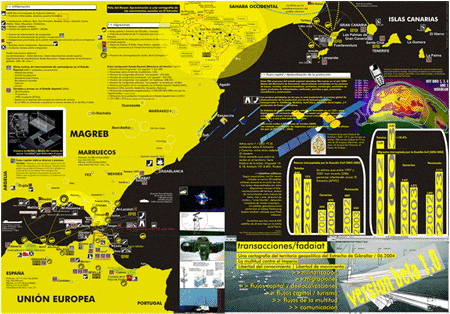 | |||||||||
| Djembe World Drum Music Recording Session Young Musicians in Mali | |||||||||
| Angolan Music is featured on Afro Pop Worldwide Welcome to Angola!Most world music fans hear the soulful, raspy voice of Bonga when they think of Angola. A few other Angolan artists with international careers come to mind such as Carlos Burity , Paulo Flores, and Waldemar Bastos. But for the most part, Angola is absent from the North American stage. The only artist who has toured here recently is Waldemar Bastos. So finding out more about what's happening in Angolall was our mission for Afropop's first visit in November, 2005. This was the month Angola celebrated the 30thanniversary of its independence from Portugal .
Luanda, the capital on the Atlantic coast, feels like a boom town. Offices and houses are going up all over the place. Logos of multi-national corporations decorate glass skyscrapers downtown. City streets are clogged with blue mini-van group taxis and lots of late model SUVs, Land Rovers, and Jeeps. The traffic here rivals the legendary "go slows" of Lagos, Nigeria, another African commercial capital where the old colonial infrastructure is being strained by the demands of an oil rich, independence economy--too many cars, not enough roads!
Ringing the city are the museques, comparable to the favelas, or slums, in Sao Paulo and Rio de Janeiro. The museques have spawned a music genre called kuduru, high energy dance music built around programmed beats. Kuduru dance | |||||||||
| Philippine Workers Protest Workers use masks to protest regressive taxes. | |||||||||
| The citizen media scene in Madagascar The blogosphere has been growing slowly but steadily the past decade, slightly struggling to find its voice until the 2009 political crisis. The sudden precipitation of events that provoked high demand for frequent updates provided a unique set up for the budding blogosphere to assert their potential, despite the evident challenges. Bloggers' readership: 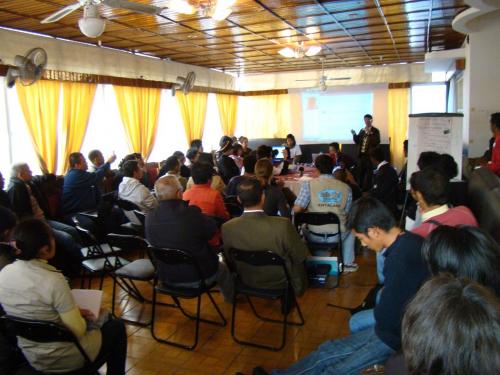 (Bar camp on reporting in times of crisis in Antananarivo. Photo credit: Ariniaina ) Although Madagascar is now theoretically connected to the high bandwidth fibre optic cables EASSy and LION, most of the country still have limited access to internet both because of lack of infrastructure and high costs of broadband internet (only 1.5% of the population used internet in 2009). Therefore, internet won't be able to fulfill the role of democratizing information/communication until access is available to more Malagasies. Still, it is undeniable that the use of online media tools has dramatically increased among urban citizens, specifically during the 2009 political crisis. Bloggers from many parts of the country ( Antananarivo, Toamasina and Mahajanga) have volunteered the statistics of their blogs since 2008 to evaluate the evolution of readership. The timeline of the number of readers can be seen below:  (Stats of 4 personal blogs in Madagascar from 2008-10 (blogs written in Malagasy (VO), French (MH, TD) and English (MM)) As shown on the charts, even though readership varies significantly between blogs, trends have been strikingly similar even though the blogs were written in different languages. Two traffic peaks can be seen around February-April 2009 when the coup occurred, followed by a sudden decrease that is probably related to uncertainty over potential consequences of writing blog posts. Readership came back when the legitimacy of the regime was questioned by the international community when the Malagasy government was shunned from speaking at the UN General Assembly. It must also be noted that writing during the height of the crisis took a toll on many bloggers who may have fatigued from the toll of trying to inform frequently. Support from the News Media: A critical development for the evolution of blogs in Madagascar were the recognition and support by international news media through mention and links: | |||||||||
| The Four Puppets Prolog of the workshop performance Yangon, Burma | |||||||||
| Prensa Comunitaria: Barrio TV Welmo Romero shows a mural to honor Filiberto Ojeda. The mural was threatened to be erased, but a campaign to keep it was launched. | |||||||||
| Water so close, yet so far India Unheard provides news through "Video Volunteers". Since 1995 the government has cut out the supply of water to this village. http://www.videovolunteers.org/ | |||||||||
| Mines Deplete Water Supply A report from Unheard India. http://www.videovolunteers.org | |||||||||
| Climate Change in Uttarakhand Program produced by "Video Volunteers". Luxmi Nautiyal explores the dangerous effects of climate changehttp://www.videovolunteers.org/ Uttarakhand's rich natural environment and thriving tourism sector are threatened by the dangerous effects of climate change. Uttarakhand is well-known for its great biodiversity and gorgeous landscapes. It lies at the foot of the Himalayas. Two of India's great rivers, the Ganga and the Yurma, originate in Uttarakhand's glacial fields. The state is host to numerous plant and animal species, many of which are endangered or rapidly disappearing, such as snow leopards and tigers. Uttarakhand's natural beauty contributes to its thriving tourism sector. Tourism is Uttarakhand's greatest source of income. It was the first state in India to establish a Tourism Development Board in order to proactively pursue and cater to this sector. Domestic and international tourists flock to Uttarakhand every year to visit its famed national parks, such as the Jim Corbett National Park, the oldest national park in India, and the Valley of the Flowers, a UNESCO World Heritage site. However, Uttarakhand is now seeing the effects of climate change on its environment. Rising summer temperatures are contributing to glacial melt. Many fear climate change will alter its unique mountainous ecosystem. Like much of India, Uttarakhand is experiencing an abnormally hot and dry summer. Over the last three years, it has received less rainfall than normal, which has adversely affected agricultural productivity. Yet the government is taking steps to combat climate change. It is establishing an authoritative body to focus on preserving the 1,400 Himalayan glaciers in the state. This committee will work in partnership with neighboring states to better manage water resources and conservation efforts. Uttarakhand is also partnering with the World Food Program to help its agricultural communities, which comprise 78 percent of the state, adapt to climate change. | |||||||||
 | Lina Fruzzetti discusses Scroll Painting in Naya | |||||||||
| John Downing Discusses Community/Citizen's/Radical Media at the Our Media Conference in Medellin. | |||||||||
| Making the village global by Jon Katz The village of El Limon in the Dominican Republic has had wireless internet for almost 10 years. The system continues to expand and have a major impact on the education of the young people living there. If you drive a 4x4 pickup truck in the Dominican Republic, and keep turning uphill whenever the road forks, eventually you'll get to El Limon, or a place that looks a lot like it. You'll see an attractive little mountain village, with perhaps three hundred residents, donkeys in the streets and an ox team tilling the fields. Then there are the things you probably won't see: electric light, phone service, books in the schools, or a health centre. The developing world is full of villages like El Limon, and they face a challenging and very uncertain future. The isolation that shaped their past is collapsing, and they must integrate into a rapidly globalizing world. In El Limon, the internet plays a key role in the community's search for a better and sustainable future. Internet was introduced in El Limon in 1997 as a sideline to a village scale micro-hydroelectric installation. As manager of this hydro project, I also had extensive experience with computers and electronics, and one summer, along with three college student interns, I brought with me a couple of laptop computers. The college students spent their days helping with construction for the hydro project and their nights introducing the village to the computers. When the summer ended, one laptop stayed behind and a couple of the village youth continued learning and teaching, all off-line of course. The next summer (1998), we got three 900Mhz FreeWave digital radios donated, assembled a solar-powered repeater, and installed it on a hilltop between El Limon and the nearby small city of Ocoa, location of closest phone line. Limon went on-line - the first rural community internet access in the Dominican Republic. | |||||||||
| Jugar o NO Jugar This area has seen much violence and conflict. The children have grown up with war. This is part of a series on the rights of children; in this case on the right of children to play. | |||||||||
 | Voz-Mob: Domestic Workers Organize with Cellphones Mobile voices in Southern California. | |||||||||
| Community Radio in Pilbara, Western Australia Ngarda Radio and TV is an Aboriginal community station in the Pilbara, Western Australia. | |||||||||
| Juan Salazar lists the importance of community media To be heard and to share alternative realities. | |||||||||
| Puppets push for ecological school cafeterias The children of Piney Branch Elementary School in Tacoma Park, Maryland create a puppet show to rid their school of styrofoam. | |||||||||
| Placemark 192 Rosamonde is a PHD student in Canada from Ghana. | |||||||||
| Melba Quijano, Orley Duran, Magdalena Medio | |||||||||
| Indigenous Web Television http://www.isuma.tv IsumaTV is an independent interactive network of Inuit and Indigenous multimedia. IsumaTV uses the power and immediacy of the Web to bring people together to tell stories and support change.  | |||||||||
| Agora TV, Grupo Alavio Community television in Argentina.  | |||||||||
| Arcoiris TV-- International internet alternative A differenza di una Tv tradizionale lo spettatore può decidere cosa vedere in qualsiasi momento, senza più vincoli d'orari e palinsesto. L'offerta di titoli è costantemente aggiornata e proviene sia da filmati che giriamo noi direttamente che da contributi esterni.  | |||||||||
| Capetown Community Television | |||||||||
| We Own TV http://weowntv.org/ Alhaji Jeffery Kamara (A.K.A Black Nature) shares his personal history and our future plans for WeOwnTV's programs in Freetown, Sierra Leone. Black Nature is the youngest member of Sierra Leone's Refugee All Stars and performs message oriented music from the heart. For more more info about the band or their award winning documentary film, please visit: http://www.refugeeallstars.org | |||||||||
| Cine Institute Haiti, and most Haitians, have been left behind. The country's infrastructure is primitive and poorly maintained, there are few local industries and the country depends almost entirely on the importation of goods and foreign aid. Film, and the training required to make films, can offer Haitians access to the 21st century means of production, by providing entry to a universe of educational, technological and economic opportunities. Film and filmmaking breaks isolation, expands horizons, creates new skills and provides a voice to the previously unheard. The Institute's core programs accomplish the following:Ciné Klas: increases students' enthusiasm for learning, enhances school curricula and improves student comprehension of subject matter. Ciné Lekol: trains filmmakers and film technicians who each leave our program with experience and skills. | |||||||||
| The Landless Workers Movement Written in the Brazil constitution is the principle that land must be productive. The Landless Reform Movement bases its actions on this principle. In this clip several people who are occupying land in Sao Paulo explain the process by which poor landless people petition the government for title to the farmland they are cultivating.The movement identifies land that is not used productively or has not had taxes paid on it or was acquired by dubious or unlawful means. The Landless Workers Movement then occupies the land and makes its case to the government that the title of the land should pass to those who will develop the land to benefit people. | |||||||||
| World Kids News: Zambia How kids are helping to clean the environment in Zambia. www.worldkidsnews.com | |||||||||
| World Kids News: Burma Worldkidsnews item from Youth Voice Burma about the devastating hurricane Nargis and how children cope. The Cory Peck Award was given for a DVB documentary 'Orphanes of Nargis'. www.worldkidsnews.com | |||||||||
| World Summit of Media for Children | |||||||||


 inventions disseminate rapidly through the museques, with new ones appearing constantly.


 themediamentor


